Step 5 - Greenhouses
The Best Greenhouse for Starting Seeds
A greenhouse earns its keep in February and March, not August. Propagation asks for different things than growing does.
Janet H. - the hands-on owner behind Janet Media Group.
Published
This page contains affiliate links. If you buy through them we may earn a commission at no cost to you, and it never decides what we recommend. How this site is funded.
The short version. For seed starting, the GarveeHome 6 x 8 is the right structure: a rigid, lockable walk-in whose footprint fits two runs of staging with a path between them, which is exactly the layout propagation wants. The budget pick is the Ohuhu mini greenhouse -- four shelves under a cover, outside the back door, which does most of the same job for a small fraction of the money if you do not need to stand inside. Whichever you buy, the two accessories that actually change results are greenhouse staging to get trays off the floor and a seedling heat mat to put warmth where the seed is.
Seed starting is the use that makes a greenhouse pay for itself, because it is the use that happens when nothing else can. In February and March a structure lets you sow six to eight weeks ahead of open ground, and it does that without needing to hold summer temperatures. The specification that follows is different from a growing greenhouse: bench area matters more than headroom, bottom heat matters more than air heat, and automatic venting matters most of all.
How we chose
The germination and lighting guidance is University of Minnesota Extension's work on starting seeds indoors; the greenhouse temperature targets and bench layout come from Colorado State University Extension and University of Georgia Extension's hobby greenhouse material.
- Bench area, not floor area. Trays live at waist height. A greenhouse's useful propagation capacity is its bench square footage, which is usually a fraction of its footprint.
- A footprint that fits standard staging. The common widths have racks and benches sized around them; an odd footprint wastes space permanently.
- Somewhere to put a heat mat. A flat, dry, powered bench. This is the single biggest difference to germination speed for warm-season crops.
- Venting that works unattended. Sowing happens in March, when a sunny morning can cook a tray by eleven o'clock and you are not there.
- A live price, now. Each pick carries a current price from our price layer, with the date shown.
Quick picks
| # | Product | Best for | Score | Price |
|---|---|---|---|---|
| 1 | 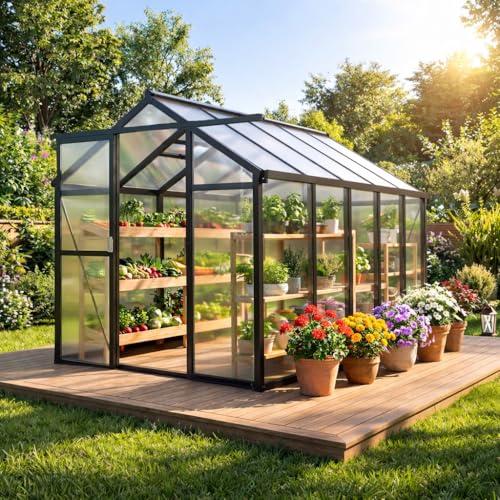 Top pickGarveeHome 6 x 8 ft Polycarbonate GreenhouseAluminum frame, polycarbonate panels, roof vent, sliding door | A first hard-sided greenhouse | 8.7 | $291.99 - View on Amazon |
| 2 | 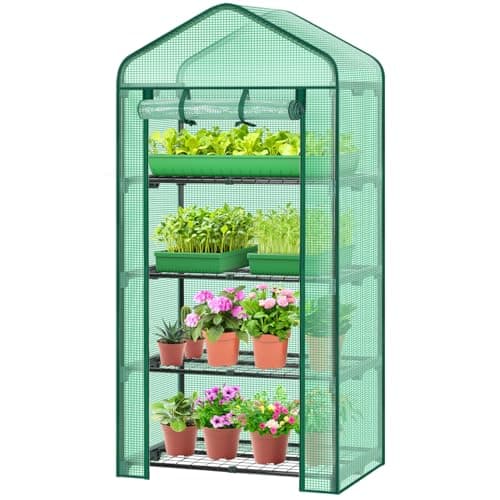 Ohuhu Mini Greenhouse with Shelves4-tier shelf frame with zip cover | Balconies and seedling trays | 7.5 | $36.54 - View on Amazon |
| 3 | 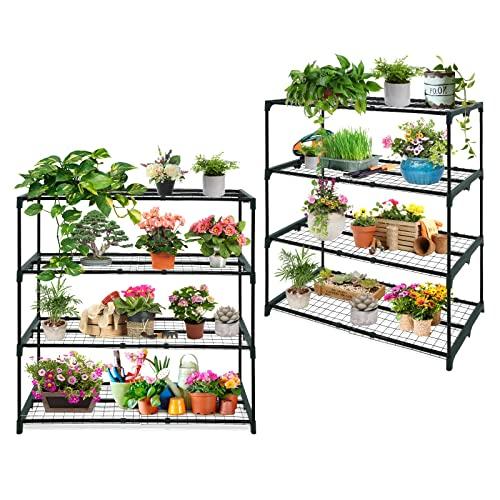 EAGLE PEAK Double 4-Tier Greenhouse StagingTwo 4-tier racks, 42 x 17 x 42 in each | Doubling usable space | 8.2 | $74.99 - View on Amazon |
| 4 | 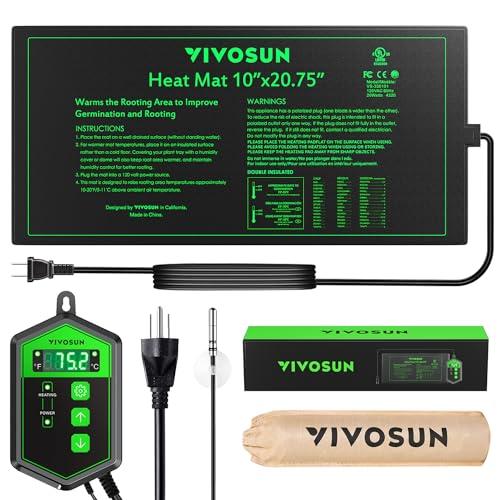 VIVOSUN Seedling Heat MatWaterproof mat sized for 1020 trays | Peppers, tomatoes and slow germinators | 8.8 | $25.01 - View on Amazon |
| 5 | 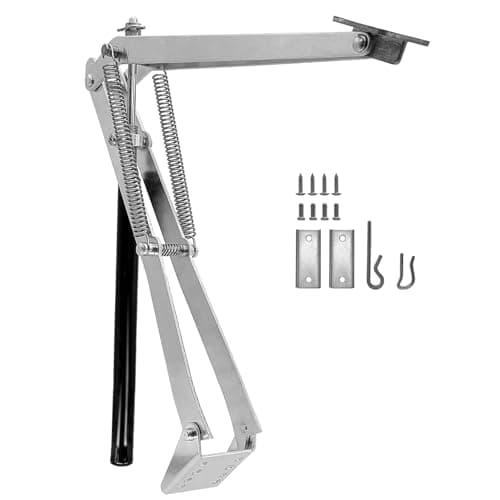 Automatic Greenhouse Vent OpenerNon-electric heat-driven cylinder, dual spring, lifts up to about 15 lb | Venting on a weekday when nobody is home | 8.3 | $27.99 - View on Amazon |
#ad We may earn a commission - Price as of November 24, 2026
Scores are our own editorial judgment, formed from published specifications and independent sources. They are not aggregated customer ratings, and they are not the result of hands-on testing, which we do not currently do. See how we choose.
Bench space is the real capacity
People buy greenhouses by footprint and then propagate on about a third of it. Extension's guidance on hobby greenhouse layout is worth translating into trays: a bench serviced from one side should be no wider than you can comfortably reach across, and a walkway you only stand in while working wants a bit over a foot and a half.
| Greenhouse width | Bench layout | Roughly how many 1020 trays |
|---|---|---|
| Mini shelf unit | Four shelves, one tray deep | 4 to 8 |
| 6 ft | One bench plus a standing strip | 12 to 16 |
| 6 ft | Two shallow racks, both sides | 16 to 24 |
| 8 ft | Two benches with a barrow path between | 24 to 40 |
The two-shallow-racks row is the one most people miss. Replacing one deep bench with two narrow racks in a six-foot house increases tray capacity substantially while keeping everything within reach, which is why staging is on the pick list above. Greenhouse shelving covers the depths that take a 1020 tray without overhang.
Bottom heat beats air heat, every time
Heating the air in a greenhouse in March is expensive and mostly wasted -- the heat goes out through thin glazing while the seed sits in cold mix. Heating the tray is cheap and works, because germination responds to soil temperature rather than air temperature.
- Warm-season crops need it. Peppers, aubergines, tomatoes and basil germinate slowly or not at all in cold mix. A mat solves this for the cost of a few bags of compost.
- Cool-season crops do not. Lettuce, brassicas, peas and onions germinate fine at cool temperatures and some are actively inhibited by heat. Do not put them on the mat.
- Move trays off the mat once they germinate. Warmth after emergence encourages soft, stretched growth. The mat is for germination, not for growing on.
- A thermometer tells you whether you need a heater at all. Most seed starting in a greenhouse needs frost protection on a handful of nights, not a season of heating. Do I need a greenhouse heater? has the honest answer.
Automatic venting is the accessory that saves the crop
This is the specific failure that ruins greenhouse-sown seedlings: a cold, bright morning in March, the house shut up overnight, nobody home, and by midday the trays have been through forty degrees of swing. A non-electric heat-driven vent opener lifts the roof vent when the air warms and closes it again as it cools, with no power and no attention.
It costs very little relative to the kit and it is the difference between sowing confidently on a weekday and only sowing at weekends. Greenhouse ventilation covers the powered options for larger houses, and when to start seeds in a greenhouse covers the timing side of all of this.
The picks in full
Top pick
GarveeHome 6 x 8 ft Polycarbonate Greenhouse
GarveeHome
The specification most people picture when they say greenhouse -- aluminum frame, rigid panels, a roof vent and a lockable sliding door -- at a price that leaves room for the base and the staging.
The jump from a covered frame to a rigid kit is the biggest single step in this category, and it happens well below the thousand dollar line. An aluminum frame does not rust, rigid panels do not flap or tear, and a hinged or sliding door with a latch stays shut in wind that would have a zipper door open all afternoon.
The roof vent is the detail worth noticing on the spec sheet. A sealed greenhouse in April sun will pass 100 degrees Fahrenheit by mid-morning, and a kit without a vent has to be propped open by hand every day. One included vent is the difference between a greenhouse you run and a greenhouse you babysit.
What you do not get at this price is a published wind or snow rating, heavier frame section, or glazing thick enough to hold heat overnight. That is the honest ceiling of the bracket, and it is why the premium kits exist.
What works
- Rigid panels and an aluminum frame, not a cover over hoops -- it is a structure
- Roof vent included rather than sold as an accessory, which matters more than it sounds
- Sliding door takes no swing space, which suits a kit squeezed against a fence
- The common 6 x 8 footprint means staging and shelving are easy to size
What does not
- No published wind or snow rating, so treat it as a three-season structure
- Panels are thin compared with a premium kit; they diffuse light but insulate little
- Assembly is a long afternoon and genuinely needs a second person
- Needs a level base and ground anchors, neither of which is in the box
Skip it if: you get real snow load. This is a three-season specification, and no budget kit publishes a snow rating because none of them would like the number.
| Footprint | 6 x 8 ft |
|---|---|
| Frame | Aluminum |
| Glazing | Polycarbonate panels |
| Ventilation | Adjustable roof vent |
| Door | Sliding, with a lock |
Balconies and seedling trays
Ohuhu Mini Greenhouse with Shelves
Ohuhu
A shelved cover for seed trays rather than a greenhouse you walk into, and the right answer where there is no room for anything larger.
Calling this a greenhouse oversells it, which is why it disappoints people who expected one. What it actually is: a shelf unit with a cover, sized for standard seed trays, that fits on a balcony or against a wall.
For that job it is good. Seedlings started indoors need somewhere sheltered to harden off, and this gives them a few protected degrees and shelter from wind and heavy rain.
Tie it to something. An empty covered shelf unit is remarkably light and catches wind like a sail.
What works
- Holds several seed trays in almost no floor space
- Cheap enough to be a seasonal purchase
- Zip front rolls up for ventilation
- Folds flat for storage
What does not
- Blows over easily unless tied to something solid
- Very little thermal mass -- it buys a few degrees, not many
- Cover is the first thing to fail
Skip it if: you want to grow plants to maturity. This is a propagation space and a frost blanket, not a growing house.
| Frame | Steel tube shelving |
|---|---|
| Cover | Zip-front PE cover |
| Shelves | Typically 4 tiers |
| Footprint | Fits against a wall or balcony rail |
| Anchoring | Tie to a wall or rail -- essential |
Doubling usable space
EAGLE PEAK Double 4-Tier Greenhouse Staging
EAGLE PEAK
A greenhouse is measured in shelf area, not floor area, and staging is the cheapest way to double what you have.
The first thing most new greenhouse owners discover is that a 6 x 8 footprint is smaller than it looked in the listing. Staging is the fix: three tiers of trays in the floor space of one.
Look for slatted or mesh tops rather than solid ones. Water has to drain and air has to move, or the trays on the shelf become the place fungus gnats and damping-off start.
Plan for the seasonal switch. Staging is right in February and March when the greenhouse is full of seed trays, and comes out in May when tall crops go in and the shelves would only shade them.
What works
- Two racks per order, which is both sides of a 6 ft kit in one purchase
- A 17 in deep tier takes a standard 1020 tray with the lip fully supported
- Stops at 42 in, so it fits under the sloping eaves of a hobby kit
- Comes apart and stores when you switch to tall crops
What does not
- Upper tiers shade the lower ones -- seedlings belong on top
- No published per-shelf load rating, so treat it as staging rather than storage
- Powder-coated steel rusts at any scratch in a wet house
- Two racks in a narrow kit leave a tight aisle; measure the internal width first
Skip it if: you are growing tall crops to maturity in the ground inside. Staging and mature tomatoes compete for the same light.
| Type | Double tiered staging, 4 tiers per rack |
|---|---|
| Dimensions | 42 x 17 x 42 in per rack (manufacturer) |
| Depth | 17 in -- takes a standard 1020 tray flat |
| Material | Powder-coated steel, green finish |
| Assembly | Bolt-together; build it outside and carry it in |
Peppers, tomatoes and slow germinators
VIVOSUN Seedling Heat Mat
VIVOSUN
Germination is driven by soil temperature, not air temperature -- and a heat mat is the difference between peppers in ten days and peppers in four weeks.
Seeds respond to the temperature of the medium they are in, not the room. Peppers and eggplants want soil in the 80s Fahrenheit to germinate briskly, and a 68-degree house gives them soil in the low 60s -- which is why they sit there for weeks.
A mat under the tray fixes that. Pair it with a thermostat probe if you can: without one the mat simply runs at its own output, which can be too warm for some seeds and is impossible to tune.
Take the tray off the mat once germination is done. Bottom heat after that encourages soft, stretched growth, and it dries the tray faster than you will remember to water it.
What works
- Dramatically faster germination for warm-season crops
- Waterproof, so spills are not a hazard
- Sized to standard trays
- Cheap to run
What does not
- Without a thermostat it just runs warm, with no target
- Dries trays out faster -- watering needs watching
- Should come off once seedlings are up
Skip it if: you only start cool-season crops. Lettuce, brassicas and peas germinate fine at room temperature and can actually be inhibited by heat.
| Type | Seedling heat mat |
|---|---|
| Sizing | Made to fit one or two standard 1020 trays |
| Construction | Waterproof |
| Thermostat | Sold separately on most models |
Venting on a weekday when nobody is home
Automatic Greenhouse Vent Opener
Various
The accessory that turns a greenhouse from a weekend structure into a year-round one: a wax cylinder that pushes the roof vent open as the air warms and closes it as it cools, with no power and no attention.
Overheating kills more greenhouse crops than cold does, and it happens on ordinary spring afternoons rather than in a heatwave: a closed 6 x 8 kit in April sun can run 30 degrees F above the outside air. The fix is the roof vent, and the problem with the roof vent is that it needs opening at about 11am and shutting at about 5pm, every day, by somebody who is there.
A wax-cylinder opener does both. The cylinder contains a wax that expands as it warms, pushing a piston that lifts the vent; as the air cools the wax contracts and the vent falls shut. There is no power, no thermostat and nothing to program -- you set the opening point on a threaded collar and leave it.
Two honest limitations. It is slow, because wax takes time to change volume, so a sharp spike in temperature is vented late rather than immediately. And its lift is modest: one opener manages one hinged vent, so a larger structure that needs real air exchange still wants a thermostat and an exhaust fan. For a hobby kit with one or two roof vents, it is the single accessory that most changes what the greenhouse can do.
What works
- Vents the greenhouse at midday whether or not anyone is there
- No power, so it works in a greenhouse with no electricity run to it
- Closes again as the air cools, which is the half people forget
- Cheap relative to a thermostat and exhaust fan doing the same job
What does not
- Slow to react -- the wax takes time to expand, so it lags a sudden temperature spike
- Limited lift, so it opens a vent rather than ventilating a big structure on its own
- Fits hinged vents only; check your kit before buying
- A cheap unit can seize after a season or two outdoors
Skip it if: you are home all day and happy to open and shut vents by hand, or your kit's roof vent is a sliding panel rather than a hinged one -- these fit hinged vents.
| Type | Non-electric wax-cylinder (thermal) actuator |
|---|---|
| Power | None -- no wiring, no battery |
| Lift | Up to about 15 lb on the dual-spring kits (listing figure) |
| Fits | Hinged greenhouse roof and side vents |
| Installation | Two brackets, screwdriver, no cutting |
Common questions
Can you start seeds in an unheated greenhouse?
Yes, for cool-season crops and for anything you are sowing within a few weeks of your normal outdoor date. Warm-season crops such as peppers and tomatoes need soil warmth to germinate, which is best supplied by a heat mat under the tray rather than by heating the whole structure.
What size greenhouse do I need for seed starting?
Smaller than you would need for growing. A six-foot-wide house with two narrow racks holds a surprising number of 1020 trays, and a shelf-type mini greenhouse outside the back door holds enough for a normal home garden. Bench area is the number that matters, not footprint.
Do I need a heat mat in a greenhouse?
For warm-season crops, yes -- germination responds to soil temperature, and March mix in an unheated greenhouse is cold. For lettuce, brassicas, peas and onions, no; some of them germinate worse with bottom heat. Move everything off the mat once it has emerged.
Why are my greenhouse seedlings tall and floppy?
Too little light relative to warmth. Weak early-spring light with warm air produces stretched, pale growth. Space the trays out, keep the glazing clean, vent to keep the air cooler, and if necessary add supplementary light -- do not add more heat.
How do I stop a greenhouse overheating while I am at work?
A non-electric automatic vent opener. It uses a heat-sensitive cylinder to lift the roof vent as the air warms and lets it close as it cools, needs no power and no attention, and prevents the single most common way a weekday sowing is lost.
Sources
Factual claims on this page are backed by the published sources below, and product specifications are the manufacturers’ own. Where a figure is not published, we say so rather than estimating it.