Step 3 - Seed Starting
The Best Soil Blockers
The tool matters less than the block size and the number of blocks per press. Here is which to buy first, and what the expensive ones actually buy you.
Janet H. - the hands-on owner behind Janet Media Group.
Published
This page contains affiliate links. If you buy through them we may earn a commission at no cost to you, and it never decides what we recommend. How this site is funded.
A soil blocker is a hand press that compresses damp mix into free-standing cubes. There is no pot and no cell: the block is the container. Every tool on this page makes essentially the same object, so the decision is not really about quality -- it is about how many blocks you make per press, what size they are, and whether you intend to run the two-stage method.
The short version. For most people the BlumWay 8-cell is the right first tool: it makes the standard 2 inch block eight at a time, which halves the work of filling a tray, and it costs a fraction of the reference tools. If you want the tool you will still own in twenty years, the Ladbrooke Basics set is the English-made reference and arrives as a complete set rather than a single press. The KHAMAL 4-cell is the budget pick and the cheapest honest way to find out whether you like the method at all. The TILLERMAN bundle gives you a large and a small press together, which is what the block-into-block method needs. And the Ladbrooke Micro 20 is the dedicated micro blocker for anyone starting hundreds of seedlings in a small space.
How we chose
We have not run a side-by-side blocking trial. What this page does is work out which specifications actually change the experience, check each tool against them, and be plain about where the extra money goes.
- Blocks per press. The single most important number. A 1020 flat holds around 40 two-inch blocks; at four per press that is ten loads and ten ejections, at eight it is five.
- Block size. Two inches is the standard that nearly all seed-starting advice assumes. Three-quarter inch micro blocks are a separate job, not a smaller version of the same one.
- Whether the seed pins are included. Pins set the dibble depth to the seed. A tool without them makes you poke holes with a pencil.
- Release quality. A press that sticks is a press you stop using. Machining and handle design are what you pay for at the top of the range.
- Does it support the two-stage method? Micro block into 2 inch block is the technique that saves the most bench space. It needs two tools.
- Currently purchasable. Every tool here was confirmed as a live, in-stock listing before it went on the page.
Quick picks
| # | Product | Best for | Score | Price |
|---|---|---|---|---|
| 1 | 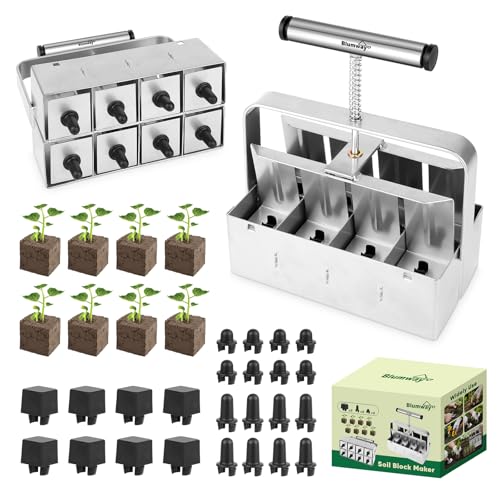 Top pickBlumWay 8-Cell 2 in Soil BlockerEight 2 in blocks per press, three seed pin types | Twice the blocks per press | 8.6 | $25.19 - View on Amazon |
| 2 | 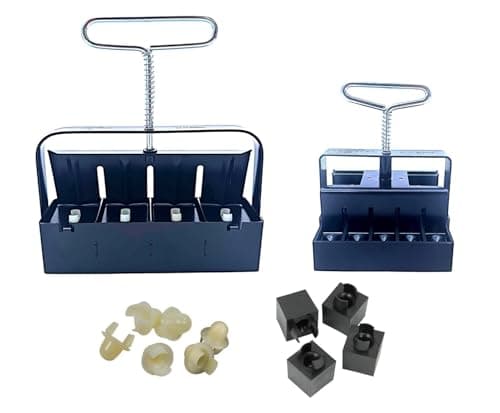 Ladbrooke 4-Piece Basics Soil Blocker SetMini 4 and Micro 20 blockers with cubic inserts and seed pins | Committing to the method properly | 9.0 | $84.95 - View on Amazon |
| 3 | 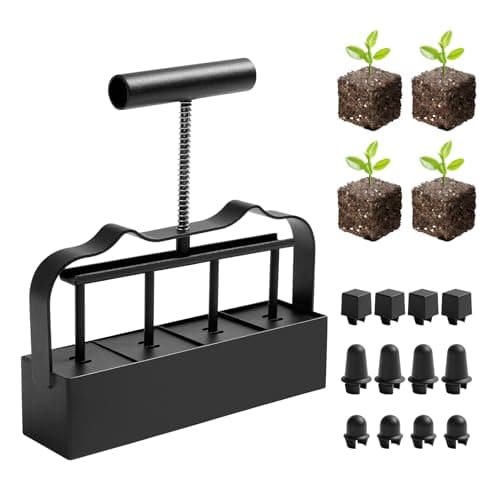 KHAMAL 4-Cell 2 in Soil BlockerFour 2 in blocks per press, three seed pin types included | Finding out whether soil blocking suits you | 8.1 | $9.99 - View on Amazon |
| 4 | 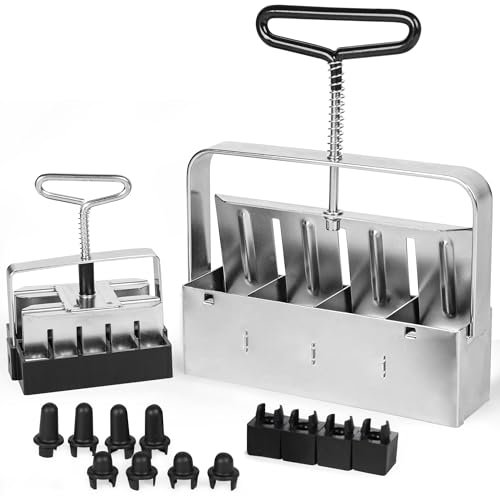 TILLERMAN Soil Blocker Bundle, Large and SmallTwo block makers, 2 in and small, with seed pins | Running the two-stage method without the reference price | 8.3 | $59.98 - View on Amazon |
| 5 | 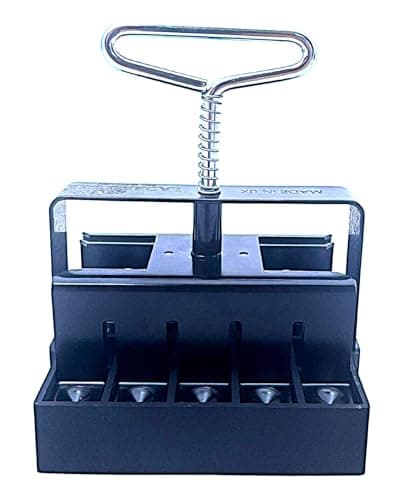 Ladbrooke Micro 20 Soil BlockerTwenty 3/4 in blocks per press | Germinating a lot of seed in very little space | 8.5 | $35.95 - View on Amazon |
#ad We may earn a commission - Price as of November 24, 2026
Scores are our own editorial judgment, formed from published specifications and independent sources. They are not aggregated customer ratings, and they are not the result of hands-on testing, which we do not currently do. See how we choose.
Block size: start with 2 inches
If you buy one blocker, buy a 2 inch one. It is the size that holds enough mix to carry a tomato or a brassica from sowing to planting out without potting on, and it is the size every piece of blocking advice assumes unless it says otherwise.
| Block size | What it suits | Watch out for |
|---|---|---|
| 3/4 in micro | Germinating hundreds of seeds in a shoebox of space | Dries out in hours; needs potting into a larger block fast |
| 1.5 in | Lettuce, brassicas and anything going out small | Tight for a tomato by week four |
| 2 in | The default -- most vegetables, sowing to planting out | Nothing much; this is the size to standardize on |
| 3 in and up | Squash, cucumbers, potting a smaller block up | Heavy, and a flat holds far fewer |
The two-stage method is where the sizes connect. You sow into micro blocks, which take almost no bench space, and when the seedling is ready you drop the whole micro block into a dibbled recess in a 2 inch block. Nothing is pulled out of anything, so there is no transplant check at all -- and in February, when every inch under the lights is contested, the space saving is the real prize.
Blocks per press is the number that changes your afternoon
This is the specification people skip and then complain about. Making blocks is a loop: load the press with wet mix, press and scrape, position over the flat, eject. The block quality is the same whether the tool makes four or eight; the number of times you run that loop is not.
| Blocks per press | Presses per flat | Suits |
|---|---|---|
| 4 | About 10 | A few trays a year; weaker wrists |
| 8 | About 5 | Most home gardens |
| 12 to 20 | 2 to 4 | Hundreds of plants; stand-up tools |
| 20 micro blocks | Fills a micro tray in minutes | Germination stage only |
The trade for more cells is force. Eight blocks of compressed mix needs real downward pressure through two hands, and the technique is to lean on the tool with your body weight rather than push with your arms. If that sounds like a problem, a four-cell press is the right tool and the extra loop is a fair price.
The mix is more important than the tool
Nothing on this page works with a mix that is too dry or too coarse. A blocking mix needs fine material and enough moisture to hold its shape under pressure -- wetter than feels right the first few times, closer to a thick cake batter than to damp compost. Most blocking failures are mix failures blamed on the press.
Commercial seed starting mixes are built for cells rather than blocks. University of Minnesota Extension describes them as usually peat and vermiculite, sterile, lightweight and free of weed seeds -- all good properties, but light and coarse is exactly what will not hold a block together. Adding fine screened compost and a little extra moisture is the usual fix; a DIY seed starting mix is where a blocking mix comes from, and the best seed starting mix covers the bagged options you would be modifying.
What the expensive tools actually buy
The English-made presses cost several times what the budget tools cost, and the difference is real but narrow. You are paying for machining tolerance, which shows up as a cleaner release and a block with sharper corners; for a handle and spring design that does not bind when it is full of wet mix; and for a tool that will not flex out of square after a few hundred presses.
What you are not paying for is a better block. A budget press and a reference press both make a 2 inch cube of compressed mix, and the seedling cannot tell them apart. If you sow a few trays a year, the cheap tool is genuinely sufficient and the money is better spent on a grow light.
Where the premium tools earn out is volume. At several hundred blocks a season, a press that releases cleanly every time and never binds saves more time and irritation than the price difference represents -- and the stand-up models, which let you work without bending over a bench, are a different category of comfort again.
One category is deliberately absent from the picks: the stand-up commercial blockers that make 12, 20 or 35 blocks in a single stroke from standing height. They are the right tool for anyone raising several thousand plants, and they are the only blockers that spare your back entirely. We left them off because stock on the English-made models was down to a handful of units when this page was checked, and a roundup pick that sells out the week it is published helps nobody. If you are at that scale, search the brand directly rather than taking a recommendation from a page that cannot promise it is still there.
What else you need before the first tray
The press is the only specialist purchase, but it does not work on its own. Four things complete the setup, and three of them you probably already own.
| Item | Why | Can you skip it? |
|---|---|---|
| Solid 1020 flats | Blocks stand in them and are watered from below | No -- blocks have no container of their own |
| A mixing tub | Blocking mix has to be made wet in bulk, not in the tray | No, but a builder's bucket is fine |
| A sieve or screen | Twigs and stones in the press make blocks that crumble | Only if you use bagged mix exclusively |
| Seed pins | Set the dibble depth to the seed | Usually included; a pencil works badly |
| A humidity dome | Blocks dry from five faces, not one | Helpful rather than essential, and it must come off at germination |
Looking after the tool itself takes about a minute. Rinse it the day you finish rather than letting mix dry inside the chambers, dry it properly before it goes away, and keep the seed pins with it -- loose pins are the part that goes missing between seasons. Steel presses will spot if they are stored damp; nothing about that affects the blocks, but it is avoidable.
Running blocks without losing a tray
Blocks are less forgiving than cells in exactly one way: they lose moisture from every face instead of one, so they dry faster and they dry from the outside in. Everything below follows from that.
- 1
Stand them in a solid 1020 flat
Blocks need something to sit in and water from. A no-hole flat is the right thing -- the usual seed-starting rule that containers need drainage holes applies to cells, not to the reservoir underneath them. The best seed starting trays covers which flats hold water without seeping.
- 2
Water from below, never over the top
Add water to the flat and let the blocks draw it up. Watering over the top erodes the blocks and, as Extension's seedling troubleshooting notes, a wet surface is what damping off needs.
- 3
Leave a gap between blocks
Air between the blocks is what prunes the roots. Packed tight, they knit together and you are back to pulling seedlings apart at transplanting.
- 4
Check twice a day in warm weather
A block that dries completely shrinks away from its own roots and does not recover well. This is the one real discipline the method asks for.
- 5
Pot on by dropping, not by pulling
A ready block goes into a dibbled recess in a larger block, or straight into the bed. Nothing is ever pulled out of a container, which is the whole point -- Extension's warning is that roots grown together get injured at transplanting, and a block never grows into its neighbor.
- 6
Skip the sterilizing chore
There are no cells to disinfect. Reused plastic trays want a 30 minute disinfectant soak between seasons; a blocker wants rinsing.
Still deciding whether the method is for you at all? Soil blockers vs seed trays puts the two systems side by side on cost, time per tray and what each does to the roots, and is honest about how much slower blocking is.
The picks in full
Top pick
BlumWay 8-Cell 2 in Soil Blocker
BlumWay
Eight blocks a press instead of four, which halves the number of times you load, press and eject to fill a tray -- the one thing that makes blocking tiring.
The complaint about soil blocking is never the blocks, it is the arithmetic. A 1020 flat holds around 40 two-inch blocks, and at four blocks a press that is ten loads, ten presses and ten ejections for one tray. At eight a press it is five.
That is the entire argument for this tool, and it is a good one if you sow more than a tray or two. What you pay for it is force: double the cells means double the mix being compressed under the same two hands.
Everything else is standard. Two-inch blocks, three pin sizes for different seed depths, and the same requirement every blocker has -- a mix wet enough to hold together, which is wetter than feels right the first few times.
What works
- Eight blocks a press is half the repetitions of a four-cell tool for the same tray
- Still makes the standard 2 in block, so all the usual seed-starting advice applies
- Interchangeable pins set the dibble to the seed rather than the other way round
- Costs a fraction of the reference tools while doing the same job
What does not
- Needs noticeably more force than a four-cell press, and leaning on it is the technique
- Budget construction: expect more flex than a machined English tool
- Eight wet blocks at once is heavy to carry to the tray before they set
- Ejection is less crisp if the mix is even slightly too dry
Skip it if: you have weak wrists or shoulders. Eight blocks of compressed mix takes real downward force, and a four-cell tool is easier to work.
| Blocks per press | Eight |
|---|---|
| Block size | 2 in (manufacturer) |
| Seed pins | Three sizes supplied |
| Build | Steel, described by the maker as heavy duty |
| Use with | A standard 1020 flat to hold the blocks |
Committing to the method properly
Ladbrooke 4-Piece Basics Soil Blocker Set
Ladbrooke
The reference tools, sold as a nesting pair: 3/4 inch micro blocks to germinate in, 2 inch mini blocks to grow on in, and the inserts that let one drop into the other.
Ladbrooke is the name behind the modern soil blocker, and this is the pair of tools the method was designed around rather than a copy of them. The Micro 20 makes twenty three-quarter-inch blocks at a press; the Mini 4 makes four two-inch blocks with a recess sized to take one.
That pairing is the actual argument for spending this much. In February, bench space under lights and warmth on a heat mat are the two things in shortest supply. Germinating in micro blocks means twenty seedlings occupy the footprint four would, and only the ones that actually came up get promoted into a full-size block. Nothing is wasted on a seed that never germinated.
Potting on becomes a non-event, which is the part people underrate. The micro block drops into the recess in the mini block. There is no tugging a seedling out of a cell, no root torn away from mix, no check to growth. University of Minnesota Extension's warning about seedling roots growing together and being injured at transplanting simply does not arise.
The honest counter-argument is the price. If you sow two trays each spring, a budget press makes an identical two-inch block for a fraction of this. The set earns its money on volume and on the years you keep using it.
What works
- The two-stage method in one box: germinate twenty seeds in the space of four, pot the winners on
- Cubic inserts make a recess sized to the micro block, so potting on is a drop rather than a transplant
- Metal tools with no consumable parts -- the running cost after purchase is mix and nothing else
- Saves bench and heat-mat space in the weeks when both are scarcest
- Resale value is real; these hold their price in a way plastic trays do not
What does not
- Expensive next to a budget press that makes the same 2 inch block
- The two-stage workflow is a habit to learn, not a feature you switch on
- Micro blocks dry out fast and are unforgiving if you miss a day
- Still four blocks per press on the mini, so volume work is slow
- You need a proper blocking mix; ordinary seed-starting mix often will not hold a block
Skip it if: you only ever sow a tray or two. This is a long-term tool set at a price that only makes sense if you will use it every season.
| Includes | Mini 4 and Micro 20 blockers (manufacturer) |
|---|---|
| Mini 4 blocks | Four 2 in blocks per press |
| Micro 20 blocks | Twenty 3/4 in blocks per press |
| Inserts | Cubic inserts, so a micro block drops into a mini block |
| Seed pins | Supplied |
| Origin | Made in England (manufacturer) |
Finding out whether soil blocking suits you
KHAMAL 4-Cell 2 in Soil Blocker
KHAMAL
The cheapest honest way into soil blocking: it makes the same 2 inch block the expensive tools make, and it costs about what a few packets of seed cost.
The usual objection to soil blocking is the entry price, and it is a fair one: the famous tools cost more than several years of plastic trays. This removes the objection. It presses four two-inch blocks, it comes with the seed pins, and it costs very little.
Two inches is the right size to start with. It holds enough mix to carry a tomato or a brassica from sowing to planting out without potting on, and it is the size every soil blocking article you will read assumes you are using.
What you give up against a machined tool is refinement. Cheaper presses flex slightly, release a little less cleanly, and are less tolerant of a mix that is marginally too dry. In practice that means a few more failed blocks while you learn how wet the mix should be -- which you have to learn anyway.
Buy this to find out whether you like the method. If you make three hundred blocks next spring and still like it, that is the point at which a better tool starts to earn its money.
What works
- Costs less than one tray of bought transplants, so the experiment is nearly free
- Makes the standard 2 inch block, which is the size most seed-starting advice assumes
- Interchangeable seed pins let you set the dibble depth to the seed rather than the tool
- Nothing to wear out in a way that matters at this price
- A sensible gift for someone curious about starting seeds without plastic
What does not
- Budget construction: expect more flex and a less crisp release than a machined tool
- Four blocks per press makes a 72-block tray a genuine arm workout
- No micro blocker, so you cannot do the two-stage block-into-block method
- Block quality depends heavily on getting the mix wet enough, and a cheap press is less forgiving of a mix that is slightly off
Skip it if: you will be making hundreds of blocks a season. A budget press is a fine way to learn the technique and a tiring way to run a production line.
| Blocks per press | Four |
|---|---|
| Block size | 2 in (manufacturer) |
| Seed pins | Three types supplied |
| Handle | Shaped grip |
| Use with | A standard 1020 tray to hold the finished blocks |
Running the two-stage method without the reference price
TILLERMAN Soil Blocker Bundle, Large and Small
TILLERMAN
A large and a small blocker in one box, which is what you need for the block-into-block method, at a fraction of what the English pair costs.
Two-stage blocking is the method serious blockers talk about: sow into a tiny block, then drop that whole block into a dibbled hole in a bigger one when the seedling is ready. No potting on, no root disturbance, and far less bench space used in February when space is tightest.
It needs two tools, and buying the reference pair is what stops most people trying it. A bundle at this price removes that objection, and the blocks it makes are the standard sizes the method assumes.
The honest caveat is the learning curve. Small blocks dry out in hours on a warm bench, and the handover from small to large has a window. Get that wrong and you have lost a tray; get it right and you will not go back to cell packs.
What works
- The two-tool set is what the block-into-block method actually needs
- Sealed handle is a real improvement on presses that bind with wet mix
- Costs far less than the reference English pair while making the same block sizes
- A reasonable gift for someone who already sows seed every spring
What does not
- Two-stage blocking is a technique, not a product -- expect a season to get good at it
- Not machined to the standard of the reference tools, so release is less consistent
- Small blocks dry out alarmingly fast and need checking twice a day
- No stand-up handle, so this is still a tool you use leaning over a bench
Skip it if: you only ever sow large seeds direct into 2 in blocks. The second tool is there for a method you may never use.
| Tools | Two -- large and small block makers |
|---|---|
| Block size | 2 in large block (manufacturer) |
| Seed pins | Supplied |
| Handle | Rubber sealed, no-spring-slip design per the maker |
| Use with | A standard 1020 flat |
Germinating a lot of seed in very little space
Ladbrooke Micro 20 Soil Blocker
Ladbrooke
The single most space-efficient way to germinate seed indoors: twenty blocks per press, in roughly the bench area four standard blocks would take.
Space under lights is the real constraint on indoor seed starting, and this tool attacks it directly. Twenty three-quarter-inch blocks occupy about the area four two-inch blocks do, which means a single heat mat germinates several times as much seed.
The workflow it enables is worth describing. You sow everything into micro blocks, keep them warm and damp, and after a week or so you know exactly which seeds came up. Only those get promoted into full-size blocks and only those occupy the expensive real estate under the lights. The dud seed never cost you anything but mix.
The discipline it demands is watering. A block this small has very little reservoir, and a warm room will dry it out in a day. Bottom water in a solid 1020 tray, keep a dome or a cover over it until germination, and do not plan a weekend away during the first fortnight.
On its own it is a specialist tool. Bought alongside a two-inch blocker it changes how the whole February bench works, which is why the sets usually make more sense than the individual presses.
What works
- Turns one heat mat into roughly five times the germination capacity
- Ideal for fine and expensive seed where you want to see what germinates before committing space
- Works for microgreens as well as transplants
- Blocks are air pruned on every face, so roots stop at the edge instead of circling
- Pairs with the Mini 4 so potting on is a drop, not a transplant
What does not
- Small blocks dry out quickly -- miss a watering in a warm room and you lose the tray
- Only useful if you have somewhere for the seedlings to go within two or three weeks
- Not a standalone purchase for most people; the value appears when you own both sizes
- Fiddly to sow: 3/4 inch blocks want one seed each and a steady hand
Skip it if: you are not going to pot the seedlings on within a couple of weeks. A 3/4 inch block is a nursery, not a home.
| Blocks per press | Twenty |
|---|---|
| Block size | 3/4 in (manufacturer) |
| Nests with | The Mini 4 blocker, via its cubic insert |
| Origin | Made in England (manufacturer) |
| Use with | A standard 1020 tray, bottom watered |
Common questions
What size soil blocker should I buy first?
A 2 inch one. It holds enough mix to take most vegetables from sowing to planting out without potting on, and it is the size every piece of blocking advice assumes. Micro blockers are for the germination stage of the two-stage method, not a cheaper version of the same tool.
How many blocks per press do I need?
Eight is the sweet spot for a home garden. A standard 1020 flat holds roughly 40 two-inch blocks, so a four-cell press means about ten loads per flat and an eight-cell press means about five. The trade is force -- eight blocks of compressed mix needs real downward pressure.
Are expensive soil blockers worth it?
If you make hundreds of blocks a season, yes: better machining means a cleaner release every time and a tool that stays square. If you fill a tray or two each spring, no -- a budget press makes the same 2 inch block and the seedling cannot tell the difference.
What mix do you use in a soil blocker?
A fine, moisture-retentive mix wetter than you would use in cells -- closer to a thick batter than to damp compost. Standard bagged seed-starting mixes are peat and vermiculite, light and coarse, which is why they crumble in a press. Adding fine screened compost and more water is the usual fix.
Do soil blocks need a tray?
Yes, a solid one. Blocks have no container, so they stand in a 1020 flat and are watered from below by adding water to the flat. A flat with drainage holes defeats the purpose -- the no-hole flats sold for bottom watering are the right thing here.
Why do my soil blocks fall apart?
Almost always the mix. Too dry and it will not compress; too coarse, or full of twigs and stones from unscreened compost, and the block breaks on ejection. Screen the compost, wet the mix more than feels right, and press with your body weight rather than your arms.
Sources
Factual claims on this page are backed by the published sources below, and product specifications are the manufacturers’ own. Where a figure is not published, we say so rather than estimating it.