Step 3 - Seed Starting
The Best Seed Starting Racks
A rack is the cheapest way to multiply how many seedlings you can grow well, because it multiplies the only thing that is actually short: lit surface.
Janet H. - the hands-on owner behind Janet Media Group.
Published
This page contains affiliate links. If you buy through them we may earn a commission at no cost to you, and it never decides what we recommend. How this site is funded.
The short version. The Amazon Basics 5-shelf wire rack on casters is the right frame for a home seed starting station: the shelves are adjustable so you can set light height per tier, the wire deck lets water drain and air move, it carries far more weight than wet trays will ever put on it, and the casters mean you can turn the whole thing to clean behind it. Pair it with Barrina T5 linkable LED strips, which are the simplest way to light four tiers from one plug. The budget pick is the Panana 4-tier staging, two racks per box -- less adjustable and lighter duty, but it puts two complete tiers of shelving in a spare room for under half the price of the wire unit.
The reason a rack matters more than almost anything else on this hub is simple arithmetic. The limit on home seed starting is not seed, mix, or enthusiasm -- it is lit surface area. A south-facing windowsill offers one tray's worth of mediocre light. A four-tier rack with strips under each shelf offers four trays' worth of good light in the same floor space, and it does it in a basement, a garage or a spare room where no window is involved at all.
How we chose
The light distance and duration guidance is University of Minnesota Extension's work on starting seeds indoors and on lighting for indoor plants; the leggy-seedling reasoning is University of Illinois Extension's seed starting troubleshooting material.
- Shelf dimensions that take a 1020 tray. A standard flat is about 11 by 21 inches. A 14-inch-deep shelf takes one comfortably; a 12-inch shelf takes one with the lip overhanging.
- Adjustable shelf height. Seedlings need the light within inches of the leaves and then need it raised as they grow. Fixed shelves force a compromise.
- Open deck. Wire or slatted shelves drain spills and let air move, which matters for damping off. A solid shelf becomes a tray of standing water.
- It takes the weight wet. A 1020 tray full of saturated mix is heavy, and four tiers of them is heavier than people estimate.
- A live price, now. Each pick carries a current price from our price layer, with the date it was checked shown.
Quick picks
| # | Product | Best for | Score | Price |
|---|---|---|---|---|
| 1 | 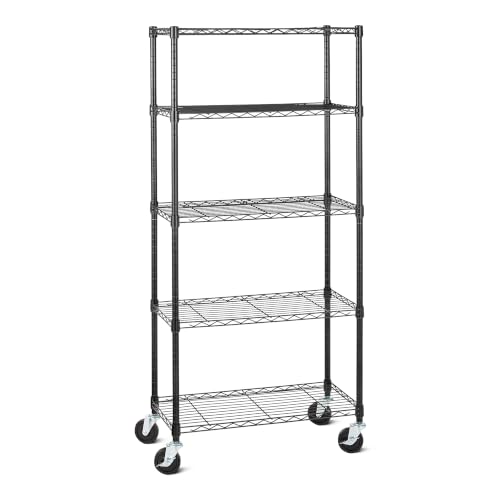 Top pickAmazon Basics 5-Shelf Wire Shelving on Casters300 lb per shelf, 30 x 14 x 64.75 in, adjustable | Heavy wet pots and bags of mix | 8.3 | $45.87 - View on Amazon |
| 2 | 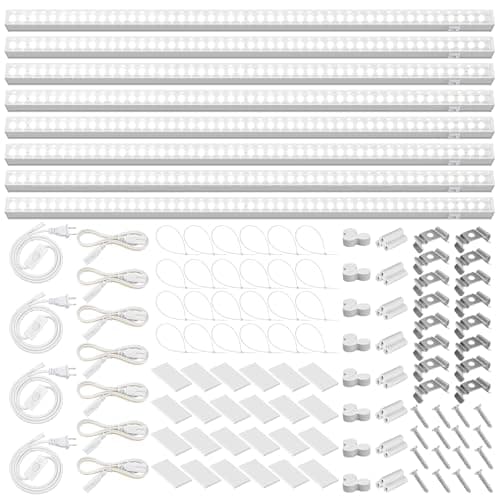 Barrina T5 Full-Spectrum LED Grow LightsLinkable LED strips, full spectrum | Stopping leggy seedlings | 9.0 | $60.99 - View on Amazon |
| 3 | 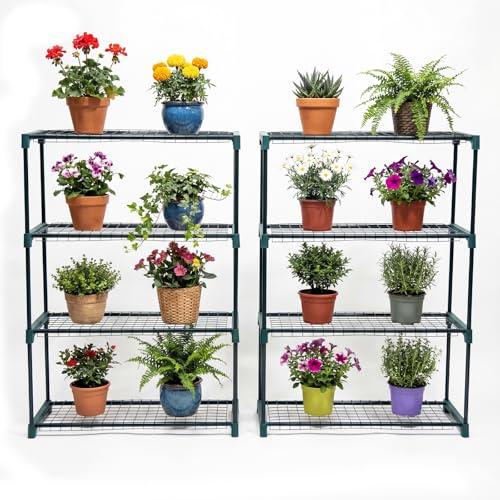 Panana 4-Tier Greenhouse Staging, 2 PackTwo 4-tier steel racks in one box | Shelving both sides for the least money | 8.0 | $42.54 - View on Amazon |
| 4 | 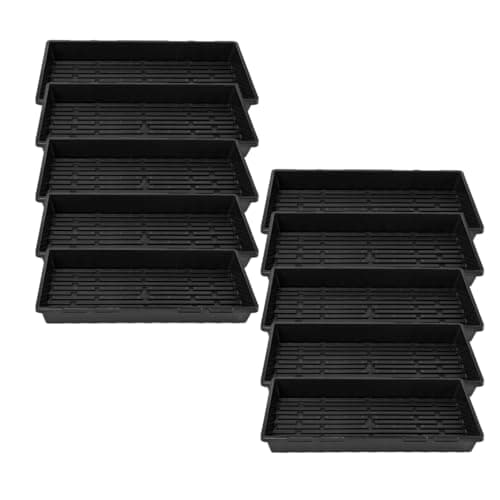 Bootstrap Farmer 1020 Seed TraysHeavy-gauge 1020 trays, reusable for years | Trays that last more than one season | 8.5 | $66.49 - View on Amazon |
| 5 | 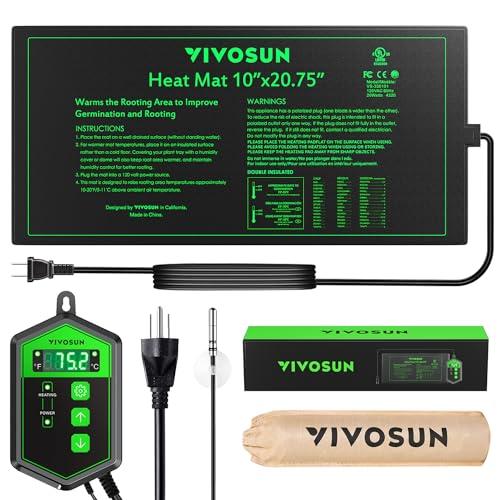 VIVOSUN Seedling Heat MatWaterproof mat sized for 1020 trays | Peppers, tomatoes and slow germinators | 8.8 | $25.01 - View on Amazon |
#ad We may earn a commission - Price as of November 24, 2026
Scores are our own editorial judgment, formed from published specifications and independent sources. They are not aggregated customer ratings, and they are not the result of hands-on testing, which we do not currently do. See how we choose.
Sizing the rack to your sowing
| Rack | Trays per shelf | Total trays | Suits |
|---|---|---|---|
| 4-tier light-duty staging | 1 | 3 to 4 under lights | A normal home vegetable garden |
| 5-shelf wire, 30 in wide | 1 across, 2 with overhang | 4 to 8 | Someone sowing in succession all spring |
| Two 5-shelf wire units side by side | 2 per shelf | 8 to 16 | Selling plants, or a very large garden |
| Single bench or table | 2 to 4 | 2 to 4 | Starting out; outgrown within a season |
Most people need the first or second row. The common mistake is buying one wide shelf and lighting it badly rather than buying tiers and lighting each one properly -- an unlit shelf is storage, not growing space.
Lighting a rack properly
This is where a rack succeeds or fails. The point of tiers is that each one gets its own light, mounted to the underside of the shelf above, close to the seedlings. Extension guidance on indoor lighting is consistent on the two variables that matter.
- Distance. Keep the light close -- a few inches above the leaves for LED strips -- and raise it as the seedlings grow. Distance is the single biggest cause of stretched, pale seedlings.
- Duration. Around fourteen to sixteen hours a day on a timer. More is not better; seedlings need a dark period. How long to leave grow lights on seedlings has the detail.
- Coverage, not intensity alone. A single bright spot lights the middle of a tray and starves the corners. Linkable strips across the shelf width beat one point source.
- One timer for the whole rack. Four tiers on one plug and one timer is the setup that gets used; four separate switches is the setup that gets forgotten.
What else lives on the rack
Two things earn permanent space. A heat mat on the bottom shelf, used only for germinating warm-season crops and then vacated -- peppers, aubergines, tomatoes and basil all germinate slowly in cold mix, while lettuce and brassicas do not need it at all. And a small fan, which is the cheapest insurance against damping off because it keeps the surface of the mix and the seedling stems dry.
Heavy-gauge 1020 trays are worth the money on a rack specifically, because thin flats flex when you lift them full and that is how spills and broken seedlings happen. Best seed starting trays covers the tray and insert combinations, and damping off covers the airflow and watering practice that prevents the one disease that can clear a whole shelf overnight.
The picks in full
Top pick
Amazon Basics 5-Shelf Wire Shelving on Casters
Amazon Basics
Not greenhouse-specific and all the better for it: a published 300 lb per-shelf rating and adjustable tiers, on wheels so it rolls out of the way.
Nothing about this is designed for a greenhouse, which is exactly why it belongs on the list. Greenhouse staging is usually sold on looks and shelf count; wire shelving is sold on load rating, and a wet 10 inch pot is heavier than most staging expects.
Three hundred pounds per shelf, adjustable spacing and casters together solve the problems that make people replace their first staging: it sagged, the shelf spacing was wrong for what they grow, and they could not get behind it to clean.
The limit is headroom. At 64.75 inches tall it needs the straight section of a wall or the center line of the house, and in a small lean-to it will not fit at all.
What works
- A published per-shelf load rating, which greenhouse-branded staging rarely gives
- Adjustable tiers, so you can set one bay tall enough for staked tomatoes or a mix bag
- Wheels mean it rolls out for cleaning instead of being dismantled
- Open wire shelves drain and let light through to the tier below
What does not
- Tall: in a hobby greenhouse it only works against the straight part of the wall
- Epoxy over steel is a garage finish, not a marine one -- it will mark in constant damp
- Wire shelving needs a liner or a tray under small pots, which tip through the gaps
- Casters make it mobile and also slightly wobbly on a gravel floor
Skip it if: your greenhouse has sloping eaves and no center headroom. At nearly 65 inches tall this only fits down the middle or against a straight wall.
| Shelves | 5, adjustable in 1 in increments |
|---|---|
| Load rating | 300 lb per shelf (manufacturer) |
| Dimensions | 30 x 14 x 64.75 in |
| Casters | Four 4 in wheels included |
| Finish | Black epoxy-coated steel |
Stopping leggy seedlings
Barrina T5 Full-Spectrum LED Grow Lights
Barrina
The fix for the most common seed-starting failure. A windowsill grows pale, stretched seedlings; a strip light 3 inches above them does not.
A seedling stretches toward light. On a windowsill in February the light comes from one side and there is not enough of it, so the stem elongates, the plant gets pale and floppy, and it never fully recovers. That is the single most common seed-starting failure and it is entirely a light problem.
LED strips fix it because they can sit 2 to 4 inches above the leaves without cooking them. Distance is what matters more than wattage: the same light at 18 inches does very little.
Run them about 14 to 16 hours a day on a timer and raise them as the seedlings grow. Linkable strips mean a whole shelving rack runs from one outlet.
What works
- Directly fixes stretched, leggy seedlings
- Linkable, so one outlet runs a whole shelf
- Very low heat, so it can sit close to the leaves
- Cheap to run
What does not
- Needs to be within a few inches of the seedlings to work
- Height must be adjusted as plants grow
- White light is unflattering in a living space
Skip it if: you have a genuinely bright greenhouse and are sowing in season. Then you are buying light you already have.
| Type | Linkable LED strip lights |
|---|---|
| Spectrum | Full spectrum, commonly 5000K white |
| Lengths | 1 ft, 2 ft and 4 ft strips |
| Mounting | Clips, hanging kit or double-sided tape |
| Linking | Strips daisy-chain from one outlet |
Shelving both sides for the least money
Panana 4-Tier Greenhouse Staging, 2 Pack
Panana
Two four-tier racks for roughly what one mid-range unit costs, which is the cheapest way to get staging down both sides of a small kit.
Staging is the accessory that changes a greenhouse the most per dollar, and the usual mistake is buying one rack when the structure has two sides. This is two racks of four tiers each, which is the whole interior of a small kit sorted in a single order.
The trade for the price is depth. These are narrow racks, so trays overhang and heavy wet pots want to sit on the lower tiers. For seed trays, module trays, cuttings and small pots -- which is what a spring greenhouse is actually full of -- that is a fair trade.
Treat any scratch in the powder coat as something to touch up. A greenhouse is a wet, warm place and budget steel finds rust there faster than it does in a garage.
What works
- Two racks per order, so a 6 x 8 kit gets both sides done in one purchase
- Steel frame rather than the plastic shelving sold at a similar price
- Narrow footprint leaves a usable path down the middle of a small greenhouse
- Light enough to move out for a deep clean between seasons
What does not
- Shallow shelves: a standard 1020 tray will hang over the front edge
- Budget steel and powder coat -- expect surface rust at any scratch in a damp house
- Thin shelves flex under wet pots, so the load wants spreading rather than stacking
- No published per-shelf load rating, which is itself a signal about the capacity
Skip it if: you need a deep shelf. Narrow staging is what makes this price possible, and a 1020 tray will overhang it.
| Tiers | 4 per rack |
|---|---|
| Quantity | 2 racks per order |
| Frame | Powder-coated steel |
| Assembly | Bolt-together, no tools claimed by the maker |
| Use | Greenhouse, shed or garage |
Trays that last more than one season
Bootstrap Farmer 1020 Seed Trays
Bootstrap Farmer
Thick enough to pick up full without folding, which is the entire complaint about cheap trays and the reason these cost more.
Anyone who has carried a cheap 1020 tray full of wet compost knows the failure mode: it folds in the middle and the seedlings go on the floor. Heavy-gauge trays do not do that.
The 1020 name is a standard footprint, roughly 10 by 20 inches, and it is worth sticking to. Every humidity dome, heat mat, cell insert and shelf is built around it.
Buy a couple of solid, undrained trays alongside the drained ones. A solid tray underneath lets you water from below, which is gentler on small seedlings than watering from above and keeps the leaves dry.
What works
- Can be lifted full of wet medium without collapsing
- Lasts many seasons rather than one
- Standard 1020 footprint fits every dome and mat
- Solid trays double as reservoirs for bottom watering
What does not
- Several times the price of disposable trays
- Only worth it if you actually reuse them
- Heavier to store in quantity
Skip it if: you start one tray a year. The economics only work once you are reusing them season after season.
| Type | 1020 standard seedling trays |
|---|---|
| Gauge | Heavy-duty, substantially thicker than standard |
| Drainage | Drain-hole and solid versions sold |
| Compatibility | Fits standard domes, mats and inserts |
Peppers, tomatoes and slow germinators
VIVOSUN Seedling Heat Mat
VIVOSUN
Germination is driven by soil temperature, not air temperature -- and a heat mat is the difference between peppers in ten days and peppers in four weeks.
Seeds respond to the temperature of the medium they are in, not the room. Peppers and eggplants want soil in the 80s Fahrenheit to germinate briskly, and a 68-degree house gives them soil in the low 60s -- which is why they sit there for weeks.
A mat under the tray fixes that. Pair it with a thermostat probe if you can: without one the mat simply runs at its own output, which can be too warm for some seeds and is impossible to tune.
Take the tray off the mat once germination is done. Bottom heat after that encourages soft, stretched growth, and it dries the tray faster than you will remember to water it.
What works
- Dramatically faster germination for warm-season crops
- Waterproof, so spills are not a hazard
- Sized to standard trays
- Cheap to run
What does not
- Without a thermostat it just runs warm, with no target
- Dries trays out faster -- watering needs watching
- Should come off once seedlings are up
Skip it if: you only start cool-season crops. Lettuce, brassicas and peas germinate fine at room temperature and can actually be inhibited by heat.
| Type | Seedling heat mat |
|---|---|
| Sizing | Made to fit one or two standard 1020 trays |
| Construction | Waterproof |
| Thermostat | Sold separately on most models |
Common questions
What size shelf do I need for a 1020 seed tray?
A standard 1020 flat is roughly 11 by 21 inches, so a shelf about fourteen inches deep takes one without overhang. A twelve-inch shelf works but the lip of the tray hangs over the edge, which makes the tray easier to knock and harder to lift cleanly.
Can you use a wire shelving unit for seed starting?
It is the standard answer, and a good one. Adjustable shelf height lets you set the light distance per tier, the open wire deck drains spills and lets air move, and the load rating is far beyond anything wet trays will apply. Casters are a genuine convenience rather than a gimmick.
How close should grow lights be to seedlings?
Close -- a few inches above the leaves for LED strips -- and raised as the seedlings grow. Light distance is the single biggest cause of stretched, pale seedlings, and it is the reason adjustable shelves matter more than the brand of light.
How many hours a day should lights be on a seed starting rack?
Around fourteen to sixteen hours on a timer. Seedlings need a dark period, so running lights continuously is not an improvement. One timer for the whole rack is what makes the routine reliable.
Do I need a fan on a seed starting rack?
A small one helps a lot. Moving air keeps the surface of the mix and the seedling stems dry, which is the practical defence against damping off, and it slightly thickens stems. On an enclosed rack in a basement it is close to essential.
Sources
Factual claims on this page are backed by the published sources below, and product specifications are the manufacturers’ own. Where a figure is not published, we say so rather than estimating it.