Step 2 - Soil & Fill
The Best Fertilizer for Raised Beds
A first-year bed usually needs nothing. From year two, the right bag is a low-analysis granular worked in each spring -- here is which one and how much.
Janet H. - the hands-on owner behind Janet Media Group.
Published
This page contains affiliate links. If you buy through them we may earn a commission at no cost to you, and it never decides what we recommend. How this site is funded.
For most raised beds the best fertilizer is a low-analysis organic granular worked into the surface each spring, and Espoma Organic Garden-Tone 3-4-4 is the easiest version of that to buy and hard to overdo. If you want to know exactly what is in the bag, Down To Earth All Purpose 4-6-2 names every input and is OMRI listed. For tomatoes, peppers and anything else that fruits, Espoma Tomato-Tone 3-4-6 holds back nitrogen and adds calcium. On a budget, Jobe's Organics covers about 120 square feet per 4 lb bag. And when a crop needs help this week rather than next month, a liquid feed such as Neptune's Harvest Fish & Seaweed is the only thing here that works on that timescale.
One caveat first, because it saves money: a bed filled last spring with a good compost-rich mix usually does not need any of this yet. Do you need to fertilize raised beds? is the question to settle before buying a bag.
What a raised bed needs, and when
A raised bed is not in-ground soil, and the feeding pattern is genuinely different. Three things happen over the first few seasons: the organic matter decomposes and the level drops, the crops remove nutrients and you carry them off in the harvest, and the free drainage that makes a bed work also leaches soluble nutrients -- nitrogen first -- down through the base.
- Year one, good mix: feed nothing. The mix contains more nutrition than one season of crops will use, and added nitrogen buys you large leafy plants that fruit poorly.
- Year two onward: an inch or two of compost each spring is the whole answer for most beds. Compost is both a nutrient source and a slow-release one.
- Compost plus a granular feed: worth it for heavy feeders -- tomatoes, squash, corn, brassicas -- and for any bed whose growth was visibly disappointing last season.
- A specific amendment: only on the evidence of a soil test. Guessing at a nutrient deficiency is how beds end up with too much phosphorus.
That ordering matters for the shopping list. Compost first, granular feed second, anything else third. A bed that gets compost every spring and a modest granular feed at planting is being managed correctly, and nothing else on the shelf will improve it.
How to read an NPK label
The three numbers on every bag are the percentages by weight of nitrogen, available phosphate and soluble potash, always in that order. A 3-4-4 bag is 3% nitrogen, 4% phosphate, 4% potash. The rest is carrier material and whatever the inputs bring with them.
| Nutrient | What it drives | Too much looks like |
|---|---|---|
| N -- nitrogen | Leaf and stem growth; the limiting nutrient for greens | Big soft leafy plants, few flowers, little fruit, aphids |
| P -- phosphate | Root establishment, flowering and fruit set | Rarely visible; accumulates in soil and can run off into water |
| K -- potash | Fruit quality, water regulation, general hardiness | Rarely visible; can interfere with magnesium uptake |
Two rules follow from that table. Leafy crops want relative nitrogen; fruiting crops want relative potassium with the nitrogen held back. And low numbers are a feature, not a weakness, in a raised bed -- a 3-4-4 is difficult to misuse, where a concentrated synthetic at 20-20-20 will burn a seedling if you are careless with the scoop.
How these were chosen
- Low, gentle analyses. Everything here is in single digits for all three numbers. A raised bed is a container of manufactured soil with a compost base; it does not need concentrated feed, and the risk of overdoing it is real.
- Named inputs where possible. A label that lists bone meal, feather meal and kelp is one you can reason about. 'Organic ingredients' is not.
- Granular slow-release as the default, liquid as the supplement. Granular matches how beds are managed -- worked in once, maybe side-dressed once. Liquid is for mid-season problems.
- Currently stocked. Each was confirmed as a current, in-stock listing before being written in, in several bag sizes so you can buy to the size of the garden.
- An honest downside on each. Including on the top pick: low-analysis organic granular means more bag per bed and slower release in a cold spring.
Quick picks
| # | Product | Best for | Score | Price |
|---|---|---|---|---|
| 1 | 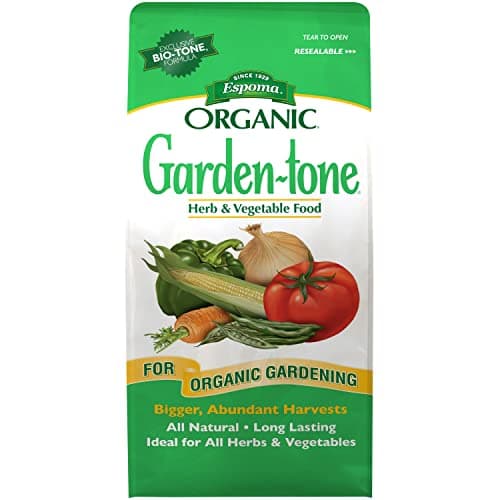 Top pickEspoma Organic Garden-Tone 3-4-43-4-4 granular, formulated for vegetables and herbs | The one bag most beds need | 9.0 | $15.00 - View on Amazon |
| 2 | 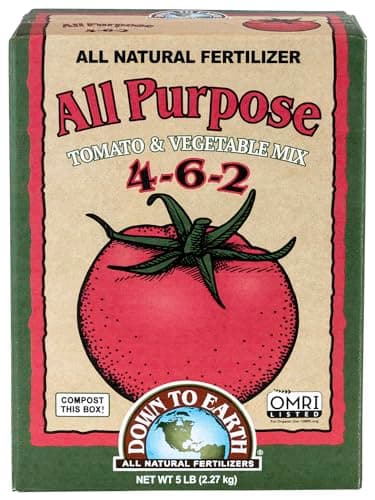 Down To Earth All Purpose Mix 4-6-24-6-2 from a named ingredient list, OMRI listed | Knowing exactly what you are putting in the bed | 8.9 | $21.99 - View on Amazon |
| 3 | 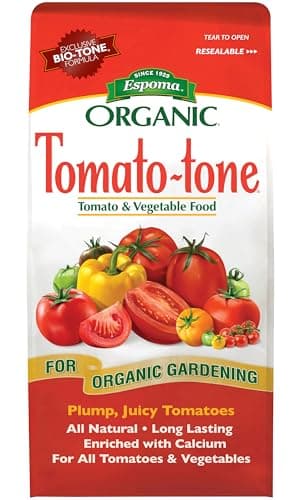 Espoma Organic Tomato-Tone 3-4-63-4-6 with 8% calcium | Tomatoes, peppers and anything that fruits | 8.6 | $15.36 - View on Amazon |
| 4 | 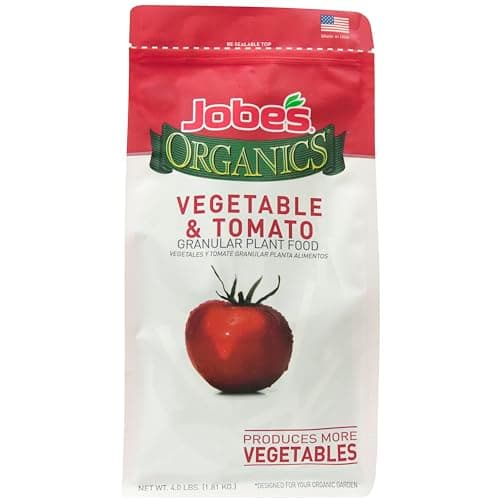 Jobe's Organics Vegetable & Tomato Granular Fertilizer2-5-3 OMRI-listed granular, 4 lb covers about 120 sq ft | The lowest cost per bed | 8.2 | $11.94 - View on Amazon |
| 5 | 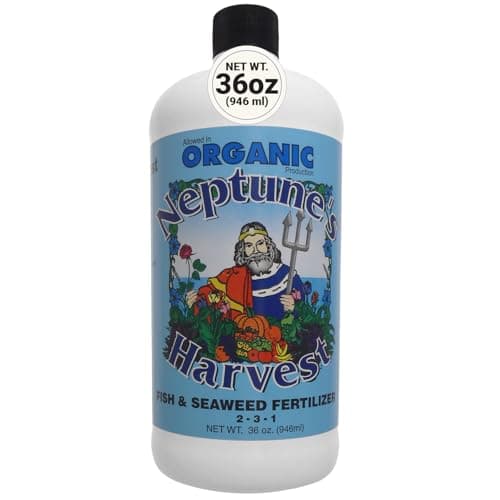 Neptune's Harvest Fish & Seaweed Fertilizer 2-3-12-3-1 liquid concentrate, diluted and watered on | A mid-season boost that works in days | 8.4 | $22.49 - View on Amazon |
#ad We may earn a commission - Price as of October 12, 2026
Scores are our own editorial judgment, formed from published specifications and independent sources. They are not aggregated customer ratings, and they are not the result of hands-on testing, which we do not currently do. See how we choose.
Which one for which crop
| What you are growing | Use | Why |
|---|---|---|
| A mixed bed, one bag only | A balanced granular, around 3-4-4 | Enough of everything, impossible to skew the bed |
| Tomatoes, peppers, squash, cucumbers | A fruiting formula, lower N and higher K, with calcium | Nitrogen at fruit set costs you fruit |
| Salad, spinach, chard, brassicas | A balanced or nitrogen-forward granular | Leaf crops are nitrogen-limited |
| Root crops -- carrots, beets, parsnips | Compost only, or a very light balanced feed | Rich nitrogen gives forked, leafy roots |
| Blueberries in a bed | An acid-forming fertilizer for ericaceous plants | They need ammonium nitrogen and a low pH, not a vegetable feed |
| A pale, struggling crop mid-season | Dilute liquid feed now, granular next spring | Granules take weeks; a liquid works in days |
The blueberry row is the one real exception on the site, and it is worth not getting wrong: a general vegetable fertilizer is the wrong product for them. The best raised bed for blueberries covers the soil and the feed together.
Organic or synthetic
For a raised bed there is a practical argument for organic granular that has nothing to do with ideology. Organic fertilizers release as soil organisms break them down, which means release depends on warmth and moisture rather than solubility. In a bed that is already compost-rich and biologically active, that is a good match: the nutrients arrive gradually, little leaches out through the base, and it is very hard to burn a plant.
Synthetic fertilizers are soluble and immediate. They cost less per unit of nutrient, they work in cold soil where organic granules sit inert, and they are easy to overapply. In a free-draining raised bed, more of a soluble feed leaves through the bottom than in heavy ground.
The honest summary: organic granular in spring for the base feed, and a dilute soluble or liquid organic feed for mid-season correction. If all you have is a box of general-purpose soluble fertilizer, use it at half the label rate and water it in -- that is better than a bed going hungry.
How much, and how to apply it
- 1
Follow the label rate, because it is specific to the bag
Analyses differ by a factor of two or three across the products here, so there is no universal cups-per-bed figure, and anyone quoting one is guessing. The label gives a rate per square foot or per plant -- use it.
- 2
Top up with compost first
An inch or two over the surface each spring, which replaces the volume lost to decomposition along with most of the fertility. Do this whether or not you add fertilizer.
- 3
Work the granular into the top two inches
Scattered on the surface and left, organic granules do very little -- they need soil contact and moisture to break down. Rake them in, then water.
- 4
Side-dress the long croppers at mid-season
Tomatoes, squash, peppers and corn are still feeding in July. A second light application beside the plants, worked in and watered, carries them to the end.
- 5
Use liquid feed as the response, not the plan
Diluted at label rate every week or two for anything pale or in a container. If a bed needs this to keep going, the fix is more compost next spring.
- 6
Soil test before chasing a deficiency
A test through your state extension service costs very little and is the only way to know whether a bed is actually short of something. Everything else is guessing with a trowel.
Reading the plants, carefully
Deficiency symptoms are real and documented, and they are also easy to misread -- drought, waterlogging, root damage and cold soil all produce pale, stunted plants that look exactly like hunger. Treat the list below as a prompt to investigate rather than a diagnosis.
| What you see | Often means | Check first |
|---|---|---|
| Older, lower leaves yellowing while new growth stays green | Nitrogen is short -- the plant is moving it to new leaves | Whether the bed has had compost this year |
| Whole plant pale and small, growth stalled | Nitrogen, or cold soil that has stalled release | Soil temperature early in the season, and watering |
| Leaf edges scorched or yellowing between the veins | Potassium or magnesium | Moisture consistency; drought mimics both |
| Dark, dull, purplish leaves on young plants | Phosphorus, classically in cold wet soil | Soil temperature -- it often resolves as the bed warms |
| Masses of leaf, few flowers or fruit | Too much nitrogen | What you have been feeding; stop feeding nitrogen |
| Blossom-end rot on tomatoes and peppers | Calcium uptake interrupted | Watering regularity, not the calcium level |
The last two rows are the ones that matter most in a raised bed, because both are usually caused by something other than a missing nutrient. If a bed is producing enormous foliage and no fruit, adding fertilizer makes it worse. If tomatoes are rotting at the base, more calcium rarely helps and steady watering usually does.
What not to buy
- Lawn fertilizer. High nitrogen, sometimes with a weedkiller in it. Never on a vegetable bed.
- Fertilizer spikes for vegetables. They concentrate nutrients in one spot in a bed whose roots are spread through the whole volume. Fine for a tree, poor for a bed.
- Another bag of bed mix as a feed. Bagged raised bed mix is a fill, not a fertilizer. If the bed has dropped, top it up -- but that is a volume decision, and the raised bed soil calculator is the quicker way to size it.
- Micronutrient cocktails bought on spec. Without a soil test you are adding things at random. Spend the money on the test first.
- Anything promising a dramatic yield increase. Good soil, steady water and enough sun set your yield. Fertilizer removes a limit; it does not add a bonus.
The picks in full
Top pick
Espoma Organic Garden-Tone 3-4-4
Espoma
The default: a gentle, balanced organic granular made for vegetable beds, stocked almost everywhere, and hard to overdo.
If you want one bag in the shed and no more decisions, this is the one. The 3-4-4 analysis is deliberately modest, which is exactly right for a raised bed: the mix is already compost-rich, so the job is topping up what a season of cropping removed, not force-feeding.
Granular slow-release suits the way beds are actually managed. Work it into the top couple of inches before planting, side-dress mid-season for long croppers, and water it in. Because release depends on soil biology rather than solubility, there is no spike and little leaching -- and little risk of burning a seedling you planted a day later.
The honest limitation is that low analysis means volume. Across several beds you will go through more of this than of a concentrated product, and the per-bed cost is higher than a bulk single-ingredient feed. That is the price of a fertilizer that is hard to misuse.
What works
- Low, even analysis: very difficult to burn a crop with it
- Made for vegetables rather than relabeled lawn feed
- Slow-release, so one application carries weeks rather than days
- Stocked by garden centers and hardware stores, so mid-season top-ups are easy
- Granular, which suits working into a bed surface before planting
What does not
- Low analysis means more bag per bed than a concentrated synthetic
- Organic granules need soil warmth and moisture to release -- slow in a cold spring
- Has a smell for a day or two after application, and dogs are interested in it
- No micronutrient package worth relying on if a soil test shows a specific deficiency
Skip it if: your bed is in its first season after a compost-rich fill. It does not need feeding yet, and the nitrogen will cost you fruit.
| Analysis | 3-4-4 (N-P-K) |
|---|---|
| Type | Granular, slow-release organic |
| Made for | Cool and warm season vegetables and herbs |
| Application | Worked into the bed at planting and as a side-dressing, per label |
| Bag sizes | Several, from small bags up to large sacks |
Knowing exactly what you are putting in the bed
Down To Earth All Purpose Mix 4-6-2
Down To Earth
The pick for anyone who reads labels: every input is named, it is OMRI listed, and it is formulated to feed soil biology as well as the crop.
The reason to pay more for this one is the label. Fish bone meal, blood meal, feather meal, alfalfa meal, rock phosphate, langbeinite, humates and kelp meal -- that is the whole list, and every item is a known quantity. Plenty of competing bags say 'organic ingredients' and leave it there.
Practically, the blend does two jobs. The meals supply nitrogen and phosphorus over weeks rather than days, and the alfalfa, humates and kelp supply the organic matter and trace elements that the microbial side of a raised bed runs on. In a bed that has been cropped for a few seasons, that second half matters more than the headline numbers.
The 4-6-2 ratio leans toward phosphorus, which supports root establishment and fruit set. That makes it a good choice for transplanting tomatoes, peppers and squash, and a less necessary one for a bed of salad leaves, where nitrogen is the limiting nutrient.
What works
- Full ingredient list on the label -- no proprietary blend hiding the inputs
- OMRI listed, which matters if you are gardening to an organic standard
- Higher phosphorus than most all-purpose feeds, which suits fruiting crops in a new bed
- Kelp, humates and alfalfa feed soil life, not only the plant
- Sold from 1 lb up to 50 lb, so you can buy to the size of the garden
What does not
- Costs more per pound than a mass-market organic granular
- Blood and fish meals have a strong smell when first applied, and attract animals
- 4-6-2 is a maintenance feed, not a rescue for a visibly starved bed
- Needs to be worked in and watered; left on the surface it does little
Skip it if: you want the cheapest adequate feed. Named single-origin inputs cost more than a generic blend that works nearly as well.
| Analysis | 4-6-2 (N-P-K) |
|---|---|
| Inputs | Fish bone meal, blood meal, feather meal, alfalfa meal, rock phosphate, langbeinite, humates, kelp meal |
| Certification | OMRI Listed; CDFA registered organic input material |
| Type | Granular, non-burning |
| Bag sizes | 1, 5, 15, 40 and 50 lb |
Tomatoes, peppers and anything that fruits
Espoma Organic Tomato-Tone 3-4-6
Espoma
The right feed for fruiting crops: less nitrogen, more potassium, and the calcium that blossom-end rot depends on.
The all-leaves-no-tomatoes problem is a nitrogen problem, and this formula is built around avoiding it. At 3-4-6 the potassium sits above the nitrogen, which is what supports flowering and fruit rather than foliage.
The 8% calcium is the other reason to choose it. Blossom-end rot is a calcium availability problem in the developing fruit, and a bed that is short of calcium will show it. One honest caveat: in most raised beds the calcium is present and the real cause is irregular watering, which interrupts uptake. Fertilizer will not fix that -- steady moisture will, which is one more argument for putting drip irrigation in the bed.
Use it for tomatoes, peppers, eggplant, squash and cucumbers, and use a balanced feed for the salad and brassica end of the garden. If you only want one bag for a mixed bed, buy the balanced one.
What works
- Potassium above nitrogen, which is the ratio fruiting crops actually want
- 8% calcium addresses the deficiency behind blossom-end rot
- Same gentle, hard-to-overdose granular behavior as Garden-Tone
- Widely stocked, so a mid-season top-up is a local errand
What does not
- A single-purpose bag -- wrong for the greens half of the garden
- Calcium in the bag does not fix blossom-end rot caused by uneven watering, which is the usual cause
- Slow release means it has to go on before the plants need it, not when symptoms appear
- Buying both this and Garden-Tone is two bags for one bed
Skip it if: you are feeding leafy greens. They want the nitrogen this formula deliberately holds back.
| Analysis | 3-4-6 (N-P-K) |
|---|---|
| Calcium | 8% |
| Type | Granular, slow-release organic |
| Made for | Tomatoes and other fruiting vegetables |
| Application | At planting and as a side-dressing through the season, per label |
The lowest cost per bed
Jobe's Organics Vegetable & Tomato Granular Fertilizer
Jobe's
The budget pick that is still a real organic fertilizer: OMRI listed, named inputs, and the cheapest way to feed a couple of beds properly.
Price per square foot is the argument. A 4 lb bag covers about 120 square feet, which is three or four standard beds' worth of a single feeding, and it is still an OMRI-listed product derived from bone meal, poultry manure and sulfate of potash rather than a mystery blend.
The analysis tells you where it fits. At 2-5-3 it is phosphorus-forward and nitrogen-light, which suits transplanting tomatoes, peppers and squash and is thin for a bed of spinach or chard. If your garden is mostly fruiting crops, that is fine; if it is mostly greens, pair it with something stronger in nitrogen or buy a balanced feed instead.
Treat the Biozome microbe claim as a bonus rather than a reason to buy. Beneficial microbes are real and useful in soil, but a bed that gets compost every spring already has them in numbers no sachet in a fertilizer bag will meaningfully change.
What works
- Cheapest of the picks here, and it covers about 120 sq ft per 4 lb bag
- OMRI listed despite the price
- Inputs are named on the label: bone meal, poultry manure, sulfate of potash
- Easy to find in big-box stores as well as online
What does not
- 2% nitrogen is low -- leafy crops will want more
- Poultry manure smells strongly for the first day or two
- Microbe additives like Biozome are marketed harder than the evidence supports
- Small bag sizes mean repeat purchases on a larger garden
Skip it if: you want a single bag for the whole garden. The low nitrogen suits fruiting crops better than leafy ones.
| Analysis | 2-5-3 (N-P-K) |
|---|---|
| Derived from | Bone meal, poultry manure and sulfate of potash |
| Added | Biozome, the brand's beneficial microbe package |
| Certification | OMRI Listed |
| Coverage | A 4 lb bag covers about 120 sq ft |
| Application | At planting, then every 4 to 8 weeks per label |
A mid-season boost that works in days
Neptune's Harvest Fish & Seaweed Fertilizer 2-3-1
Neptune's Harvest
The one to reach for when a crop needs help now: a liquid feed takes effect in days where granules take weeks.
Granular fertilizer is the plan; liquid fertilizer is the response. When a crop is visibly pale in July and you need growth this fortnight rather than next month, a dilute liquid feed is the only thing on this page that works on that timescale.
Fish hydrolysate supplies readily available nitrogen and phosphorus, and the seaweed fraction brings trace elements and plant growth compounds that a straight meal-based blend does not. Mixed at label rate in a watering can it is gentle enough for seedlings at half strength, which makes it genuinely useful in a seed-starting setup as well as in the bed.
Two practical notes. The smell is real and it lingers for about a day outdoors, so pick your moment. And it is a supplement -- if a bed needs a liquid feed every week to keep going, the fix is more compost and a granular base feed in spring, not a bigger bottle.
What works
- Fast-acting: nutrients are already in solution and available to roots
- Seaweed contributes trace elements a granular blend may not
- Can be used as a foliar feed as well as a soil drench
- Easy to dose gently for seedlings and container plants at a reduced rate
What does not
- It smells like what it is made of, strongly, for a day
- Effect is short-lived -- it is a supplement, not the backbone of a feeding plan
- Mixing a watering can every week or two is real work across several beds
- Costs more per unit of nutrient than granular fertilizer
Skip it if: you want to feed the bed once and forget it. Liquid feeds need reapplying every week or two through the season.
| Analysis | 2-3-1 (N-P-K) |
|---|---|
| Type | Liquid concentrate, diluted in water |
| Inputs | Hydrolyzed fish and seaweed |
| Application | Watered onto the soil or used as a foliar feed, per label dilution |
| Bottle sizes | 18 oz, 36 oz, 1 gallon and larger |
Common questions
What is the best fertilizer for raised garden beds?
A low-analysis organic granular around 3-4-4, worked into the top two inches each spring on top of an inch or two of compost. It suits the compost-rich, biologically active mix in a raised bed, releases slowly rather than leaching out through the base, and is very difficult to overapply.
Do raised beds need fertilizer every year?
They need compost every year; they need fertilizer from about year two, and more certainly if you grow heavy feeders such as tomatoes, squash or corn. A bed filled last spring with a good mix is already fed, and adding more nitrogen to it tends to produce leafy plants with little fruit.
What do the numbers on fertilizer mean?
They are the percentages by weight of nitrogen, available phosphate and soluble potash, in that order. Nitrogen drives leaf growth, phosphate supports roots and fruit set, potash supports fruit quality and hardiness. For a raised bed, low single-digit numbers are a feature rather than a weakness.
Is organic fertilizer better for raised beds?
It is a better match. Organic granules release as soil organisms break them down, which is gradual, leaches less from a free-draining bed, and rarely burns a plant. Synthetics are cheaper per unit of nutrient and work in cold soil, but are easy to overapply and more of them wash out through the base of a bed.
How much fertilizer do I put in a 4x8 raised bed?
Follow the label rate on the bag you bought. Analyses across common vegetable fertilizers differ by a factor of two or three, so there is no honest universal cups-per-bed figure -- any source quoting one is guessing. The label states a rate per square foot or per plant, and a 4 x 8 bed is 32 square feet.
Can I use compost instead of fertilizer?
In most raised beds, yes. An inch or two of compost each spring replaces both the volume lost to decomposition and most of the fertility a season of cropping removed. Add a granular feed on top of that for heavy feeders, or when growth was visibly poor the previous year.
Sources
Factual claims on this page are backed by the published sources below, and product specifications are the manufacturers’ own. Where a figure is not published, we say so rather than estimating it.