Step 3 - Seed Starting
How Long to Leave Grow Lights On for Seedlings
Fourteen to sixteen hours a day, a few inches away, on a timer. Each of those three numbers is doing a job.
Janet H. - the hands-on owner behind Janet Media Group.
Published
This page contains affiliate links. If you buy through them we may earn a commission at no cost to you, and it never decides what we recommend. How this site is funded.
Run grow lights 14 to 16 hours a day for vegetable seedlings, and give them 8 to 10 hours of genuine darkness. Keep the light 2 to 4 inches above the tops of the seedlings with LED strips, raising it as they grow. The hours matter less than people expect; the distance matters far more. A light left on 16 hours a day but hung 18 inches up produces exactly the pale, stretched seedlings it was bought to prevent.
Hours by stage and crop
| Stage or crop | Hours per day | Notes |
|---|---|---|
| Before germination | None needed for most seeds | Warmth matters; light does not, until they emerge |
| The moment seedlings emerge | 14 to 16 | Start immediately. The first 48 hours is when stretching begins |
| Tomatoes, peppers, eggplant | 14 to 16 | Long-season heat crops; they want the upper end |
| Lettuce, spinach, brassicas | 12 to 14 | Cool-season crops cope with slightly less |
| Herbs: basil, parsley | 14 to 16 | Basil in particular stretches badly in low light |
| Onions and leeks | 14 to 16 | Slow and grassy; they need the hours |
| Hardening off, outdoors by day | Natural daylight | Stop supplementing once they are going outside |
A few seeds do want light to germinate -- lettuce and some herbs among them -- and those are sown on the surface rather than covered. Everything else germinates in the dark on warmth alone, which is why a heat mat matters before emergence and a light matters immediately after.
Why not 24 hours a day
It is tempting, and it is a mistake. Plants run two processes: photosynthesis in the light, and respiration, repair and transport of sugars in the dark. Remove the dark period and the second set never happens properly. Continuous light produces seedlings that look acceptable for a week and then stall, and in sensitive crops it causes leaf chlorosis and damage.
The other reason is practical: a plant grown under 24-hour light is grown under conditions it will never meet again. Seedlings that have experienced a day and night cycle transition to a windowsill or a greenhouse with much less of a check.
Setting the light up
- 1
Put it on a timer on day one
The single highest-value item in the whole setup. Human memory produces a 10-hour day on Tuesday and a 19-hour day on Saturday, and seedlings respond to the inconsistency.
- 2
Hang the light so it can be raised
Chain, cord ratchets or simply a hook you can move. The light needs to go up roughly every few days through the fastest growth.
- 3
Set it 2 to 4 inches above the seedling tops
Close enough that no seedling is reaching for it, far enough that nothing touches the fixture. Check every couple of days.
- 4
Cover the full tray footprint
A single narrow strip over a 10 x 20 inch tray lights the middle row properly and leaves the edges stretching. Link two or three strips, or center the tray under the fixture.
- 5
Run a small fan nearby, on low
Air movement thickens stems and dramatically reduces damping-off. It is the cheapest improvement after the light itself.
- 6
Stop supplementing at hardening off
Once seedlings are spending days outdoors, natural light takes over. Keep the indoor light only for whatever is still in the tray.
Reading the seedlings
| What you see | Usually means | Change |
|---|---|---|
| Long pale stems, wide spacing between leaves | Not enough light intensity | Lower the light. Hours are rarely the issue |
| Seedlings leaning hard to one side | The light is off-center, or a window is dominating | Center the fixture; rotate trays daily |
| Edges of the tray leggy, middle fine | The fixture is too narrow for the tray | Add a second strip or shrink the footprint |
| Leaves bleached, dry or curling at the tips | Too close, or too long a day for that crop | Raise the light an inch or two and check the timer |
| Purple tinge on tomato leaves | Often cold roots rather than light | Check temperature before changing the lighting |
| Growth stalled after a strong start | Nutrient exhaustion, not light | Start a weak liquid feed or pot on |
The first row is the one that matters, because it is the reason most people buy a light and the reason they are still disappointed. Why are my seedlings leggy? works through the whole diagnosis, and grow lights vs a sunny windowsill explains why even a bright south window is not equivalent to a strip light at three inches.
What the light runs over
A fixture is only as useful as the tray under it. Standard 1020 trays -- roughly 10 by 20 inches -- exist because every dome, mat and shelf is built around that footprint, and a non-standard tray makes the lighting geometry awkward forever. Heavy-gauge trays are worth it once you are reusing them season after season rather than replacing flimsy ones every spring.
What to buy
The products that fit the advice above, chosen by the process on our how we choose page. We have not hands-on tested them; specifications are the manufacturers’ own.
Quick picks
| # | Product | Best for | Score | Price |
|---|---|---|---|---|
| 1 | 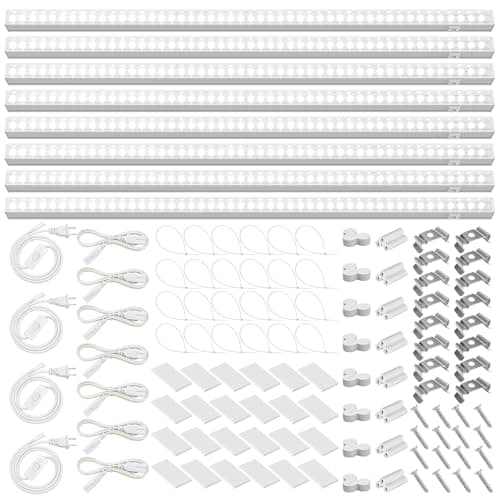 Top pickBarrina T5 Full-Spectrum LED Grow LightsLinkable LED strips, full spectrum | Stopping leggy seedlings | 9.0 | $54.89 - View on Amazon |
| 2 | 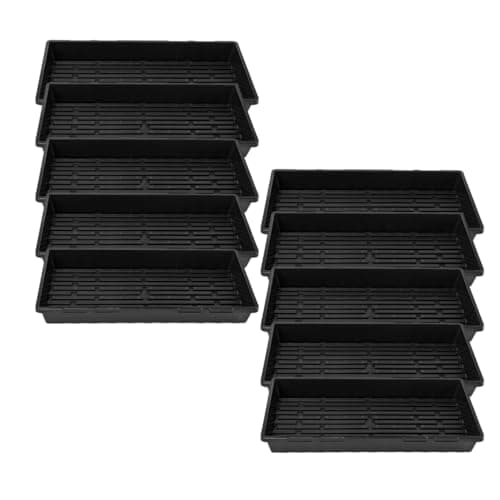 Bootstrap Farmer 1020 Seed TraysHeavy-gauge 1020 trays, reusable for years | Trays that last more than one season | 8.5 | $66.49 - View on Amazon |
#ad We may earn a commission - Price as of October 17, 2026
Scores are our own editorial judgment, formed from published specifications and independent sources. They are not aggregated customer ratings, and they are not the result of hands-on testing, which we do not currently do. See how we choose.
Common questions
How many hours a day should grow lights be on for seedlings?
Fourteen to sixteen hours for most vegetable seedlings, with eight to ten hours of darkness. Cool-season crops such as lettuce and brassicas do fine at twelve to fourteen. Use a timer rather than switching it manually, because inconsistent day length is itself a cause of uneven growth.
Can I leave grow lights on 24 hours a day?
No. Plants use the dark period for respiration and for moving sugars around, and removing it entirely produces seedlings that stall after an initially good start, sometimes with yellowing or damaged leaves. It also means the plant has never experienced the day-night cycle it will meet outdoors.
How close should a grow light be to seedlings?
Two to four inches above the tops of the seedlings for LED strip lights, raised as they grow. This is the number that actually determines whether seedlings stretch. A light hung from a shelf 12 or 18 inches above a tray delivers a fraction of the intensity at the leaf, however many hours it runs.
Do seeds need light to germinate?
Most do not -- they need warmth and moisture, and germinate perfectly well in the dark under a dome. A few, including lettuce and several herbs, are sown on the surface because they do need light. The light matters for every seedling the moment it emerges, which is when stretching starts.
My seedlings are still leggy under a grow light. Why?
Almost always because the light is too far away, not because it is on too few hours. Light intensity falls off sharply with distance. Lower the fixture to two to four inches above the canopy, make sure it covers the full width of the tray, and run a small fan to thicken the stems.
Sources
Factual claims on this page are backed by the published sources below, and product specifications are the manufacturers’ own. Where a figure is not published, we say so rather than estimating it.