Step 2 - Soil & Fill
The Best Soil Test Kits for Raised Beds
Six pages on this site tell you to test before you add anything. This is the page about what to test with -- and what each kind of kit can honestly tell you.
Janet H. - the hands-on owner behind Janet Media Group.
Published
This page contains affiliate links. If you buy through them we may earn a commission at no cost to you, and it never decides what we recommend. How this site is funded.
Before buying any kit, check whether your state extension service runs a home garden soil test. It is usually the cheapest proper analysis available, it is run by a laboratory rather than a color chart, and the recommendations come calibrated to your region's soils. That is the buyer-first answer and it pays us nothing.
If there is no accessible local program, or you want the result without the forms, a mail-in lab kit is the equivalent: real chemistry, a list of plant-available nutrients, and an amount to apply. For a yearly pH check in each bed, the Luster Leaf 1601 capsule kit costs a few dollars and is genuinely worth owning, with the digital version worth the premium only if color charts defeat you. If you intend to act on pH -- lime, sulfur, moving the blueberries -- a calibrated pH pen is the way to get a number instead of a band. A probe meter earns its place for moisture and light, and should not be trusted for pH.
What a soil test is actually for
A raised bed is a closed system. You filled it with a mix you chose, you have been taking crops out of it since, and nothing is arriving from the subsoil to replace what left. After two or three seasons it is no longer the mix you bought, and the only way to know what it has become is to measure it.
Penn State Extension describes a soil test as a soil-management tool for determining fertility and the optimum lime and fertilizer requirement. Their laboratory report covers phosphorus, potassium, magnesium and calcium, along with soil pH, organic matter and exchangeable acidity -- and from those it calculates whether lime is needed and how much.
Two things on that list deserve attention from a raised bed gardener. Organic matter, because it is the number that tells you whether your annual compost habit is keeping up with decomposition. And exchangeable acidity, because it is what turns a pH reading into a lime quantity -- two beds at the same pH can need very different amounts of lime.
Quick picks
| # | Product | Best for | Score | Price |
|---|---|---|---|---|
| 1 | 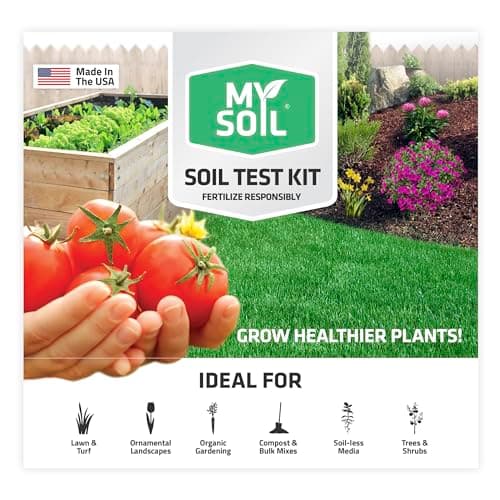 Top pickMySoil Soil Test KitMail-in lab analysis, 13 plant-available nutrients plus pH | A real lab number without the state lab's paperwork | 9.0 | $31.99 - View on Amazon |
| 2 | 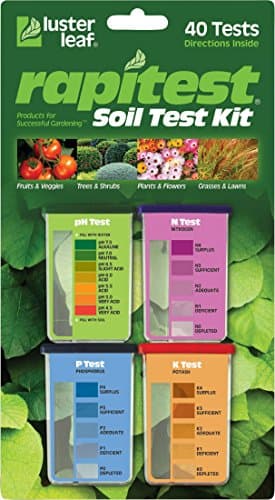 Luster Leaf 1601 Rapitest Soil Test Kit40 tests -- 10 each of pH, nitrogen, phosphorus and potash | A cheap pH reading before you plant | 8.2 | $17.48 - View on Amazon |
| 3 | 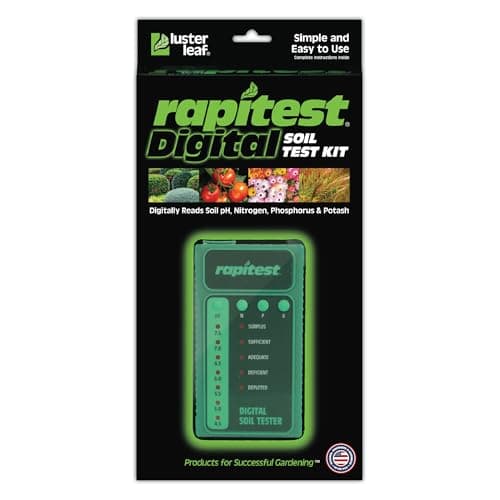 Luster Leaf 1605 Rapitest Digital Soil Test KitSame capsule chemistry, LED comparator reads the color for you | Taking the color guessing out of the capsule test | 8.0 | $21.95 - View on Amazon |
| 4 | 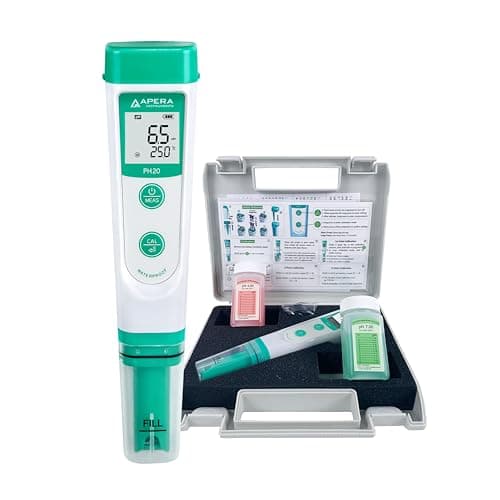 Apera Instruments PH20 Waterproof pH TesterPlus or minus 0.1 pH accuracy, waterproof, auto-calibration | A pH number you can actually trust | 8.5 | $56.65 - View on Amazon |
| 5 | 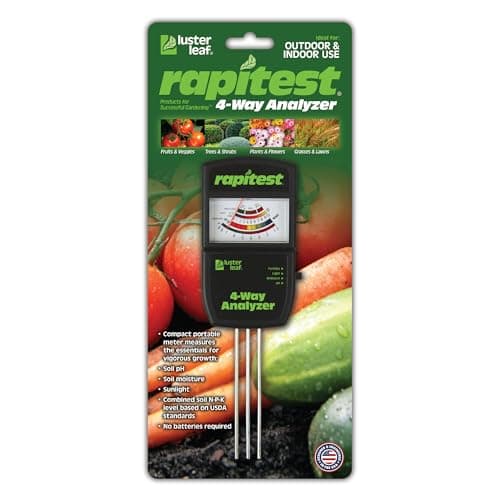 Luster Leaf 1880 Rapitest Electronic 4-Way AnalyzerProbe meter reading pH, light, moisture and fertility | Quick moisture and light checks around the garden | 7.4 | $26.50 - View on Amazon |
#ad We may earn a commission - Price as of November 3, 2026
Scores are our own editorial judgment, formed from published specifications and independent sources. They are not aggregated customer ratings, and they are not the result of hands-on testing, which we do not currently do. See how we choose.
The three kinds of kit, and what each can tell you
| Method | What it gives you | Trust it for | Cost bracket |
|---|---|---|---|
| Extension or mail-in lab | Measured nutrient levels, pH, lime requirement, quantities to apply | Any decision involving money | Low to moderate, per sample |
| Capsule chemistry kit | Color bands for pH, N, P and K | An annual pH check and spotting an outlier bed | Very low |
| Digital capsule kit | The same bands, read electronically | Consistency between repeat tests | Low |
| Calibrated pH pen | A numeric pH with a stated tolerance | Acting on pH -- lime, sulfur, acid-loving crops | Moderate |
| Probe meter | Relative moisture, light, rough pH and conductivity | Moisture and light only | Very low |
The pattern is consistent: the cheaper the test, the wider the band it reports. That is not a reason to avoid cheap kits -- a pH that is wildly wrong shows up on any of them -- but it is a reason not to buy fertilizer on the strength of one.
Taking a sample that means something
Most bad test results are bad samples. A single trowelful from one corner of one bed tells you about that corner. Extension sampling guidance is specific, and it takes about ten minutes to follow.
- 1
Sample to the depth the roots use
Penn State's instruction for gardens is a slice or core 6 to 8 inches deep -- lawns are shallower at 4 inches. In a raised bed, that is well into the mix rather than the top inch of mulch.
- 2
Take 8 to 10 cores per bed and combine them
Random spots across the bed, mixed together in a clean plastic bucket. The combined sample is what gets tested; it represents the bed instead of one lucky spot.
- 3
Test beds separately if you filled them differently
A bed that got bagged raised bed mix and one that got the bulk topsoil delivery are two different soils. One combined sample across both averages away the thing you are trying to find.
- 4
Skip the unusual spots
Not where the compost pile stood, not the strip where ash or lime was spilled, not within a few inches of pressure-treated timber. Those spots are real but they are not the bed.
- 5
Dry it before posting
Air dry on a tray out of direct sun. Wet soil in a mailer arrives as a sealed anaerobic lump and some labs will reject it.
- 6
Label it with the crop you intend to grow
Lab recommendations are crop-specific. Vegetables, blueberries and a lawn get three different answers from the same soil.
How often to test
Extension guidance for in-ground soils is to test sandy-textured soils every two to three years and clay soils every three to four, with an extra test any time problems appear during the season.
A raised bed is closer to the sandy end of that range than the clay end. The mixes used in beds are deliberately light and free-draining, which is the same property that lets nutrients leach out with every watering, and the bed is also being cropped harder than open ground. Testing every two years is a reasonable rhythm, with a test in any year a bed underperforms for no obvious reason.
Timing matters more than frequency. Test in fall, not spring. Lime takes months to change pH, so a fall test leaves time to apply it and have it work before planting; a test in April tells you what you should have done in October.
pH: the reading that decides the others
If you only ever measure one thing, measure pH. It governs whether the nutrients already present in the bed are available to a plant at all -- a bed can be well supplied with phosphorus and still show a deficiency because the pH has drifted far enough to lock it up.
Most vegetables sit comfortably in a mildly acidic to neutral range, and the exceptions are the ones worth knowing: blueberries want distinctly acid soil and will sulk at a pH that suits beans perfectly. That single fact is why a blueberry bed should be tested and managed separately -- see the best raised bed for blueberries for how to keep that bed separate from the rest.
Changing pH is slow in both directions. Lime raises it over months; elemental sulfur lowers it over months. Neither is a planting-week job, and both want a measured starting number rather than a guess, which is the case for a lab test or a calibrated pen over a probe.
What to do with the result
| Result | What it usually means | Sensible response |
|---|---|---|
| pH below the crop's range | Acidic mix, or acidic irrigation water over time | Lime in fall, at the rate the report gives, then retest next year |
| pH above the crop's range | Alkaline fill, or hard water | Elemental sulfur, slowly; choose crops that tolerate it meanwhile |
| Phosphorus high, everything else fine | Years of compost or manure | Stop adding P sources; use a low-phosphorus feed |
| Potassium low | Heavy fruiting crops with no replacement | A potassium source at the recommended rate before the next crop |
| Organic matter falling | Decomposition outpacing the compost going in | More compost annually; see refreshing the mix |
| Everything adequate | The bed is fine | Add nothing. A test that says do nothing has paid for itself |
That last row is the one people forget. The most common outcome of a first soil test on a well-made raised bed is that nothing needs adding, and the money saved on unnecessary fertilizer usually covers the test. Do you need to fertilize raised beds is the companion question, and the best fertilizer for raised beds is where to start if the answer turns out to be yes.
If the report shows organic matter sliding and nutrients broadly low, the fix is usually volume rather than a bottle: how to refresh raised bed soil covers the annual top-up that keeps a bed from needing rescuing.
The picks in full
Top pick
MySoil Soil Test Kit
MySoil
The only kit here that produces a number a soil scientist would act on: you mail a sample to a lab and get back the nutrient levels and a fertilizer recommendation.
There are two kinds of soil test and they are not comparable. A home kit runs a color reaction in a tube and gives you a band -- low, adequate, high. A laboratory extracts the nutrients chemically and measures how much of each one is actually available to a plant. This is the second kind, posted.
What you get back is the list a fertilizer decision actually needs: phosphorus, potassium, calcium, magnesium, sulfur and the micronutrients, plus pH, plus a recommendation expressed as an amount to apply. For a raised bed that has been in soil mix for three years and is quietly running out of potassium, that is the difference between fixing the problem and buying another bag of general-purpose feed.
The honest caveat sits in the skip line above. Most state extension services run the same class of test for home gardeners, often for less money, and their recommendations are calibrated to the soils of your region. Check yours first. This kit is the right buy when there is no accessible local program, or when you want the result without the forms.
What works
- Laboratory chemistry rather than a color chart, which is the difference between data and a hint
- Covers micronutrients that no home kit measures at all
- Recommendations come as quantities to apply, not just high or low
- Register, fill, mail -- no forms to print and no check to write
- Results are stored online, so you can compare next season's test against this one
What does not
- One sample per kit, so testing three beds separately costs three times as much
- Your state extension lab usually does the equivalent test for less
- You wait roughly a week rather than getting a reading in the garden
- Recommendations are generic to the crop you select, not to your local soil type
Skip it if: your state extension service runs a home garden soil test. That is the same kind of analysis, usually cheaper, and the recommendations are written for your region's soils.
| Type | Mail-in laboratory analysis |
|---|---|
| Reports | 13 plant-available nutrients plus pH (manufacturer) |
| Includes | Nitrogen, phosphorus, potassium, calcium, magnesium, sulfur and micronutrients |
| Postage | Prepaid return mailer included |
| Samples | One per kit -- a second bed means a second kit |
| Turnaround | Roughly a week in practice; varies with mail and lab load |
| Output | Online report with fertilizer recommendations |
A cheap pH reading before you plant
Luster Leaf 1601 Rapitest Soil Test Kit
Luster Leaf
The classic capsule kit: cheap, genuinely useful for pH, and worth owning as long as you treat the nutrient readings as a hint rather than a measurement.
Judge this kit on what it is for. As a pH check it is genuinely useful: pH decides whether the nutrients already in your bed are available to the plant at all, it drifts over time, and a reading in the wrong band explains more mystery failures than any nutrient deficiency.
As a nutrient test it is a rough indicator. The chemistry gives you a color band rather than a number of parts per million, and the nitrogen result in particular is the hardest to trust -- soil nitrogen is mobile and changes with temperature, rainfall and what the microbes are doing this week, which is why laboratory reports for gardens often focus on phosphorus, potassium and pH instead.
Used sensibly it is still worth the shelf space. Test the pH of each bed in spring, keep the numbers, and watch the trend. If one bed drifts while the others do not, that is a real signal, and it cost a few dollars to find.
What works
- Costs less than a bag of compost and tells you your pH, which is the reading that matters most
- Four tests per bed means you can compare one bed against another in an afternoon
- No batteries, no calibration, nothing to go flat
- Refills are cheap, so it stays useful for years
- Good enough to catch a genuinely wrong pH, which is the error worth catching
What does not
- Color matching is subjective, and two people reading the same tube will often disagree
- The nitrogen reading is the least reliable of the four -- soil nitrogen changes week to week
- Bands are broad: low, adequate and high, with no quantity to apply
- Capsules deteriorate with age, so an old kit reads worse than a new one
Skip it if: you want to know how much fertilizer to apply. Color-chart bands tell you roughly where you are, not what to add.
| Type | Capsule chemistry with color comparator |
|---|---|
| Tests | 40 total -- 10 each of pH, N, P and K |
| Method | Soil and water in a chamber, capsule added, color matched to a chart |
| Reading time | Minutes |
| Consumables | Refill capsules sold separately |
| Also includes | pH preference list for common plants |
Taking the color guessing out of the capsule test
Luster Leaf 1605 Rapitest Digital Soil Test Kit
Luster Leaf
The capsule kit for anyone who finds color charts maddening: identical chemistry, but an electronic comparator decides the shade instead of your eyes.
The weakness of a capsule kit is not usually the chemistry, it is the person holding the tube up to the window. Color matching under kitchen light, garage light and spring sunlight produces three different answers, and the bands are close enough together that it matters.
This version puts the tube in a lighted chamber and reads the color electronically, which makes repeat tests comparable. That is worth something if you intend to track pH across several beds and several seasons, because a trend is only meaningful if the readings are taken the same way each time.
What it does not do is turn a band into a number. If you want parts per million and a recommendation in pounds per hundred square feet, that is a laboratory test, and no home comparator will substitute for it.
What works
- Removes the subjective part of a capsule test, so repeat readings agree with each other
- Lighted chamber makes a reading possible in a dim shed or garage
- Same cheap refills as the manual kit
- Easier to use with poor color vision, which the chart version is genuinely hard for
- Step-by-step prompts make a first test straightforward
What does not
- The underlying chemistry is unchanged -- this is more consistent, not more accurate
- Needs batteries, which is one more thing to find in March
- Costs several times the manual kit for the same four readings
- Still gives bands rather than an amount of fertilizer to apply
Skip it if: you are comfortable reading a color chart. The chemistry underneath is the same, so the extra money buys consistency, not accuracy.
| Type | Capsule chemistry with digital color comparator |
|---|---|
| Measures | pH, nitrogen, phosphorus and potash |
| Readout | Electronic comparator with lighted test chamber |
| Power | Battery operated |
| Consumables | Capsule refills, as the manual kit |
| Reading time | Minutes |
A pH number you can actually trust
Apera Instruments PH20 Waterproof pH Tester
Apera Instruments
The accurate way to measure pH at home: calibrate it against buffer solutions, read a soil slurry, and get a number rather than a color band.
If you are going to act on pH -- add lime, add sulfur, change what you plant where -- it is worth measuring properly. A calibrated pen does that: two or three buffer solutions set it against known values, and then the reading it gives is a number with a stated tolerance rather than a shade of orange.
The method matters as much as the meter. Mix soil with distilled water at roughly equal parts by volume, stir, let it settle for a few minutes, then read the liquid above the sediment. Tap water has its own pH and will shift the result, which is the commonest way a good meter gives a bad answer.
Two maintenance rules decide whether it lasts: keep the electrode wet in storage solution between uses, and recalibrate regularly rather than once at purchase. A pen that has been dry in a drawer since last spring is not a precision instrument any more.
What works
- Gives a numeric pH rather than a band, so small changes between seasons are visible
- Calibrates against known buffers, which is what makes a reading trustworthy
- Works on anything liquid -- a soil slurry, hydroponic solution or compost tea
- Fast enough to test several beds in one session
- Replaceable buffers keep it accurate for years
What does not
- Requires making a slurry with distilled water -- it does not go straight in the ground
- The electrode must be stored wet in storage solution or it dies
- Calibration is a habit, not a one-time task; an uncalibrated pen is no better than a probe meter
- Measures pH only, so it tells you nothing about nutrients
Skip it if: you only test once a year. A calibrated pen is overkill for an annual check, and the capsule kit or a lab test costs far less.
| Accuracy | Plus or minus 0.1 pH (manufacturer) |
|---|---|
| Calibration | Automatic, against standard buffer solutions |
| Rating | Waterproof body, floats |
| Method | Soil and distilled water slurry, settled, then read |
| Included | Buffer solution sachets and storage cap in the kit version |
| Electrode | Glass electrode -- store wet, never dry |
Quick moisture and light checks around the garden
Luster Leaf 1880 Rapitest Electronic 4-Way Analyzer
Luster Leaf
Useful for two of the four things it claims: moisture and light are worth checking with a probe, while the pH and fertility readings should not drive a buying decision.
Probe meters are the most-bought and least-trusted category in soil testing, and the honest position is in the middle. What they do well is relative measurement: this end of the bed is wetter than that end, this corner gets half the light the other does. Those are real, useful answers and they cost almost nothing to obtain.
What they do badly is absolute chemistry. A pH reading from a pair of dissimilar metal probes depends on how wet the soil is and how much of the probe is in contact with it, so the same spot can read differently an hour later. The fertility scale is a conductivity measurement, which responds to dissolved salts in general rather than to the nutrients a plant needs.
So buy it for the moisture and light functions, use the pH function only as a very rough screen, and make any decision that involves money -- lime, sulfur, a fertilizer program -- on a capsule test or a laboratory report instead.
What works
- The moisture reading is genuinely useful and the quickest way to settle a watering argument
- The light meter answers the siting question for a bed or a houseplant honestly
- Instant readings, nothing to mix, nothing to wait for
- Cheap enough to keep in the shed as a second opinion
- No consumables at all
What does not
- Probe pH readings are unreliable compared with a chemical test or a calibrated pen
- The fertility reading measures conductivity, which is not the same as available nutrients
- Readings change with how damp the soil is and how firmly the probe is pushed in
- Dirty or corroded probes drift, and most people never clean them
Skip it if: you are buying it for pH. Probe-style pH readings vary with soil moisture and contact, and a capsule kit or a pH pen is the better answer.
| Type | Direct-insert probe meter |
|---|---|
| Readings | pH, light level, moisture and fertility |
| Use | Insert in moist soil, read, clean the probe after each use |
| Depth | Reads at probe depth only, not through the profile |
| Speed | Immediate |
| Consumables | None |
Common questions
Are home soil test kits accurate?
For pH they are useful; for nutrients they give broad bands rather than measurements. Capsule kits match a color to a chart, which is enough to catch a clearly wrong pH or a bed that differs from its neighbors, but not enough to calculate how much fertilizer to apply. For that you need a laboratory test -- either through your state extension service or a mail-in kit.
How deep should I take a soil sample from a raised bed?
Six to eight inches for a garden, according to Penn State Extension, rather than the four inches used for lawns. Take 8 to 10 cores from random spots across the bed and mix them together in a clean bucket; that combined sample is what you test.
How often should I test raised bed soil?
Every two years is a reasonable rhythm. Extension guidance is every two to three years for sandy soils and three to four for clay, and raised bed mixes behave more like the sandy end -- light, free-draining and cropped hard. Also test any year a bed underperforms without an obvious cause.
When is the best time to test soil?
Fall. Lime takes months to change soil pH and elemental sulfur is slower still, so a result in October can be acted on and have taken effect by planting time. A test taken in April mostly tells you what you should have done the previous autumn.
Do soil test kits measure nitrogen reliably?
Not really. Soil nitrogen is mobile and changes with temperature, rainfall and microbial activity, which is why standard garden laboratory reports concentrate on phosphorus, potassium, calcium, magnesium and pH. A home kit's nitrogen band reflects conditions on the day as much as the soil's fertility.
Is a probe-style pH meter good enough?
For moisture and light, yes -- those are the readings a probe does well, and they are genuinely useful. For pH, no: the reading depends on soil moisture and probe contact, so the same spot can read differently an hour later. Use a capsule kit or a calibrated pH pen before spending money on lime or sulfur.
Sources
Factual claims on this page are backed by the published sources below, and product specifications are the manufacturers’ own. Where a figure is not published, we say so rather than estimating it.