Step 5 - Greenhouses
The Best Greenhouse Shelving and Staging
A greenhouse is measured in shelf area, not floor area. Here is how much shelving a kit actually needs, the one dimension most cheap staging gets wrong, and what to buy.
Janet H. - the hands-on owner behind Janet Media Group.
Published
This page contains affiliate links. If you buy through them we may earn a commission at no cost to you, and it never decides what we recommend. How this site is funded.
A greenhouse kit arrives as an empty box with a transparent roof. The floor is the least useful surface in it -- cold, dark at the edges, and awkward to work at -- and the thing that turns the volume into growing space is staging. It is the cheapest upgrade in the greenhouse aisle and the one most people under-buy in their first year.
If you want the short answer: for a standard 6 ft wide hobby kit, the EAGLE PEAK double four-tier staging is the most shelving per order in a size that fits, and the Ohuhu extra-wide four-tier pair is the pick if you run standard 1020 seed trays, because a 12 inch deep shelf actually supports one. The Panana two-pack is the budget pick and gets both sides of a small kit shelved for very little. If you are putting heavy wet pots or bags of mix on it, skip greenhouse-branded staging entirely and buy Amazon Basics wire shelving, which is the only unit here that publishes a per-shelf load rating. And if your back is the problem rather than your space, the Palram Canopia work bench is a waist-height surface rather than another rack.
How we chose
We have not run a greenhouse staging trial, and there is no point pretending otherwise. What this page does is take the bench and walkway guidance published by University of Georgia Extension for hobby greenhouses, work out which dimensions it implies for a backyard kit, and then check currently purchasable units against them.
- Depth before anything else. A standard 1020 tray is roughly 21 x 11 inches. A shelf under 11 inches deep leaves every tray you own overhanging, which is the single most common reason staging gets replaced.
- A reach you can service. Extension's rule for side benches is that they should be no wider than you can reach across -- about 2 ft for some people, perhaps 3 ft for others. Deeper than your reach and the back row never gets watered properly.
- Height that clears the eaves. Hobby kits slope. A 42 inch rack fits against the side wall of almost any kit; a 65 inch one needs the straight section or the center line.
- A load rating if the maker will publish one. Wet pots are heavy. Most greenhouse-branded staging publishes no capacity at all, which is itself information.
- Rust behavior in a wet, warm box. Everything steel in a greenhouse eventually meets a scratch. Powder coat over budget steel is fine; it just needs touching up rather than ignoring.
- In stock, from a real listing. Every unit here was confirmed as currently purchasable before it went on the page.
Quick picks
| # | Product | Best for | Score | Price |
|---|---|---|---|---|
| 1 | 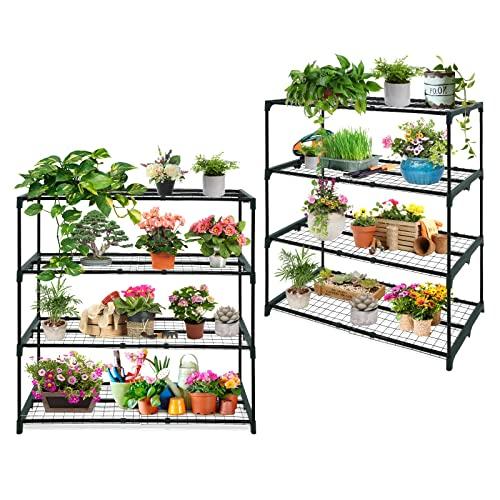 Top pickEAGLE PEAK Double 4-Tier Greenhouse StagingTwo 4-tier racks, 42 x 17 x 42 in each | Doubling usable space | 8.2 | $74.99 - View on Amazon |
| 2 | 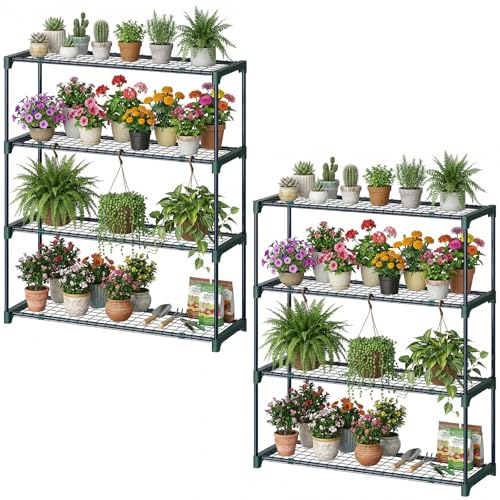 Ohuhu Extra-Wide 4-Tier Greenhouse Shelves, 2 Pack35 x 12 x 42 in per rack, 2 racks per order | Shelves a 1020 tray actually fits on | 8.6 | $48.44 - View on Amazon |
| 3 | 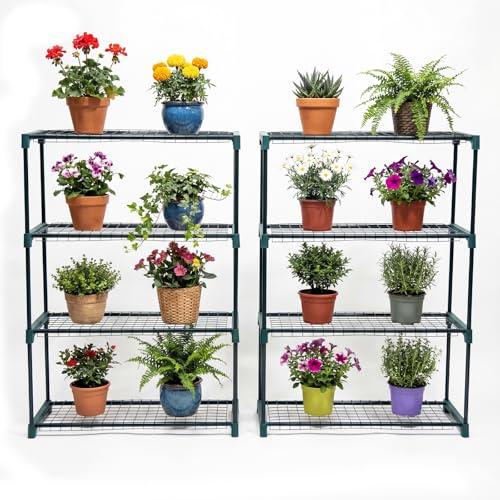 Panana 4-Tier Greenhouse Staging, 2 PackTwo 4-tier steel racks in one box | Shelving both sides for the least money | 8.0 | $42.54 - View on Amazon |
| 4 | 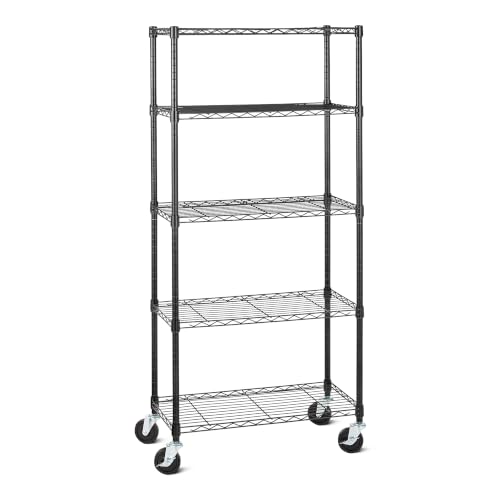 Amazon Basics 5-Shelf Wire Shelving on Casters300 lb per shelf, 30 x 14 x 64.75 in, adjustable | Heavy wet pots and bags of mix | 8.3 | $45.87 - View on Amazon |
| 5 | 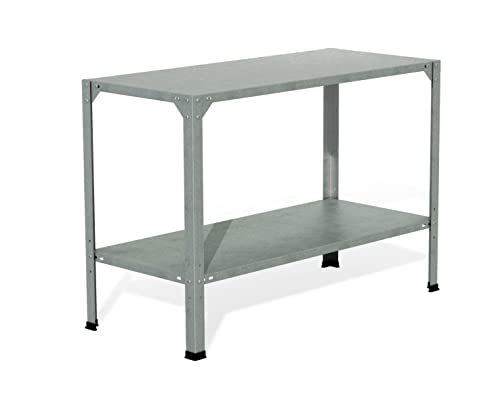 Palram Canopia Metal Work Bench44.8 x 19.6 x 31.4 in metal bench with a lower shelf | Potting up without bending over | 8.2 | $104.00 - View on Amazon |
#ad We may earn a commission - Price as of November 24, 2026
Scores are our own editorial judgment, formed from published specifications and independent sources. They are not aggregated customer ratings, and they are not the result of hands-on testing, which we do not currently do. See how we choose.
How much shelving does a greenhouse actually need?
There is a published answer to this, and it is more useful than it sounds. University of Georgia Extension's guidance for sizing a hobby greenhouse is that most 6 inch pot plants need a minimum of 1 square foot of bench space, so 100 plants needs a minimum of 100 square feet of bench area plus the walkways -- and that in a working greenhouse, roughly two-thirds of the floor plan is bench and one-third is walkway and aisle.
Run that backwards for a typical 6 x 8 ft kit. Forty-eight square feet of floor, two-thirds of which wants to be bench, is about 32 square feet of bench footprint -- and because staging is tiered, two or three shelves over that footprint multiply it. That is why a modest kit can hold a startling number of 4 inch pots and seed trays, and why an unstaged greenhouse feels full with twenty plants in it.
The dimension cheap staging gets wrong
Depth. Nearly every budget greenhouse rack is built narrow, because narrow is cheap to ship and makes the rack look tall and generous in the photograph. Then the trays arrive -- and if you have not bought those yet, the best seed starting trays covers the standard the shelves have to fit.
| Shelf depth | What it holds properly | What hangs over |
|---|---|---|
| Under 10 in | Small pots, 3 in modules, tools | Any standard 1020 tray |
| 10 to 11 in | A 1020 tray, just | Tray lips and anything in a saucer |
| 12 in | A 1020 tray flat, with the lip supported | Nothing in normal use |
| 14 in and up | Two trays staggered, or a bag of mix | Your reach, eventually |
The second half of the depth question is reach, and Extension is specific about it: a side bench serviced from one side should be no wider than you can comfortably reach across -- around 2 ft for some people and as much as 3 ft for others -- while a bench you can walk around can be as wide as 6 ft. A 24 inch deep shelf against the wall of a 6 ft kit is at the limit of that, and the back of it is where plants go to be forgotten.
Leave room to walk
The other thing people get wrong is shelving both sides of a narrow kit and leaving a slot they have to sidle down. Extension's walkway figures are a useful sanity check: an 18 or 19 inch walk is enough if it is only a place to stand while working the benches, and 24 to 30 inches is what you want for comfortable passage or for getting a wheelbarrow in.
In a 6 ft wide kit, two 12 inch racks leave about 4 ft of aisle, which is generous. Two 24 inch benches leave 2 ft, which is workable. Two 30 inch benches leave a foot, which is not. Measure the internal width -- not the external kit size -- before buying a pair of anything. What size greenhouse do I need works the same arithmetic from the other direction.
Staging, shelving and a bench are three different things
| Format | What it is for | Typical height | Buy it when |
|---|---|---|---|
| Tiered staging | Maximum growing surface along a wall | About 42 in | The greenhouse is full and you have not added shelves yet |
| Wire shelving | Heavy, wet or bulky things | 60 to 65 in | Pots, mix bags and watering cans are living on the floor |
| Work bench | Potting up at standing height | About 31 in | You are doing all the potting outside because there is no surface |
| Plant stand | A display of a few pots | Varies | Honestly, rarely in a working greenhouse |
Most first greenhouses need staging and nothing else. The bench becomes obvious in year two, usually on the day you catch yourself kneeling on the floor to fill modules because every horizontal surface already has a tray on it.
Load: the specification almost nobody publishes
A 10 inch pot of wet mix is heavy, and a tray of 50 freshly watered modules is heavier than it looks. Yet most greenhouse staging is sold without any stated capacity, while garage wire shelving routinely publishes a per-shelf figure -- the Amazon Basics unit here states 300 lb per shelf.
That gap is worth knowing about rather than worrying about. Light tiered staging is entirely adequate for seed trays, modules and 4 inch pots, which is the great majority of what a spring greenhouse holds. It is the wrong furniture for a row of 5 gallon containers, a stack of mix bags or anything you would describe as a load. When the job is heavy, buy the rack that tells you what it can take.
Rust, light and the rest of the practical detail
- Treat every scratch. A greenhouse is warmer and far wetter than a garage. Powder-coated steel is fine in it, but a chipped coat rusts fast, and the usual first casualty is the shelf edge you drag trays across.
- Open tiers over solid ones, mostly. Open wire or slatted shelves drain and let some light through to the tier below. Solid shelves hold spilled water against pot bases, which is how fungus gnats set up.
- Put a tray under small pots on wire. Anything with a base narrower than the gaps will tip. A cheap 1020 flat solves it and catches the drips.
- Level the feet. Gravel floors move. A rack that rocks will eventually walk a tray off its top shelf.
- Keep the south side clear-ish. Staging against the sunniest wall shades the floor beneath it. In a small house that is usually fine; in a house where you also want a ground bed, think about which side gets the racks. Where to put a greenhouse covers the orientation question that sits behind this.
What to buy, by greenhouse
- 1
A 6 x 4 or 6 x 6 kit, or a lean-to
One double unit of four-tier staging against the long wall, and nothing else at first. In a narrow lean-to, measure before you commit to a pair -- the format tops out at a single or double row of benches. Lean-to greenhouse kits covers how little width these have to work with.
- 2
A 6 x 8 kit, the common size
Staging down both sides, 12 inches deep, leaving roughly 4 ft of aisle. That is the configuration that makes a standard kit feel twice its size, and it is where the two-pack units earn their keep.
- 3
An 8 ft wide or larger kit
Benches down both sides plus a center run, or staging on one side and a work bench on the other. At this width you can afford a 24 inch deep bench and still walk a barrow down the middle.
- 4
A greenhouse that doubles as storage
One wire shelving unit with a published load rating for bags, cans, pots and the heater, plus staging for plants. Mixing the two jobs on light staging is what bends shelves.
- 5
A cold frame or a pop-up tunnel
Neither takes freestanding staging. Use the ground, a paving slab for warmth, and a tray to carry modules in and out. Cold frames explains what that format can and cannot do.
Setting it up so it stays useful
Assemble staging outside the greenhouse and carry it in. Most of these racks are bolt-together frames that need to be squared up on a flat surface, and squaring one up inside a 6 ft wide kit while trying not to put an elbow through a polycarbonate panel is a bad hour.
Then set the heights before you load it. On an adjustable unit, give yourself one bay tall enough for a propagator or a bag of mix, and keep the remaining spacings tight -- seed trays and 4 inch pots do not need 14 inches of headroom, and every inch of unused vertical space is a tier you did not fit.
One last point that makes a real difference in spring: leave the top tier for seedlings and keep it clear of anything tall. The first thing to go wrong in a staged greenhouse is a tomato on the middle shelf shading the tray of brassicas behind it. If you are starting seeds in there, when to start seeds in a greenhouse sets the timings that stop you needing more shelf than you have.
The picks in full
Top pick
EAGLE PEAK Double 4-Tier Greenhouse Staging
EAGLE PEAK
A greenhouse is measured in shelf area, not floor area, and staging is the cheapest way to double what you have.
The first thing most new greenhouse owners discover is that a 6 x 8 footprint is smaller than it looked in the listing. Staging is the fix: three tiers of trays in the floor space of one.
Look for slatted or mesh tops rather than solid ones. Water has to drain and air has to move, or the trays on the shelf become the place fungus gnats and damping-off start.
Plan for the seasonal switch. Staging is right in February and March when the greenhouse is full of seed trays, and comes out in May when tall crops go in and the shelves would only shade them.
What works
- Two racks per order, which is both sides of a 6 ft kit in one purchase
- A 17 in deep tier takes a standard 1020 tray with the lip fully supported
- Stops at 42 in, so it fits under the sloping eaves of a hobby kit
- Comes apart and stores when you switch to tall crops
What does not
- Upper tiers shade the lower ones -- seedlings belong on top
- No published per-shelf load rating, so treat it as staging rather than storage
- Powder-coated steel rusts at any scratch in a wet house
- Two racks in a narrow kit leave a tight aisle; measure the internal width first
Skip it if: you are growing tall crops to maturity in the ground inside. Staging and mature tomatoes compete for the same light.
| Type | Double tiered staging, 4 tiers per rack |
|---|---|
| Dimensions | 42 x 17 x 42 in per rack (manufacturer) |
| Depth | 17 in -- takes a standard 1020 tray flat |
| Material | Powder-coated steel, green finish |
| Assembly | Bolt-together; build it outside and carry it in |
Shelves a 1020 tray actually fits on
Ohuhu Extra-Wide 4-Tier Greenhouse Shelves, 2 Pack
Ohuhu
The width problem solved: a 12 inch deep, 35 inch wide shelf takes a standard seed tray without it hanging over the edge, and you get two racks.
Almost every complaint about cheap greenhouse staging is really a complaint about depth. A standard 1020 tray is about 21 by 11 inches, and a shelf under 11 inches deep means every tray you own sits with its front edge in mid-air.
This rack publishes 35 by 12 inches per tier, which is the first depth where a tray sits flat and a second tray sits beside it lengthwise. Four tiers of that, twice, is a serious amount of growing surface for a small kit.
The height is worth noticing too. At 42 inches the top tier is at a comfortable working height and clears the sloping eaves of most hobby greenhouses, where a 60 inch unit has to live in the middle of the floor.
What works
- Twelve inch depth takes a 1020 tray with the lip supported rather than overhanging
- Published dimensions, which several competing listings do not give at all
- Two racks per order at a mid-range price
- Height stops at 42 in, so the top shelf does not shade everything under it in a low-eaved kit
What does not
- Wider racks eat the floor path -- measure your interior width before ordering two
- Rustproof is the maker's word, not a coating specification
- Open wire-style tiers let small pots tip; a tray underneath fixes it
- Fixed shelf spacing, so a tall tomato plant is not going on a middle tier
Skip it if: your greenhouse is under 4 ft wide inside. Two racks of this depth will leave you sidling, not walking.
| Dimensions | 35 x 12 x 42 in per rack (manufacturer) |
|---|---|
| Tiers | 4 per rack |
| Quantity | 2 racks per order |
| Frame | Rustproof metal, per the maker |
| Portability | Lift-out design for cleaning or winter storage |
Shelving both sides for the least money
Panana 4-Tier Greenhouse Staging, 2 Pack
Panana
Two four-tier racks for roughly what one mid-range unit costs, which is the cheapest way to get staging down both sides of a small kit.
Staging is the accessory that changes a greenhouse the most per dollar, and the usual mistake is buying one rack when the structure has two sides. This is two racks of four tiers each, which is the whole interior of a small kit sorted in a single order.
The trade for the price is depth. These are narrow racks, so trays overhang and heavy wet pots want to sit on the lower tiers. For seed trays, module trays, cuttings and small pots -- which is what a spring greenhouse is actually full of -- that is a fair trade.
Treat any scratch in the powder coat as something to touch up. A greenhouse is a wet, warm place and budget steel finds rust there faster than it does in a garage.
What works
- Two racks per order, so a 6 x 8 kit gets both sides done in one purchase
- Steel frame rather than the plastic shelving sold at a similar price
- Narrow footprint leaves a usable path down the middle of a small greenhouse
- Light enough to move out for a deep clean between seasons
What does not
- Shallow shelves: a standard 1020 tray will hang over the front edge
- Budget steel and powder coat -- expect surface rust at any scratch in a damp house
- Thin shelves flex under wet pots, so the load wants spreading rather than stacking
- No published per-shelf load rating, which is itself a signal about the capacity
Skip it if: you need a deep shelf. Narrow staging is what makes this price possible, and a 1020 tray will overhang it.
| Tiers | 4 per rack |
|---|---|
| Quantity | 2 racks per order |
| Frame | Powder-coated steel |
| Assembly | Bolt-together, no tools claimed by the maker |
| Use | Greenhouse, shed or garage |
Heavy wet pots and bags of mix
Amazon Basics 5-Shelf Wire Shelving on Casters
Amazon Basics
Not greenhouse-specific and all the better for it: a published 300 lb per-shelf rating and adjustable tiers, on wheels so it rolls out of the way.
Nothing about this is designed for a greenhouse, which is exactly why it belongs on the list. Greenhouse staging is usually sold on looks and shelf count; wire shelving is sold on load rating, and a wet 10 inch pot is heavier than most staging expects.
Three hundred pounds per shelf, adjustable spacing and casters together solve the problems that make people replace their first staging: it sagged, the shelf spacing was wrong for what they grow, and they could not get behind it to clean.
The limit is headroom. At 64.75 inches tall it needs the straight section of a wall or the center line of the house, and in a small lean-to it will not fit at all.
What works
- A published per-shelf load rating, which greenhouse-branded staging rarely gives
- Adjustable tiers, so you can set one bay tall enough for staked tomatoes or a mix bag
- Wheels mean it rolls out for cleaning instead of being dismantled
- Open wire shelves drain and let light through to the tier below
What does not
- Tall: in a hobby greenhouse it only works against the straight part of the wall
- Epoxy over steel is a garage finish, not a marine one -- it will mark in constant damp
- Wire shelving needs a liner or a tray under small pots, which tip through the gaps
- Casters make it mobile and also slightly wobbly on a gravel floor
Skip it if: your greenhouse has sloping eaves and no center headroom. At nearly 65 inches tall this only fits down the middle or against a straight wall.
| Shelves | 5, adjustable in 1 in increments |
|---|---|
| Load rating | 300 lb per shelf (manufacturer) |
| Dimensions | 30 x 14 x 64.75 in |
| Casters | Four 4 in wheels included |
| Finish | Black epoxy-coated steel |
Potting up without bending over
Palram Canopia Metal Work Bench
Palram Canopia
A bench rather than shelving: waist-height work surface, a shelf underneath for bags and pots, and it is built by the company that made half the greenhouses on this site.
Staging holds plants. A bench is where you work, and the two are not interchangeable: potting up a hundred modules on a 30 inch high shelf means a bent back for an afternoon.
The dimensions are the useful part. A 19.6 inch depth fits against the wall of a 6 ft wide kit and still leaves a path, and the 31.4 inch height is standing work height rather than the perching height of most plant stands.
Buy this second, not first. Fill the house with staging, and add the bench in the year you find yourself doing all the potting on the lawn because there is nowhere inside to put a bag of compost down.
What works
- Waist-height surface, which is the difference between potting up standing and kneeling
- Metal top wipes clean and does not rot the way a timber bench does in a humid house
- Lower shelf takes the mix bags that otherwise sit on the floor
- Made by a greenhouse manufacturer, so the depth suits a 6 ft wide kit
What does not
- One surface for the floor area of two shelving racks -- it is not a space multiplier
- No published load rating for the top
- Metal top is noisy and cold to work on compared with timber
- Costs more than any of the staging here, for less growing surface
Skip it if: floor space is the thing you are short of. A bench occupies the footprint of two racks and gives you one work surface.
| Dimensions | 44.8 W x 19.6 D x 31.4 H in (manufacturer) |
|---|---|
| Work height | 31.4 in -- standing work height for most adults |
| Structure | Metal frame and top, silver finish |
| Storage | Lower shelf under the work surface |
| Fit | Sold as a greenhouse accessory, also usable outdoors |
Common questions
How deep should greenhouse shelving be?
Twelve inches is the useful minimum if you use standard 1020 seed trays, because a tray is about 11 inches across and anything shallower leaves it overhanging. At the other end, University of Georgia Extension's guidance for a bench serviced from one side is that it should be no wider than you can comfortably reach across -- about 2 ft for some people and up to 3 ft for others.
How much bench space does a greenhouse need?
Extension's figure is a minimum of 1 square foot of bench per 6 inch pot plant, and in a working hobby greenhouse roughly two-thirds of the floor area is bench with one-third as walkway and aisle. For a 6 x 8 ft kit that is about 32 square feet of bench footprint -- which tiered staging multiplies two to four times over.
Can I use garage wire shelving in a greenhouse?
Yes, and it is often the better buy for heavy items because it publishes a per-shelf load rating and adjusts in small increments. The two limitations are height -- 60 to 65 inch units only fit the straight part of a wall or the center line of a sloping kit -- and finish, since an epoxy-coated garage rack will mark in constant damp.
Should greenhouse shelves be solid or slatted?
Slatted or wire shelves for growing, in most cases. They drain, they let some light reach the tier below, and they do not hold a puddle against pot bases. The exception is the surface you pot up on, where solid is far easier to work on and to sweep clean.
Do I need staging on both sides of a 6 ft greenhouse?
Usually yes, provided you keep the shelves shallow. Two 12 inch racks in a 6 ft wide kit still leave roughly 4 ft of aisle, which is well above the 18 to 19 inches Extension treats as sufficient for standing room. Two deep benches in the same kit leave a slot you will resent by March.
What is the difference between staging and a potting bench?
Staging holds plants and is usually around 42 inches tall in several tiers. A potting bench is a single work surface at about 31 inches -- standing height -- with storage underneath. They do not substitute for one another: staging will not save your back and a bench will not double your growing area.
Sources
Factual claims on this page are backed by the published sources below, and product specifications are the manufacturers’ own. Where a figure is not published, we say so rather than estimating it.