Step 5 - Greenhouses
How to Anchor a Greenhouse to the Ground
A greenhouse is a very light box with an enormous sail area. Anchoring is not a finishing touch; it is the structural step.
Janet H. - the hands-on owner behind Janet Media Group.
Published
This page contains affiliate links. If you buy through them we may earn a commission at no cost to you, and it never decides what we recommend. How this site is funded.
Anchor a greenhouse by fixing its base rail to something heavy and fixed: a pressure-treated timber base frame pinned into the ground with rebar or ground screws, a concrete perimeter footing, or a slab with masonry anchors. On soil, the timber-frame-plus-ground-anchor approach is the usual answer and the most forgiving. Whatever the method, the load you are resisting is uplift, not sideways push -- wind over the roof lifts the whole structure, and a greenhouse that is merely sitting on a level patch will leave the yard in one piece in the first real storm.
Why uplift is the thing to design for
A kit greenhouse is aluminum and plastic. An 8 by 12 structure might weigh a couple of hundred pounds, which is nothing against the force of wind moving across a curved or pitched roof. The wind does not mainly push the greenhouse over; it reduces pressure above the roof and lifts it, exactly as it does over a wing.
That is why the anchoring has to connect the frame itself to the ground, continuously around the base, rather than just stopping the structure from sliding. Weighting the inside shelves with pots does almost nothing, because the weight is not attached to the frame.
Choosing a method for your surface
| Surface | Method | Notes |
|---|---|---|
| Bare soil or lawn | Pressure-treated timber base frame, pinned with rebar or ground screws | The standard approach. Level the frame first; the greenhouse is only as square as its base |
| Gravel pad | Timber frame on top of the gravel, pinned through into the soil below | Gravel alone holds nothing. The pins must reach undisturbed ground |
| Concrete slab | Masonry anchors or expansion bolts through the base rail | The strongest option. Mark and drill carefully; mistakes are permanent |
| Concrete perimeter footing | Anchor bolts set in the wet pour, base rail bolted down | What a permanent greenhouse ideally sits on |
| Deck or patio pavers | Bolt through to the joists, or to a weighted frame | Pavers are not an anchor. They move, and so does anything bolted only to them |
| Portable hoop or cover greenhouse | Supplied stakes plus guy ropes to separate ground anchors | Use every stake and every rope. These are the structures most often lost |
Building a timber base, step by step
- 1
Set the footprint and check it is square
Lay out the exact external dimensions from the manual and measure both diagonals. Equal diagonals means square. A base that is out by an inch makes the panels fight you for the whole build.
- 2
Level the ground, and level it again
Remove turf, rake flat, and check across both axes with a long level. A greenhouse on an out-of-level base twists, and doors on a twisted frame never close properly.
- 3
Build the frame from pressure-treated timber
Typically 4 x 4 or two courses of 2 x 6, cut to the manufacturer's base dimensions, screwed at the corners with exterior structural screws.
- 4
Pin the frame to the ground
Drive rebar through holes drilled in the timber at each corner and at intervals along each side, at least 18 inches into undisturbed soil. Ground screws or earth anchors do the same job with more holding power.
- 5
Assemble the greenhouse on the frame and bolt the base rail down
Use the fixing points the manufacturer provides. Every one of them, not the corners only -- an unfixed span in the middle of a long side is where a frame starts to peel.
- 6
Add diagonal bracing if the kit supplies it
Corner braces and roof bracing are not optional extras. They are what stops the whole frame racking into a parallelogram in a gust.
- 7
Re-check every bolt after the first month
Everything settles, and aluminum frames loosen. One pass with a wrench after a few weeks of weather is worth more than any upgrade.
Anchors, and how deep they need to go
- Rebar pins -- cheap and effective in soil. Use 1/2 inch stock, 24 to 36 inches long, driven through the timber frame and well into undisturbed ground.
- Ground screws and earth anchors -- screw-in spirals or augers, far better holding power in uplift than a straight pin, and removable.
- Masonry anchors -- for slabs. Match the anchor to the slab thickness; a thin patio slab may not hold a heavy expansion bolt.
- Auger-style dog anchors with guy ropes -- the right answer for portable cover greenhouses, used in addition to the supplied stakes, not instead of them.
- Concrete deadmen -- buried blocks with a strap up to the frame, used where you cannot pour a footing but need real holding power.
Depth matters more than the anchor type. A pin that goes 12 inches into topsoil will pull out; the same pin at 30 inches into undisturbed subsoil will not. Where the ground freezes deeply, think about whether frost heave will lift your anchors over a winter, and consider a footing rather than pins.
Siting makes anchoring easier
The best anchoring strategy starts with not putting the greenhouse in the windiest corner of the yard. A structure sheltered on its windward side by a hedge, a fence or the house experiences a fraction of the load, and permeable shelter such as a hedge is better than a solid fence, which creates turbulence on the lee side.
Orientation helps too: the shorter end into the prevailing wind presents less area. Where to put a greenhouse in your yard works through sun, shelter and access together, and the best greenhouse for high winds covers the kits with published wind ratings for sites where shelter is not available.
What to buy
The products that fit the advice above, chosen by the process on our how we choose page. We have not hands-on tested them; specifications are the manufacturers’ own.
Quick picks
| # | Product | Best for | Score | Price |
|---|---|---|---|---|
| 1 | 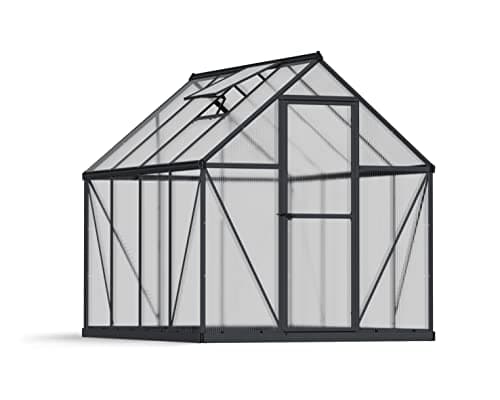 Top pickPalram Canopia Mythos GreenhouseAluminum frame, 4 mm twin-wall polycarbonate | A first real greenhouse | 9.0 | Check price on Amazon |
| 2 | 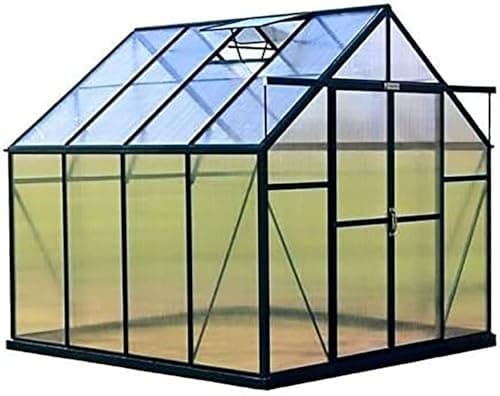 Grandio Ascent GreenhouseRated to 76 mph wind and 25 lb per sq ft snow, lifetime frame warranty | The best-engineered kit in the bracket | 9.1 | $2,199.00 - View on Amazon |
| 3 |  Quictent Portable Walk-In GreenhouseSteel tube frame with reinforced PE cover | The cheapest usable start | 7.8 | Check price on Amazon |
#ad We may earn a commission - Price as of October 17, 2026
Scores are our own editorial judgment, formed from published specifications and independent sources. They are not aggregated customer ratings, and they are not the result of hands-on testing, which we do not currently do. See how we choose.
Common questions
How do you anchor a greenhouse to the ground?
Fix the base rail to something heavy and fixed. On soil, that is normally a level pressure-treated timber base frame pinned into undisturbed ground with rebar or ground screws, with the greenhouse bolted down to it at every fixing point. On concrete, masonry anchors through the base rail do the same job.
Does a greenhouse need to be anchored?
Yes, always. A kit greenhouse is aluminum and plastic with a very large roof area, and wind lifts it rather than pushing it over. Unanchored structures are routinely lost in the first real storm, and the damage is usually total because the frame twists as it goes.
How do I anchor a greenhouse on a concrete slab?
Use masonry anchors or expansion bolts driven through the base rail into the slab, at every fixing point in the manual. Check the slab is thick enough for the anchor you have chosen -- a thin patio slab can crack around a heavy expansion bolt. Mark and drill carefully, because the holes are permanent.
Can I put a greenhouse on gravel?
Yes, and gravel makes an excellent floor because it drains. But gravel is not an anchor. Build a timber base frame on top of it and drive the pins through the gravel into the undisturbed soil underneath, or the whole assembly simply floats on a loose layer.
How deep should greenhouse anchors go?
Deep enough to reach undisturbed soil, which usually means 24 to 36 inches for rebar pins. Depth matters more than the type of anchor: a short pin in topsoil pulls straight out under uplift. Where the ground freezes deeply, consider a concrete footing instead, so frost heave does not lift the anchors over winter.
Will weighting the inside of a greenhouse hold it down?
No. Pots and bags of soil on the shelves are not attached to the frame, so the frame can lift away from them. Only a continuous mechanical connection between the base rail and a fixed, heavy base resists uplift.
Sources
Factual claims on this page are backed by the published sources below, and product specifications are the manufacturers’ own. Where a figure is not published, we say so rather than estimating it.