Step 5 - Greenhouses
Greenhouse Ventilation: What You Actually Need
More hobby greenhouse crops are lost on a sunny afternoon in April than on any night in January. This is the hardware that prevents it.
Janet H. - the hands-on owner behind Janet Media Group.
Published
This page contains affiliate links. If you buy through them we may earn a commission at no cost to you, and it never decides what we recommend. How this site is funded.
Start with an automatic vent opener. It costs less than a bag of potting mix, needs no power, and it opens the roof vent at 11am on the weekday you are at work, which is the single commonest reason a greenhouse crop dies. If the house is bigger than about 100 sq ft, or you have had a crop wilt with the vent already open, add a thermostatically controlled shutter exhaust fan -- that is the only kind of ventilation that hits the air-change rate extension guidance actually calls for. A quiet inline fan does the same job in a small kit without cutting a hole in the wall, a circulation fan fixes the still, damp air of winter that no vent can, and shade cloth removes heat at the roof before any fan has to work on it.
The thermostat is the part that turns any of it from hardware into a system, and it is the part people leave until last.
Why a hobby kit's vent is never enough
University of Georgia Extension's guidance on greenhouse ventilation sets the standard for natural venting plainly: ridge vents should be about one-fourth of the floor area, and side vents about the same again. On a 6 x 8 ft greenhouse -- 48 sq ft of floor -- that is roughly 12 sq ft of roof vent plus 12 sq ft of side vent.
Now look at what a hobby kit ships with. One hinged roof panel, commonly around 2 x 2 ft, is 4 sq ft. That is a third of the roof vent area the standard calls for and nothing at all on the sides beyond a door. The kit is not badly made; it is simply sold with the minimum, and the gap between that minimum and the standard is what the hardware on this page closes.
The same guidance warns that a greenhouse ventilated only through side vents depends on wind pressure and is usually not satisfactory. Hot air rises; it needs an opening at the top to leave through and an opening low down for cooler air to replace it. One vent in the roof and a propped door is a compromise, not a design.
Quick picks
| # | Product | Best for | Score | Price |
|---|---|---|---|---|
| 1 | 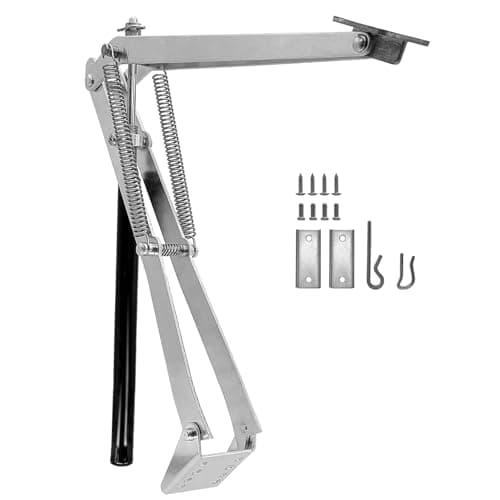 Top pickAutomatic Greenhouse Vent OpenerNon-electric heat-driven cylinder, dual spring, lifts up to about 15 lb | Venting on a weekday when nobody is home | 8.3 | $26.59 - View on Amazon |
| 2 | 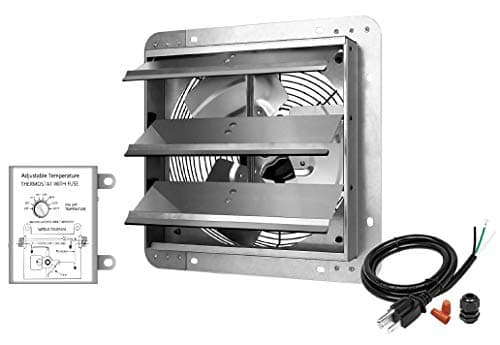 iPower 12 in Shutter Exhaust Fan with Temperature Controller940 CFM at 1600 RPM, louvered shutter, thermostat included | A real air exchange in a 6 x 8 kit and up | 8.8 | $72.99 - View on Amazon |
| 3 | 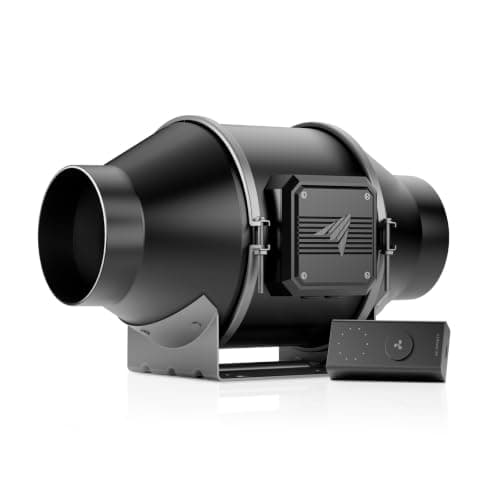 AC Infinity CLOUDLINE S4 Inline Duct Fan205 CFM, 28 dBA, EC motor with 10-speed controller | A small kit, quietly, without cutting a wall | 8.4 | $89.99 - View on Amazon |
| 4 | 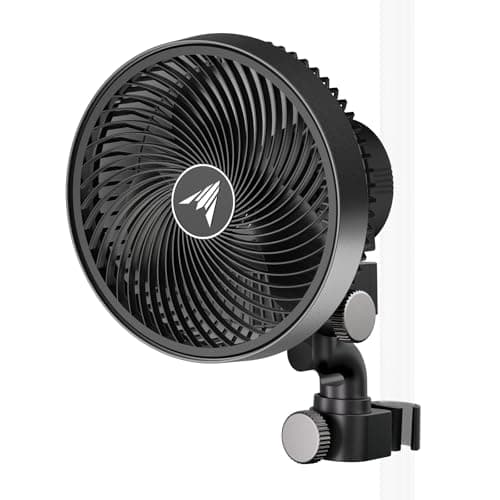 AC Infinity CLOUDRAY S6 Oscillating Clip Fan6 in oscillating clip fan, EC motor, 10 speeds, built-in timer | Moving air on days the vents stay shut | 8.3 | $49.99 - View on Amazon |
| 5 | 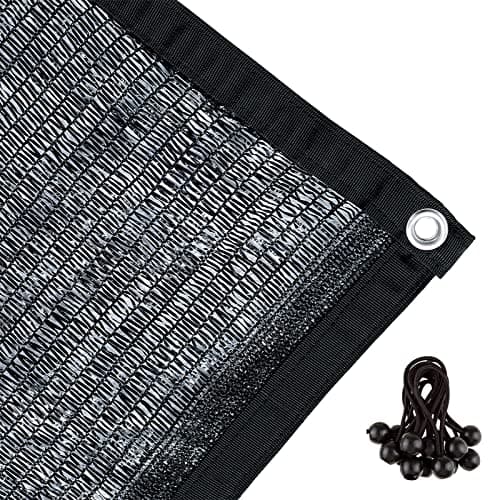 Agfabric 50% Shade Cloth with Grommets50% shade factor, grommeted edge, common sizes from 6 x 20 ft | Cutting the heat before it gets in | 8.2 | $30.39 - View on Amazon |
| 6 |  BN-LINK Digital Thermostat Controller Plug15 A / 1875 W, two-stage heat and cool outlets | Making a cheap heater behave | 8.8 | Check price on Amazon |
#ad We may earn a commission - Price as of November 2, 2026
Scores are our own editorial judgment, formed from published specifications and independent sources. They are not aggregated customer ratings, and they are not the result of hands-on testing, which we do not currently do. See how we choose.
The air-change arithmetic, done once
Fan sizing sounds technical and is one multiplication. Extension guidance for warm weather is that the system should provide a complete air exchange every minute, so the fan's CFM rating needs to be roughly equal to the volume of the greenhouse in cubic feet.
- Work out the volume. Length x width x average interior height. Use the average, not the ridge: a 6 x 8 house with a 7 ft ridge and 5 ft eaves averages about 6 ft, so 6 x 8 x 6 = 288 cu ft.
- Match the fan. One air change a minute means about 290 CFM for that house. A 940 CFM shutter fan covers it with margin and will simply run in shorter bursts on the thermostat.
- Check the intake. The fan can only pull what it can replace. The intake opening at the far end should be at least as large as the fan's own opening, or the fan strains and moves far less than its rating.
- Then set the thermostat, not the schedule. A timer runs the fan on a cold bright morning and not on a hot cloudy afternoon. A thermostat gets both right.
What that rate buys you is worth knowing, because it sets expectations. UGA's figures: at one air exchange per minute, with no evaporative cooling, the greenhouse still sits about 8 degrees F above the outside temperature. Half that rate gives about a 15 degree rise; two exchanges a minute gets it down to about 5 degrees. Ventilation does not make a greenhouse cooler than outdoors -- it stops it being 30 degrees hotter.
| Greenhouse | Approx. volume | CFM needed | Practical choice |
|---|---|---|---|
| 4 x 6 ft kit | About 130 cu ft | ~130 CFM | Inline duct fan through an existing louver |
| 6 x 8 ft kit | About 290 cu ft | ~290 CFM | Shutter exhaust fan, or a larger inline fan |
| 8 x 10 ft | About 530 cu ft | ~530 CFM | 12 in shutter fan on a thermostat |
| 10 x 12 ft | About 850 cu ft | ~850 CFM | 12 in shutter fan, intake vent sized to match |
| Lean-to or cold frame | Under 100 cu ft | Vent opener alone | Passive venting is genuinely enough |
Passive venting: cheap, slow, and usually first
A wax-cylinder vent opener has no power supply, no wiring and nothing to program. A sealed cylinder of wax expands as it warms, pushes a piston, and lifts the vent; as the house cools, the wax contracts and the vent falls shut. You set the opening point on a threaded collar once.
Its limits are honest ones. It is slow, because wax takes time to change volume, so a sharp spike is vented late. Its lift is modest, so it opens a vent rather than ventilating a structure. And it fits hinged vents, not sliding panels -- check your kit before buying.
For a small kit, or as a backstop on a house that also has a fan, it is still the best money in the greenhouse. Two openers on two roof vents, where the kit allows, is better than one.
Circulation is not ventilation
Ventilation exchanges inside air for outside air. Circulation moves the air that is already in there. They solve different problems, and in winter only one of them is available to you.
Winter is when a greenhouse is sealed, humid and still, and extension guidance is consistent that high humidity causes condensation on cool surfaces and increases leaf and flower disease. Opening a vent fixes the humidity by throwing away the heat. A small circulation fan fixes it by keeping air moving over the leaf surfaces, which is why a clip fan running on low all winter is one of the highest-value things in a hobby greenhouse.
The target is gentle, constant movement -- foliage stirring, not bending. Point it along the length of the house rather than at a plant, and leave it on.
Shade before fans
Heat arrives as light. UGA puts the theoretical solar gain at up to 300 BTU per hour per square foot of floor area, and every one of those BTUs has to be removed by the ventilation system once it is inside. Shade cloth stops a share of them at the roof, which is cheaper than removing them afterward.
The trade is light, and that trade is real: shading reduces the light reaching the plants and therefore the growth rate. So shade in July and take it down in September; pick 30% or 40% rather than 50% in a cloudy climate; and shade the roof rather than the whole structure if you only have one piece. The same cloth does the same job outdoors over a low tunnel of summer salad -- see raised bed covers and hoop kits for the frame it goes over.
If summer temperatures still exceed what the crop can take after reasonable ventilation and shading, the next step in the extension hierarchy is evaporative cooling -- a fan and pad system. That is a commercial answer and well beyond a hobby kit, which is a useful sanity check: if you are considering it, the real problem is probably siting. Where to put a greenhouse covers the afternoon-shade question that prevents half of this.
Putting it together through the year
- 1
February: fit the vent opener
Before the first bright week. Set the opening point low to start -- an hour of unnecessary venting costs nothing; an unvented afternoon costs the crop.
- 2
March: put a thermometer at plant height
Not at the door, and not in the sun. A min-max reading at the level the plants live at tells you whether anything else on this page is needed.
- 3
April: add the fan if the readings say so
If the min-max is showing 95 degrees F and up with the vent already open, passive venting has run out. Fit the exhaust fan with an intake at the opposite end and set the thermostat a few degrees above target.
- 4
June: shade the roof
Cloth on the outside, not the inside. Take it down when the days shorten rather than leaving it up through fall.
- 5
October: swap to circulation
Vents mostly shut, clip fan on low and running. The job changes from removing heat to keeping humid air moving.
- 6
December: check the shutters close
A louvered fan that does not shut tightly is a hole in the wall all winter. Clean the hinges and check the flaps fall flat.
What goes wrong
| Symptom | Usual cause | Fix |
|---|---|---|
| Plants wilting by 2pm with the vent open | Vent area far below the standard | Add an exhaust fan; one roof panel is a third of the area a kit this size wants |
| Fan runs but little air moves | No intake, or an undersized one | Open an intake at the opposite end at least as large as the fan |
| Flowers dropping on tomatoes and peppers | Sustained temperatures above about 90 degrees F | Shade cloth plus a thermostat-controlled fan |
| Condensation and gray mold in winter | Still, saturated air | Run a circulation fan on low; vent briefly at midday rather than all day |
| Vent opener not opening | Set too high, or the cylinder has seized | Lower the setting on the collar; replace the cylinder if it does not move in full sun |
| Greenhouse cold overnight despite a heater | Shutters or vents not closing | Check the louvers fall flat and the opener is closing fully as it cools |
Ventilation and heating are the same system seen from two ends, and buying one without the other is why a greenhouse gets used for two months a year. Greenhouse heaters covers the winter half and the thermostat that should control both, and how to insulate a greenhouse covers the step that reduces how much heating you need in the first place.
The picks in full
Top pick
Automatic Greenhouse Vent Opener
Various
The accessory that turns a greenhouse from a weekend structure into a year-round one: a wax cylinder that pushes the roof vent open as the air warms and closes it as it cools, with no power and no attention.
Overheating kills more greenhouse crops than cold does, and it happens on ordinary spring afternoons rather than in a heatwave: a closed 6 x 8 kit in April sun can run 30 degrees F above the outside air. The fix is the roof vent, and the problem with the roof vent is that it needs opening at about 11am and shutting at about 5pm, every day, by somebody who is there.
A wax-cylinder opener does both. The cylinder contains a wax that expands as it warms, pushing a piston that lifts the vent; as the air cools the wax contracts and the vent falls shut. There is no power, no thermostat and nothing to program -- you set the opening point on a threaded collar and leave it.
Two honest limitations. It is slow, because wax takes time to change volume, so a sharp spike in temperature is vented late rather than immediately. And its lift is modest: one opener manages one hinged vent, so a larger structure that needs real air exchange still wants a thermostat and an exhaust fan. For a hobby kit with one or two roof vents, it is the single accessory that most changes what the greenhouse can do.
What works
- Vents the greenhouse at midday whether or not anyone is there
- No power, so it works in a greenhouse with no electricity run to it
- Closes again as the air cools, which is the half people forget
- Cheap relative to a thermostat and exhaust fan doing the same job
What does not
- Slow to react -- the wax takes time to expand, so it lags a sudden temperature spike
- Limited lift, so it opens a vent rather than ventilating a big structure on its own
- Fits hinged vents only; check your kit before buying
- A cheap unit can seize after a season or two outdoors
Skip it if: you are home all day and happy to open and shut vents by hand, or your kit's roof vent is a sliding panel rather than a hinged one -- these fit hinged vents.
| Type | Non-electric wax-cylinder (thermal) actuator |
|---|---|
| Power | None -- no wiring, no battery |
| Lift | Up to about 15 lb on the dual-spring kits (listing figure) |
| Fits | Hinged greenhouse roof and side vents |
| Installation | Two brackets, screwdriver, no cutting |
A real air exchange in a 6 x 8 kit and up
iPower 12 in Shutter Exhaust Fan with Temperature Controller
iPower
The only kind of fan that actually hits the one-air-change-a-minute target in a hobby greenhouse, and the version to buy is the one that ships with the temperature controller.
Extension sizing for warm weather is one complete air exchange every minute, which means the fan's CFM rating needs to roughly match the volume of the greenhouse in cubic feet. A 6 x 8 kit with an average interior height of about 6 ft is around 290 cu ft; a 10 x 12 is closer to 850. At 940 CFM this fan covers both with margin, which is why it is the pick for anything above the smallest kit.
The version with the temperature controller is worth the small premium over the bare fan. Ventilation failures are almost never a hardware problem -- they are an attendance problem, and a thermostat is what removes attendance from the equation. Set it a few degrees above your target and let it cycle.
Two installation notes decide whether it works. It needs an intake opening at the opposite end, sized at least as large as the fan, or it spends its life pulling against a sealed box. And it should exhaust high, where the hot air already is, with the intake low -- which is the arrangement the air is trying to make for itself anyway.
What works
- 940 CFM is enough for a full air change a minute in a greenhouse up to roughly 900 cu ft
- The included thermostat means it runs on the one hot afternoon you are not home
- Gravity shutters close when it stops, so it does not bleed heat overnight
- Aluminum blade and housing survive greenhouse humidity better than painted steel
- Cheap relative to what it replaces -- a cooked crop, or a greenhouse you stop using in July
What does not
- Requires cutting a wall opening, which many polycarbonate kits are not designed for
- Needs mains power in the greenhouse; most hobby kits have none
- Loud compared with an inline fan -- this is a shed fan, not a bedroom one
- Useless without an intake opening at the far end; a sealed house just makes the fan strain
Skip it if: your greenhouse has no power run to it, or you are not willing to cut a 12 in opening in an end wall. A wax-cylinder vent opener is the no-power answer.
| Airflow | 940 CFM (manufacturer) |
|---|---|
| Speed | 1600 RPM |
| Blade size | 12 in, aluminum |
| Shutter | Gravity louvers -- open on airflow, fall shut when the fan stops |
| Control | Temperature controller and power cord kit included on this version |
| Mounting | Wall or gable, needs a cut opening and an intake vent opposite |
A small kit, quietly, without cutting a wall
AC Infinity CLOUDLINE S4 Inline Duct Fan
AC Infinity
The quiet option for a small greenhouse: a 4 in inline fan that ducts through an existing vent panel and runs at a noise level you would tolerate next to a patio.
Inline fans solve the installation problem rather than the airflow problem. A hobby greenhouse is usually a polycarbonate kit nobody wants to cut a 12 in hole in, and an inline fan can sit behind an existing louver panel or in a short duct run instead.
Do the arithmetic before you buy it, though. At 205 CFM it provides a full air exchange every minute in roughly 200 cu ft -- a 4 x 6 kit, a lean-to, or a tall cold frame. In a 6 x 8 house it is a useful circulation and humidity fan, but it is not the cooling system, and no amount of speed control changes that.
The reason to prefer it where it does fit is noise. At 28 dBA it is quiet enough to leave running all day, and a fan that is actually left on beats a louder one that gets switched off every time somebody is sitting outside.
What works
- Quiet enough to run continuously without annoying anyone, which is how ventilation should work
- Ducts through an existing louver or vent panel -- no cutting a hole in a polycarbonate wall
- Variable speed means it can trickle in winter and run flat out in summer
- EC motor draws very little power, so a small solar setup can run it
- Easily repurposed later for a grow tent or a seed-starting shelf
What does not
- 205 CFM only reaches the one-change-a-minute target in a very small house
- No thermostat in the box on this version -- add a controller or an outlet thermostat
- Ducting and a vent flange are extra parts to buy and fit
- Still needs mains power, which many hobby greenhouses do not have
Skip it if: your greenhouse is bigger than about 200 cu ft. At 205 CFM this will not give a 6 x 8 house a full air change a minute -- step up to a shutter fan.
| Airflow | 205 CFM (manufacturer) |
|---|---|
| Noise | 28 dBA at full speed (manufacturer) |
| Duct size | 4 in |
| Motor | EC motor, PWM speed control, dual ball bearings |
| Control | 10-speed controller included |
| Rating | IP44, dust and splash resistant |
| Power draw | 28 W maximum, about 21 W typical (manufacturer) |
Moving air on days the vents stay shut
AC Infinity CLOUDRAY S6 Oscillating Clip Fan
AC Infinity
The cheap fix for the still, damp air that causes greenhouse disease: a clip fan that keeps the whole volume moving even when it is too cold to open anything.
Ventilation and circulation are two different jobs, and the second one is the one hobby growers skip. Extension guidance on greenhouse environments is consistent that high humidity causes condensation on cool surfaces and increases leaf and flower disease, and in winter you cannot fix that by opening a vent -- the heat goes with it.
A circulation fan fixes it without the heat loss. Moving air dries leaf surfaces, stops the layer of saturated air that sits against the foliage, and evens out the five or ten degrees of difference between the ridge and the bench.
Run it on low and leave it. The target is gentle, constant movement -- enough that the leaves stir -- not a wind. In a 6 x 8 house, one unit at one end, pointed along the length rather than at a plant, is enough.
What works
- Breaks up the still, humid air that fungal disease needs, which is the winter failure mode
- Evens out the temperature between the roof and the floor of the house
- Runs for pennies, so it can stay on all day
- Clamp mount means no drilling and easy repositioning as plants grow
- Also the right fan over a seed-starting shelf indoors
What does not
- Does nothing at all about heat -- it is not a substitute for an exhaust fan
- Small houses may need two to get movement at both ends
- Clamp needs something to grip, which some pipe-frame kits do not offer
- Blades collect dust and need an occasional wipe to stay quiet
Skip it if: you are trying to cool the greenhouse. A circulation fan moves the heat around; it does not remove any of it.
| Size | 6 in blade, clip or hanging mount |
|---|---|
| Oscillation | Automatic, with a fixed-position option |
| Motor | EC motor, 10 wind speeds |
| Timer | Built-in cycle timer |
| Power | Low-wattage, runs continuously without a meaningful bill |
| Mount | Clamp fits greenhouse framing and shelf uprights |
Cutting the heat before it gets in
Agfabric 50% Shade Cloth with Grommets
Agfabric
The cheapest cooling in the greenhouse, because it stops solar gain at the glazing instead of asking a fan to remove it afterward.
Heat gets into a greenhouse as light. Extension figures put the theoretical solar gain at up to 300 BTU per hour for every square foot of floor area, and a fan can only remove that heat after it has arrived. Shade cloth stops a share of it at the roof, which is why it is the first cooling measure rather than the last.
The percentage is the decision, and higher is not better. Fifty percent suits a summer greenhouse full of leafy crops in a hot, bright climate. In the Pacific Northwest, or over tomatoes and peppers that want all the light they can get, 30% to 40% is the sensible grade -- shading reduces the light striking the plants, and light is what the crop is made of.
Fit it on the outside of the glazing where possible. Cloth hung inside still lets the solar energy through the roof and then absorbs it in the house; outside, the heat never gets in. Either way, take it down in September rather than leaving it up out of inertia.
What works
- Removes heat at the source, which no fan can do as cheaply
- Takes minutes to put up and come down seasonally
- Doubles as summer shade over a raised bed of lettuce or spinach
- Knitted fabric does not fray when cut, so odd sizes are easy
- Nothing to power, nothing to break
What does not
- Shading cuts light and therefore growth -- it is a summer-only measure
- 50% is too much for some crops; 30% or 40% is the gentler choice
- Needs secure fixing or wind will have it off the roof
- Does nothing for humidity, so it does not replace a fan
Skip it if: you are growing in a cold or cloudy climate where light is already the limiting factor -- shading always costs growth.
| Shade factor | 50% (40% and 30% versions also sold) |
|---|---|
| Material | Knitted UV-stabilized polyethylene, frayless edge |
| Sizes | Sold in several sizes, including 10 x 16 ft |
| Fixing | Grommets along the edge; clips sold with some sizes |
| Life | Several seasons outdoors |
| Also used for | Shading a low tunnel or a bed of summer salad |
Making a cheap heater behave
BN-LINK Digital Thermostat Controller Plug
BN-LINK
#ad We may earn a commission - prices are shown by Amazon, not by us
The part that turns a dumb heater into a frost-protection system: a waterproof probe at plant height, a setpoint you choose, and enough switching capacity that a 1500 W heater is inside its rating.
Most of what people call the cost of heating a greenhouse is the cost of heating it when it did not need heating. A heater on a dial runs on the weather it had an hour ago. A heater on a thermostat probe runs on the temperature at the plants, right now, and stops the moment the setpoint is met.
Watch the wattage rating when you shop this category, because it is where the cheap options fail. Heat-mat controllers are commonly rated 8.3 A / 1000 W, which is fine for a propagation mat and not fine for a 1500 W heater. The two-stage controllers rated 15 A / 1875 W have the headroom.
Put the probe at plant height, shaded, and well away from the heater outlet. A probe sitting in the warm air stream satisfies itself in seconds and leaves the rest of the structure at outside temperature -- which is the most common way a correctly sized heater still fails to protect anything.
What works
- The 1875 W rating covers a 1500 W heater, which the common 1000 W heat-mat controllers do not
- Waterproof probe can sit at plant height, where the temperature actually matters
- Heating and cooling outlets mean one unit can run a heater in January and a vent fan in June
- Cuts running cost more than anything else here, because the heater only runs when the probe says so
What does not
- It switches power, it does not produce heat -- on its own it changes nothing
- Probe placement decides everything, and a probe in the heater's own air stream short-cycles and leaves the far end cold
- One heater per unit: you cannot gang two 1500 W heaters onto a single controller
- Small display, and the buttons are awkward in gloves
Skip it if: your heater already has a digital thermostat. You would be stacking two controllers, and the coarser one would win the argument.
| Function | Two outlets, one heating and one cooling |
|---|---|
| Max load | 15 A / 1875 W at 125 V AC |
| Control range | -40 to 176 degrees F at the controller |
| Probe range | -58 to 230 degrees F, waterproof probe |
| Cords | 71 in power cord, 71 in probe cord |
| Listing | ETL listed |
Common questions
What size exhaust fan do I need for a greenhouse?
Match the CFM to the volume. Extension guidance for warm weather is one complete air exchange per minute, so a 6 x 8 ft house with an average interior height of 6 ft -- about 290 cubic feet -- wants a fan of roughly 290 CFM or more. A larger fan on a thermostat is fine; it simply runs in shorter bursts.
Is a greenhouse vent opener worth it?
For most hobby greenhouses it is the best-value item you can buy. It needs no power, costs little, and opens the roof vent in the middle of the day whether or not anyone is home -- which is exactly when an unvented greenhouse cooks its crop. Its limits are that it reacts slowly and lifts only a modest weight, so it supplements a fan on a larger house rather than replacing one.
How hot is too hot in a greenhouse?
Sustained temperatures above about 90 degrees F cause fruiting crops such as tomatoes, peppers and beans to drop their flowers, and seedlings suffer sooner than that. Put a min-max thermometer at plant height rather than by the door: that reading, not the one on the wall in the sun, tells you whether your ventilation is adequate.
Do I need a fan if my greenhouse has roof vents?
Often, yes. The published standard is roof vents totaling about a quarter of the floor area with side vents to match, and a typical hobby kit ships with a single panel of around 4 square feet -- well short on a 48 square foot floor. If plants wilt in the afternoon with the vent fully open, the vent area is the limit and a fan is the fix.
Should the greenhouse fan blow in or out?
Out, mounted high where the hot air already is, with an intake opening low down at the opposite end. That follows the air's own movement rather than fighting it. An exhaust fan with no intake opening pulls against a sealed structure and delivers a fraction of its rated airflow.
Does shade cloth replace ventilation?
No -- it reduces the load rather than removing heat. Shading stops some solar energy at the roof, which is cheaper than exhausting it afterward, but it does nothing about humidity and it costs you light and growth. Use it alongside venting in high summer, and take it down as the days shorten.
Sources
Factual claims on this page are backed by the published sources below, and product specifications are the manufacturers’ own. Where a figure is not published, we say so rather than estimating it.