Step 1 - Raised Beds
The Best Raised Bed Covers and Hoop Kits
A cover is the cheapest hardware in the garden and the only one that protects everything you already spent on the bed, the soil and the plants.
Janet H. - the hands-on owner behind Janet Media Group.
Published
This page contains affiliate links. If you buy through them we may earn a commission at no cost to you, and it never decides what we recommend. How this site is funded.
Buy hoops first, then the fabric that suits your problem. A fiberglass hoop kit turns a bed you already own into a low tunnel for the price of a couple of bags of compost, and it is what lets every cover below sit above the leaves rather than on them. Over the hoops, Agribon AG-19 row cover is the spring and fall answer -- a few degrees of frost protection and an insect barrier in one -- while insect mesh is the summer answer, because fabric in July cooks the crop it is protecting. If you want a real jump in warmth rather than a few degrees, a clear mini tunnel collects heat instead of just holding it, and if you have not bought the bed yet, a bed that ships with its own hooped cover saves buying twice.
None of this is a greenhouse, and none of it pretends to be. What a cover does is take the two or three nights a year that end a planting, and the three weeks of cabbage white season that strip a row of kale, and remove both for well under a hundred dollars.
What a cover is actually for
Covers do three separate jobs, and most buying mistakes come from assuming one product does all of them. Extension guidance from the University of Maryland lists them plainly: covers raise the temperature and humidity around the plant, extend the season at both ends by providing frost protection, and exclude animals -- which in a home garden means insects, birds, rabbits and groundhogs.
Those jobs peak in different months. Frost protection matters in April and again in late October. Pest exclusion matters from the first cabbage white in May through August. Wind and rain protection matters most over a newly transplanted seedling in any month. A fabric that is right for one is often wrong for another, which is why this page ends with two covers in the shed rather than one.
Row cover grades, in degrees
Row cover is sold by weight in ounces per square yard, and that single number decides both how much warmth it holds and how much light it lets through. The two move in opposite directions, which is the whole trade-off. University of Maryland Extension publishes the grades:
| Grade | Weight | Light transmittance | Frost protection | Use it for |
|---|---|---|---|---|
| Lightweight | 0.45 oz/sq yd | 90% to 95% | About 2 degrees F | Insect barrier; can stay on beets, beans and salad to harvest |
| Medium | 0.5 to 1.0 oz/sq yd | 70% to 85% | 4 to 6 degrees F | Spring and fall crops, and overwintering |
| Heavyweight | 1.5 to 2.2 oz/sq yd | 30% to 50% | Up to 8 degrees F | Overwintering only -- too dark for growing weather |
Read the last two columns together. Heavyweight sounds like the safe choice until you notice it blocks half to two-thirds of the light, which in a December that is already short is the resource you cannot spare. For most first gardens the useful pair is a light or medium grade for growing under, and a heavy grade kept folded for the two or three hard nights a year that actually threaten the crop.
Quick picks
| # | Product | Best for | Score | Price |
|---|---|---|---|---|
| 1 | 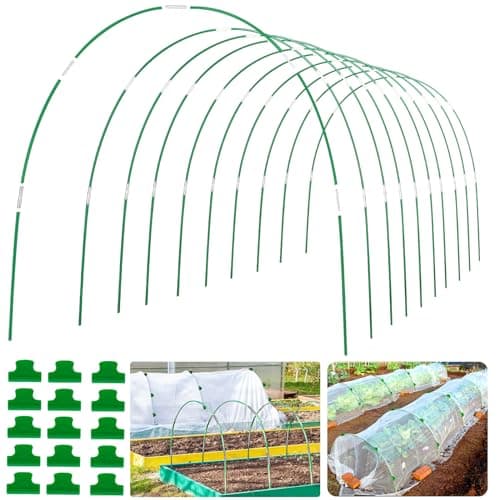 Top pickWYRJXYB 60Pcs Fiberglass Garden Hoops Grow Tunnel60 pieces of jointed fiberglass rod, building 8 ft hoops | Turning any bed you already own into a low tunnel | 8.5 | $32.99 - View on Amazon |
| 2 | 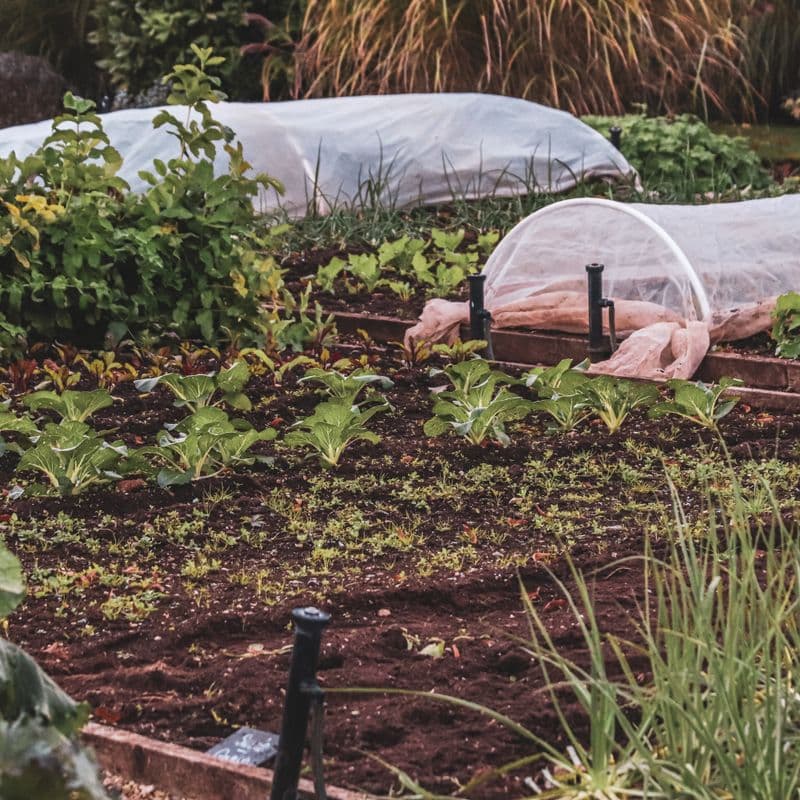 Agribon AG-19 Floating Row Cover0.55 oz/sq yd fabric, about 85% light transmission | A few degrees for almost no money | 8.4 | Check price on Amazon |
| 3 | 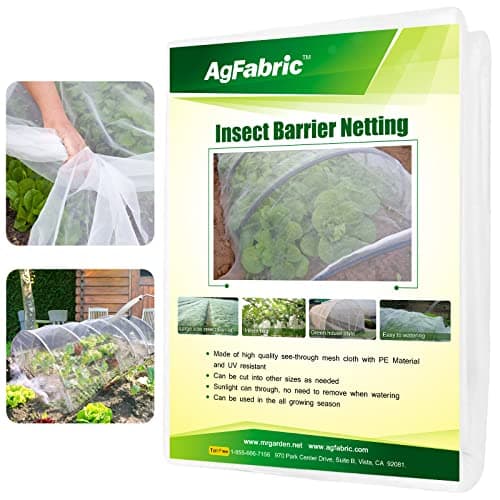 Agfabric Garden Netting Insect BarrierFine mesh net, sold in widths from 4 ft to 16 ft | Cabbage moths and birds in warm weather | 8.6 | $31.99 - View on Amazon |
| 4 | 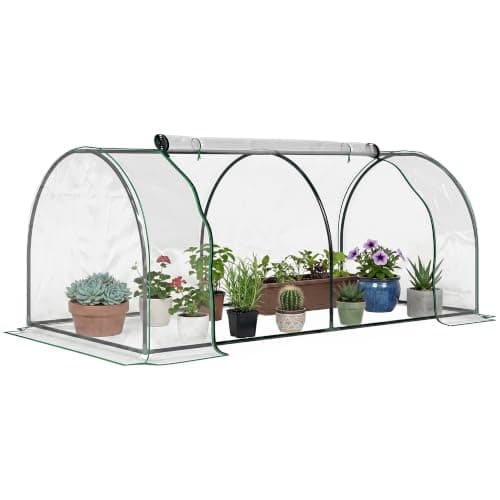 Outsunny 7 x 3 ft Mini Greenhouse Tunnel7 x 3 x 2.5 ft tunnel, clear PE cover, roll-up zippered door | A clear cover you do not have to build | 8.1 | $37.99 - View on Amazon |
| 5 | 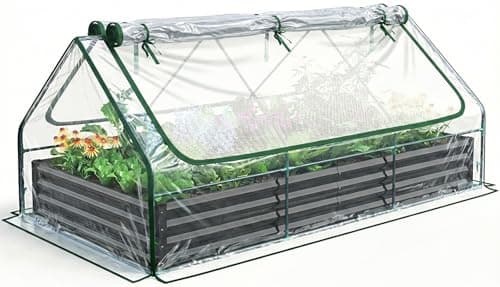 Quictent Galvanized Raised Bed with CoverMetal bed with hooped mesh and cover | Pest and frost protection | 8.0 | $99.99 - View on Amazon |
#ad We may earn a commission - Price as of November 2, 2026
Scores are our own editorial judgment, formed from published specifications and independent sources. They are not aggregated customer ratings, and they are not the result of hands-on testing, which we do not currently do. See how we choose.
Floating or hooped?
A cover laid straight onto the crop is a floating cover, and the lightest grades are designed to be used that way -- they weigh little enough that a young plant simply pushes them up as it grows. It is the cheapest arrangement and it works.
It has one real cost, which extension guidance names directly: in windy weather the fabric rubs, and repeated rubbing abrades and injures stems and leaves. Anything you are growing for the leaves -- salad, chard, brassicas -- shows this first. Hoops remove the problem completely, and UMD recommends a support whenever you move up to a medium or heavyweight fabric, because those are heavy enough to flatten a seedling on their own.
Hoops buy two more things worth having. They give you headroom, so a cover can stay on past the point where a floating one has to come off. And they let you swap what is over the top -- fabric in March, mesh in June, clear plastic in October -- on the same frame.
Sizing the cover to the bed
The commonest ordering mistake is buying fabric the width of the bed. A cover has to go over the hoops and reach the ground on both sides with enough left to pin down, so the width you need is the span across the arch plus the anchoring allowance -- not the 4 ft the bed measures.
- Measure the arch, not the bed. Over a 4 ft bed, a hoop 2 ft high is roughly a 7 ft arc from one side to the other.
- Add the anchoring allowance. A foot on each side to pin, weight or bury: that is 9 ft of width over a 4 ft bed.
- Add the ends. A tunnel loses most of its heat out of its open ends, so add about twice the tunnel height to the length -- 4 ft over an 8 ft bed, giving 12 ft.
- Then round up to a stock size. Rolls come in fixed widths; the next size up costs little and the offcut is the piece you use over the next bed.
For hoop spacing, UMD's low tunnel guidance is 2 to 4 ft apart and 15 to 30 in tall. An 8 ft bed therefore wants three or four hoops, not two -- and if you are using it in a snowy climate, closer is better, because the span between hoops is what collapses first.
Fabric, mesh or clear plastic
| Problem | Cover | Why |
|---|---|---|
| Late spring frost on transplants | Medium row cover over hoops | 4 to 6 degrees F with enough light to keep growing underneath |
| Cabbage whites on kale in June | Insect mesh | Stops the butterfly without the 5 to 15 degrees F of heat a solid cover adds in summer |
| Birds on strawberries | Insect mesh or bird netting | Sealed to the ground, it is the only thing that works |
| Starting salad four weeks early | Clear plastic tunnel | Clear plastic collects heat rather than only slowing its loss |
| Overwintering leeks and parsnips | Heavyweight row cover | Up to 8 degrees F; the light penalty does not matter on a dormant crop |
| Summer heat on lettuce | Shade cloth over the same hoops | Cuts the heat load instead of adding to it |
Putting a low tunnel over a raised bed
- 1
Set the hoops before you plant
Space them 2 to 4 ft along the bed and push them in far enough to feel firm. In loose raised bed mix that means deeper than you think -- or drive a short length of rebar in first and slide the hoop over it, which is UMD's own method.
- 2
Run a line along the ridge
A length of twine or stretchy clothesline connecting the tops of the hoops stops the fabric sagging between them and stops the hoops folding over sideways in wind.
- 3
Drape the cover with the slack at the ends
Center it, then gather the surplus at each end rather than trimming it. You will want that slack when the crop is taller.
- 4
Seal the edges to the ground
Landscape staples, boards, bricks, sandbags or soil. For pest exclusion this is not optional -- a cover that is not held tightly to the ground is a cover a cabbage white walks under.
- 5
Leave one end openable
Weight the end with a board you can roll the fabric around, so venting on a warm day is a ten-second job rather than an unpinning operation.
- 6
Lift it to weed, and put it back
Weeds grow faster under a cover for exactly the reason the crop does. Pull the cover back, weed, re-pin. Mulching the bed before you cover it cuts that job substantially.
When the cover has to come off
Anything that fruits has to be uncovered when it flowers. Squash, cucumbers, melons, beans and tomatoes all need insects to move pollen, and a cover that keeps cabbage whites out keeps bees out too. UMD's instruction is to remove covers as soon as those crops begin to flower -- a netted squash plant is a lot of leaf for no dinner.
Crops grown for leaves, stems or roots have no such deadline. Spring leafy greens, beets and snap beans can stay covered from sowing to harvest under a lightweight grade, which is the single easiest pest-free crop in a first garden.
The other reason to uncover is heat. Once days are consistently warm, a solid cover works against you, and the choice is to swap to mesh or to take it off entirely.
What goes wrong
| Symptom | Usual cause | Fix |
|---|---|---|
| Cover across the lawn after a windy night | Edges weighted, not anchored | Landscape staples every 2 ft, or bury the hem in soil |
| Caterpillars under the net anyway | Gap at the ground, or moths emerged from the soil | Seal the edges; rotate brassicas so last year's pupae are not under this year's net |
| Flowers dropping in midsummer | Heat under a solid cover | Swap to insect mesh, or uncover entirely |
| Ragged leaf edges on chard and salad | Floating cover rubbing in wind | Put it on hoops |
| Tunnel collapsed under snow | Hoops too far apart, or fiberglass rod | Halve the spacing; for a winter roof use a cold frame instead |
| Fabric shredding in its second season | UV degradation, normal | Expect 1 to 3 seasons; store it indoors or in a sealed box so mice do not nest in it |
Where a cover stops and a structure starts
There is a point where more fabric stops being the answer. A low tunnel is a few degrees and a pest barrier over one bed. A cold frame is a sealed box with a solid lid that holds considerably more warmth and stands up to snow. A greenhouse is a space you can work in through the winter.
The honest buying order is also the cheapest one: covers first, because they cost the least and solve the most common problems; a cold frame next if you want to grow through a real winter; a kit greenhouse only when you want to be in there with the plants. Cold frames covers the middle step, and greenhouse versus cold frame is the comparison to read before spending ten times as much. Whichever you end up in, the same problem follows you indoors: a closed structure overheats, and greenhouse ventilation is the hardware that prevents it.
One pairing worth planning for: hoops and a trellis compete for the same space over a bed. If the bed is going to carry a trellis for climbing crops, put the tunnel over it early in the season and take the hoops out when the trellis goes up.
Storage, life and the mice
Row cover lasts one to three seasons depending on grade, handling and weather -- lighter grades degrade faster, and UV is what kills all of them. None of it is currently recyclable, which is a reason to buy the grade you will actually use rather than the cheapest roll.
Store it dry and sealed. Extension guidance makes the point most people learn the expensive way: mice nest in stored row cover and ruin it for the next season. A lidded tote in the garage beats a bundle in the shed corner.
A cover is also the cheapest answer to the question of whether a bed is worth protecting at all. If you are still choosing the bed itself, the best raised bed kits ranks the beds these covers fit, and the raised bed size guide has the widths that make a 4 ft hoop work.
The picks in full
Top pick
WYRJXYB 60Pcs Fiberglass Garden Hoops Grow Tunnel
WYRJXYB
The cheapest way to add season extension to a bed you already have: jointed fiberglass rods that assemble into hoops tall and wide enough to clear a 4 ft bed, with clips to hold the cover on.
Hoops are the part people skip and then wish they had not. A cover laid straight on the crop -- a floating cover -- works, but in wind it rubs, and University of Maryland Extension specifically notes that repeated rubbing abrades stems and foliage. Holding the fabric a foot or two above the plants removes that problem and gives seedlings room to grow into.
The kit is a bag of jointed rod rather than fixed hoops, which is the useful part: you choose how many sections make each arch. Four or five sections give a low tunnel over salad; more give an arch tall enough to clear a young brassica. UMD's own low tunnel guidance puts hoops 2 to 4 ft apart and the tunnel 15 to 30 in high, which is a sensible target to build to.
Two honest limits. Fiberglass flexes, so this is a cover frame and not a snow roof -- if you want something that stands through a Cascades winter, that is a cold frame or a greenhouse, not a hoop. And the cover is a separate purchase, so budget for the fabric below alongside it.
What works
- Works with a bed you already own, which is far cheaper than buying a covered bed
- Fiberglass does not rust, so the hoops can stay outdoors season after season
- Jointed rods let you set the height: low for greens, tall enough to clear staked crops
- One kit usually makes enough hoops for two or three beds at UMD's recommended 2 to 4 ft spacing
- Holds fabric off the leaves, which stops the wind abrasion that floating covers cause
What does not
- Rods flex under snow -- this is a spring and fall tool, not a winter roof
- No cover included, so the real cost is this plus fabric
- Connectors are the weak point and a few usually crack within a couple of seasons
- Pushing the ends into a bed full of loose mix is less secure than rebar driven into firm ground
Skip it if: you want the hoops to carry snow all winter. Fiberglass rod flexes under a wet snow load; a hard-winter tunnel wants rigid steel or a cold frame instead.
| Contents | 60 rod sections, assembling into 8 ft hoops (listing figure) |
|---|---|
| Material | Fiberglass rod with plastic connectors, rust-free |
| Hoop size | Adjustable -- fewer sections make a shorter, lower arch |
| Fits | Beds up to about 4 ft wide at a useful working height |
| Cover | Not included -- buy row cover, mesh or plastic separately |
| Clips | Snap clips included on most configurations |
A few degrees for almost no money
Agribon AG-19 Floating Row Cover
Agribon
#ad We may earn a commission - prices are shown by Amazon, not by us
The cheapest frost protection there is, and the thing to try before buying any heater: a light spun fabric laid over the crop that buys a few degrees and costs nothing to run.
Before heating anything, try covering it. A layer of light spun fabric over the crop slows radiant heat loss on a clear night, which is when frost damage happens, and the manufacturer's figure for AG-19 is up to about 4 degrees F of protection. Inside a greenhouse, that stacks with the few degrees the structure already holds.
The weight grade is the decision. AG-19 at 0.55 oz per square yard transmits about 85% of light, which is the right compromise for season extension. Heavier frost grades hold more warmth and cut more light, and in December light is the resource you cannot spare.
Practical notes: weight the edges with soil, boards or sandbags, because it is lighter than it looks. It can stay on through rain, since it is porous. And inside a greenhouse, lay it over the plants on cold nights and pull it back on bright days so the crop gets the light it came for.
What works
- Costs a tiny fraction of a heater and nothing at all to run
- Porous to water and air, so it can stay on through rain rather than being lifted daily
- Works outdoors over a raised bed as well as inside a greenhouse
- Light enough to lay straight on the crop without hoops
What does not
- A few degrees is the whole effect -- it will not save tender plants in a hard freeze
- Cuts roughly 15% of the light, which matters in midwinter when light is already the limit
- Tears on anything sharp and degrades in UV over a couple of seasons
- Needs weighting at the edges, or the first real wind takes it across the garden
Skip it if: you are carrying tender container plants through a hard freeze. Fabric slows heat loss; it does not add heat, and a few degrees is all it is.
| Material | Spun-bonded polypropylene, UV stabilized |
|---|---|
| Weight | 0.55 oz per sq yd |
| Light transmission | About 85% (manufacturer) |
| Frost protection | Up to about 4 degrees F (manufacturer) |
| Water and air | Porous -- rain and air pass through |
| Life | 2 to 3 seasons with care |
| Sizes | From 83 in x 50 ft up to field rolls |
Cabbage moths and birds in warm weather
Agfabric Garden Netting Insect Barrier
Agfabric
The summer half of the job: mesh fine enough to stop cabbage white butterflies and birds without trapping the heat that a solid row cover does in July.
A solid row cover and a mesh net look like the same product and are not. Extension guidance is blunt about the difference: under a spun-bonded cover in summer, temperatures run 5 to 15 degrees F above the air outside, which is enough to make beans, tomatoes and peppers drop their flowers once the day tops 90 degrees F. Mesh does not do that, because it is mostly air.
So the split is seasonal. Spun fabric in spring and fall, when the few degrees are the point; mesh in summer, when the job is keeping cabbage whites off the kale and birds off the berries without heating the bed.
Whatever you use it over, seal the edges. Netting that stops at the soil surface with a gap under it stops nothing -- a cabbage white will walk in. Pin it with landscape staples, bury the hem, or weight it with boards; UMD's own instruction is that a cover must be held tightly to the ground to work against pests.
What works
- Keeps cabbage white caterpillars off brassicas, which is the single biggest summer pest win in a first garden
- Vents heat, so it can stay on through midsummer when a solid row cover would cook the crop
- Also excludes birds, which is what saves a strawberry or blueberry crop
- Lasts several seasons -- woven mesh outlasts spun-bonded fabric
- Washable and reusable, where torn row cover usually is not
What does not
- No meaningful frost protection, so it does not replace row cover in spring and fall
- Must be sealed to the ground or pests simply walk under the edge
- Has to come off fruiting crops at flowering, or nothing gets pollinated
- Pests already in the soil under the net -- flea beetles, root maggot flies -- are trapped in with the crop
Skip it if: you want frost protection. Mesh is almost all holes -- it stops insects and birds and buys essentially nothing in degrees.
| Material | Woven polyethylene mesh, UV stabilized |
|---|---|
| Sizes | Common rolls from 4 x 100 ft to 16 x 20 ft |
| Blocks | Cabbage moths, leaf miners, squash vine borer adults, birds |
| Airflow | High -- far cooler underneath than spun fabric |
| Light | Most light passes; shading is slight |
| Frost protection | Effectively none |
A clear cover you do not have to build
Outsunny 7 x 3 ft Mini Greenhouse Tunnel
Outsunny
The step up from fabric: a steel-frame tunnel with a clear cover that traps real warmth over one bed, with a zip to vent it before it cooks.
Fabric slows heat loss. Clear plastic actually collects heat, and that is a different order of protection. On a sunny March day a closed clear tunnel over a bed of salad will run well above the air outside, which is what pulls a sowing forward by weeks rather than days.
The same property is the warning. A sealed clear tunnel in April sun overheats fast, and the roll-up panel is not a convenience feature -- it is the thing that stops the crop cooking. If nobody is home on weekdays, leave the door open and accept a smaller gain rather than closing it and hoping.
Treat it as a one-bed tool. At 3 ft wide it suits a narrow bed, a half of a wide one, or a nursery area for hardening off. For a whole 4 x 8 bed, hoops plus heavyweight fabric cost less and cover more; for a structure you can stand in, you are into cold frame and greenhouse territory instead.
What works
- Clear plastic traps far more daytime warmth than any fabric cover does
- Zip and roll-up panel make venting a five-second job, which fabric covers do not allow
- Assembles in well under an hour with no tools
- Small enough to move between beds through the season
- Keeps heavy rain off winter salad, which matters as much as the warmth does
What does not
- Needs venting on any sunny day, and will cook a crop if you forget
- 3 ft wide suits a narrow bed or a half-bed, not a standard 4 ft one
- Light PE cover is a wearing part; expect to replace it before the frame
- Must be staked and guyed properly or wind will roll it across the yard
Skip it if: your beds are wider than 3 ft. The frame is a fixed size and it will not span a standard 4 ft bed.
| Footprint | About 7 ft long x 3 ft wide |
|---|---|
| Height | About 2.5 ft at the ridge |
| Cover | Clear UV-treated PE, roll-up zippered door panel |
| Frame | Powder-coated steel tube, push-fit assembly |
| Access | Roll-up front panel for venting and watering |
| Anchoring | Ground stakes and guy ropes included |
Pest and frost protection
Quictent Galvanized Raised Bed with Cover
Quictent
A bed and a crop cover in one box, which is the cheapest way to stop cabbage moths, birds and a light frost at the same time.
The cover is the product here. Cabbage white caterpillars can strip a row of kale in days, birds will take strawberries the moment they blush, and a late frost can end a first tomato planting. A hooped mesh over the bed handles all three.
Fitting the hoops to the bed from the start avoids the usual improvised arrangement of sticks and clothes pegs, and they fold back rather than having to come off entirely.
Remember to open or remove the cover once fruiting crops flower. Netting that keeps moths out also keeps pollinators out, and an unpollinated squash plant is a lot of leaf for no dinner.
What works
- Cover keeps cabbage moths and birds off brassicas and greens
- The clear cover buys a few weeks at each end of the season
- Hoops fold back for access
- Cheaper than buying a bed and a cover separately
What does not
- The bed itself is ordinary galvanized steel
- Covers need removing when crops flower and need pollinating
- Mesh is a wearing part in a windy yard
Skip it if: you already own a bed. A separate hoop-and-net kit over what you have costs far less than buying the whole thing again.
| Material | Galvanized steel bed with steel hoops |
|---|---|
| Cover | Mesh net plus a clear cover on most versions |
| Depth | Commonly 12 in |
| Assembly | Bolt-together bed, push-fit hoops |
| Soil needed | About 32 cu ft for 8 x 4 ft at 12 in |
Common questions
How many degrees of frost protection does row cover give?
It depends entirely on the grade. University of Maryland Extension puts lightweight cover (0.45 oz per square yard) at about 2 degrees F, medium grades (0.5 to 1.0 oz) at 4 to 6 degrees F, and heavyweight (1.5 to 2.2 oz) at up to 8 degrees F. The heavier the fabric, the less light reaches the crop -- heavyweight transmits as little as 30%.
Do I need hoops, or can I lay the cover on the plants?
Lightweight covers are designed to float directly on the crop and work that way. The cost is abrasion: in wind the fabric rubs and damages stems and leaves, which shows up first on salad and brassicas. Extension guidance recommends a support structure whenever you use a medium or heavyweight fabric, since those are heavy enough to flatten seedlings.
What size row cover do I need for a 4 x 8 ft raised bed?
Measure the arch rather than the bed. A 2 ft high hoop over a 4 ft bed is roughly a 7 ft arc, plus about a foot each side for anchoring -- so about 9 ft of width. For length, add about twice the tunnel height to the bed length, which makes roughly 12 ft over an 8 ft bed.
Can I leave a row cover on all season?
On crops that do not need pollinating -- salad, spinach, beets, snap beans -- yes, a lightweight cover can stay from sowing to harvest. Anything that fruits must be uncovered when it starts to flower, because the cover keeps bees out as effectively as it keeps pests out.
What is the difference between row cover and insect netting?
Row cover is a solid spun fabric that holds warmth and blocks insects; insect netting is a woven mesh that blocks insects and lets heat out. In summer a solid cover runs 5 to 15 degrees F above the outside air, hot enough to make beans, tomatoes and peppers drop flowers, so mesh is the correct summer choice and fabric the spring and fall one.
Will a bed cover protect plants in a hard freeze?
No. Covers slow heat loss, they do not add heat, so even the best grade is a single-figure improvement on the outside temperature. For growing through a real winter you want a cold frame or a greenhouse, not more fabric.
Sources
Factual claims on this page are backed by the published sources below, and product specifications are the manufacturers’ own. Where a figure is not published, we say so rather than estimating it.