Step 5 - Greenhouses
The Best Greenhouse Kits Under $500
This is the bracket where a greenhouse stops being a cover over hoops and becomes a structure with a door that latches.
Janet H. - the hands-on owner behind Janet Media Group.
Published
This page contains affiliate links. If you buy through them we may earn a commission at no cost to you, and it never decides what we recommend. How this site is funded.
The short version. Under five hundred dollars the GarveeHome 6 x 8 is the right buy for most backyards: an aluminum frame, rigid polycarbonate panels, a roof vent and a sliding door, in the footprint that staging and shelving are all sized around. If you have the ground and want the most greenhouse per dollar, the Polar Aurora 8 x 12 roughly doubles the floor area and still comes in under the line. And the budget pick is the Ohuhu mini -- four shelves under a zip cover, for a tiny fraction of the bracket, which is the right answer on a patio or balcony where none of the walk-ins fit.
Five hundred dollars is a more interesting line than a thousand, because it is where the real decision happens. Below a few hundred you are buying plastic sheeting on a frame. By the time you reach this ceiling you can have aluminum, rigid panels, a vent that opens and a door that locks -- and every pick on this page is confirmed under the line by our price layer, with the check date shown on each buy control.
How we chose
We have not assembled these kits and will not pretend otherwise. What this page does is take the hobby greenhouse sizing and siting guidance published by University of Georgia Extension and Colorado State University Extension, work out what it implies for a buyer with a hard budget, and check currently purchasable kits against it.
- Under the line with a live price. Every pick is confirmed under $500 by the price layer. Nothing here is listed on a remembered number.
- Width before length. Extension's advice is blunt: buy as wide a greenhouse as you can, because enlarging later means adding length. Width decides whether you get benches on both sides.
- A vent in the box. A sealed greenhouse in spring sun overheats by mid-morning. A kit with no vent is a kit you prop open by hand every day.
- A door that latches. Zipper doors are the first thing to fail on soft structures and the first thing wind finds.
- Honest about ratings. No kit in this bracket publishes a wind or snow rating. We say so rather than implying a structural standard nobody claims.
- A footprint standard gear fits. The common sizes have staging, shelving and 1020 trays sized around them; an odd footprint limits everything you buy afterwards.
Quick picks
| # | Product | Best for | Score | Price |
|---|---|---|---|---|
| 1 | 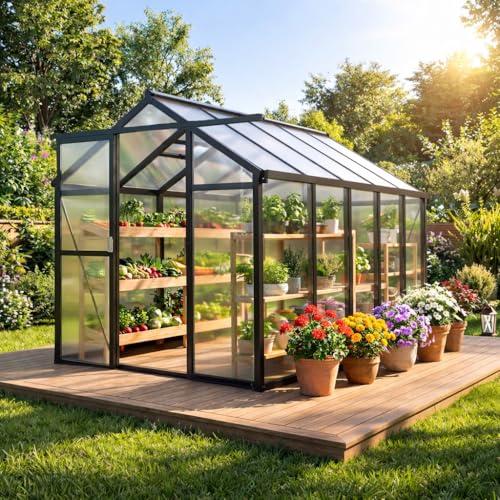 Top pickGarveeHome 6 x 8 ft Polycarbonate GreenhouseAluminum frame, polycarbonate panels, roof vent, sliding door | A first hard-sided greenhouse | 8.7 | $291.99 - View on Amazon |
| 2 | 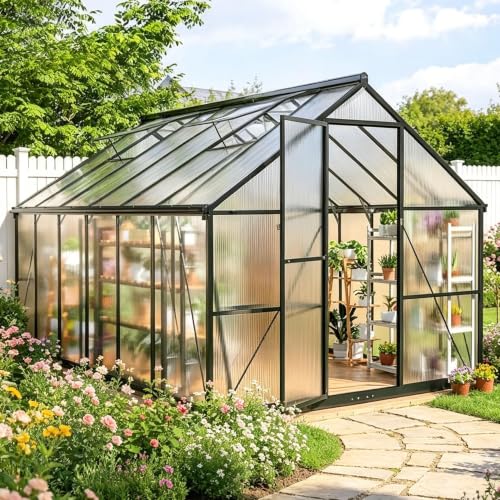 Polar Aurora 8 x 12 ft Walk-In Polycarbonate Greenhouse96 sq ft, aluminum frame, polycarbonate, ventilated windows | The most floor area under the cap | 8.5 | $419.99 - View on Amazon |
| 3 | 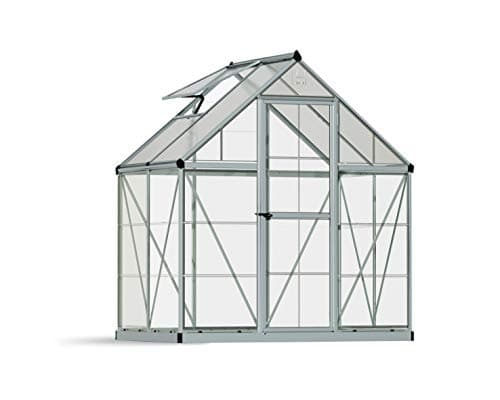 Palram Canopia Hybrid GreenhouseClear side panels, twin-wall roof | Seeing in, and light diffusion | 8.8 | $449.99 - View on Amazon |
| 4 | 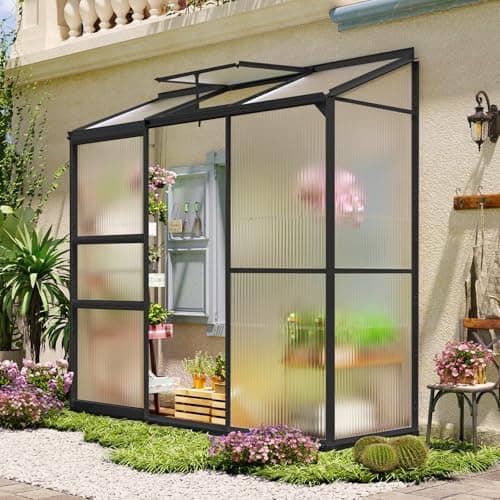 Showellgard 6 x 2 ft Lean-to Polycarbonate Greenhouse6 x 2 ft footprint, 4 mm polycarbonate panels, adjustable roof vent | A narrow path where four feet is out of the question | 8.0 | $279.99 - View on Amazon |
| 5 | 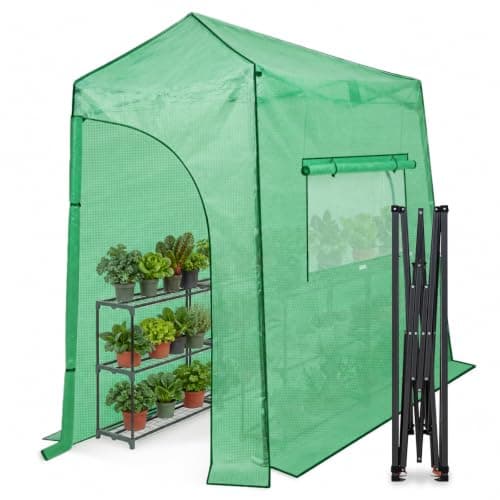 EAGLE PEAK 9 x 4 ft Pop-Up Lean-To Greenhouse9 x 4 ft pop-up frame with PE cover, one-person setup | Covering a wall this weekend without drilling anything | 7.6 | $139.99 - View on Amazon |
| 6 | 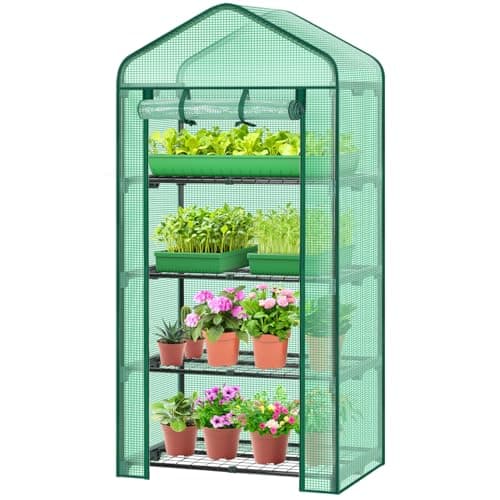 Ohuhu Mini Greenhouse with Shelves4-tier shelf frame with zip cover | Balconies and seedling trays | 7.5 | $36.54 - View on Amazon |
#ad We may earn a commission - Price as of November 24, 2026
Scores are our own editorial judgment, formed from published specifications and independent sources. They are not aggregated customer ratings, and they are not the result of hands-on testing, which we do not currently do. See how we choose.
What the $500 line costs you against $1,000
| Under $500 | Under $1,000 | |
|---|---|---|
| Frame | Light aluminum section | Heavier aluminum, sometimes resin or cedar |
| Glazing | Thin polycarbonate, often single-skin | Twin-wall more common, thicker panels |
| Typical footprint | 6 x 8 up to 8 x 12 at the top of the bracket | The same, plus permanent lean-tos |
| Published ratings | None | Still rare; only the premium kits publish them |
| What you give up | Panel thickness and frame section | Not much -- the gap is smaller than the price gap |
The useful conclusion: the step from a covered frame to a rigid kit matters far more than the step from this bracket to the next one. If five hundred dollars is your ceiling, you are not making a significant compromise -- you are buying slightly thinner glazing. Greenhouse kits under $1,000 covers the bracket above if the budget stretches, and best greenhouse for the money weighs value at every price.
Size: buy width, add length
Extension's sizing guidance is the most useful thing to read before spending here, because it runs counter to how people shop. The advice is to buy as wide a greenhouse as possible, since enlarging later means adding length -- and width is what determines the layout you can have inside.
| Width | Layout it allows | Aisle left |
|---|---|---|
| Under 4 ft | One narrow bench, reach-in use | None worth the name |
| 6 ft | One bench and a standing strip, or two shallow racks | About 4 ft with 12 in racks |
| 8 ft | Benches both sides with a path between | Comfortable, barrow-width |
| 10 ft and up | Benches both sides plus a centre run | Room for everything |
Extension also recommends building in twenty-five to fifty percent more room than your current plans need, because most people keep adding plants. In this bracket that is the argument for the 8 x 12 over the 6 x 8 wherever the ground allows -- the extra length is the cheapest square footage you will ever buy.
What no kit at this price includes
- A level base. The frame is only square if the ground is flat. Gravel over a compacted base, paving slabs or a timber frame all work; levelling is the job, not the material.
- Ground anchors. Every story about a greenhouse in a neighbour's yard starts with a kit that was not anchored. How to anchor a greenhouse covers what to use on each ground type.
- Staging or shelving. Floor space is the least useful space in a greenhouse. See greenhouse shelving and staging for the depths that take a standard 1020 tray.
- A min/max thermometer. The cheapest useful thing you can buy for a greenhouse, because every other decision depends on what the overnight low actually was.
The picks in full
Top pick
GarveeHome 6 x 8 ft Polycarbonate Greenhouse
GarveeHome
The specification most people picture when they say greenhouse -- aluminum frame, rigid panels, a roof vent and a lockable sliding door -- at a price that leaves room for the base and the staging.
The jump from a covered frame to a rigid kit is the biggest single step in this category, and it happens well below the thousand dollar line. An aluminum frame does not rust, rigid panels do not flap or tear, and a hinged or sliding door with a latch stays shut in wind that would have a zipper door open all afternoon.
The roof vent is the detail worth noticing on the spec sheet. A sealed greenhouse in April sun will pass 100 degrees Fahrenheit by mid-morning, and a kit without a vent has to be propped open by hand every day. One included vent is the difference between a greenhouse you run and a greenhouse you babysit.
What you do not get at this price is a published wind or snow rating, heavier frame section, or glazing thick enough to hold heat overnight. That is the honest ceiling of the bracket, and it is why the premium kits exist.
What works
- Rigid panels and an aluminum frame, not a cover over hoops -- it is a structure
- Roof vent included rather than sold as an accessory, which matters more than it sounds
- Sliding door takes no swing space, which suits a kit squeezed against a fence
- The common 6 x 8 footprint means staging and shelving are easy to size
What does not
- No published wind or snow rating, so treat it as a three-season structure
- Panels are thin compared with a premium kit; they diffuse light but insulate little
- Assembly is a long afternoon and genuinely needs a second person
- Needs a level base and ground anchors, neither of which is in the box
Skip it if: you get real snow load. This is a three-season specification, and no budget kit publishes a snow rating because none of them would like the number.
| Footprint | 6 x 8 ft |
|---|---|
| Frame | Aluminum |
| Glazing | Polycarbonate panels |
| Ventilation | Adjustable roof vent |
| Door | Sliding, with a lock |
The most floor area under the cap
Polar Aurora 8 x 12 ft Walk-In Polycarbonate Greenhouse
Polar Aurora
Ninety-six square feet of hard-sided greenhouse for well under the cap -- benches down both sides, a real path between them, and room to work with the door shut.
Width is the dimension worth paying for and length is the one that is cheap, which is exactly what this kit's proportions say. At 8 ft wide you get a bench down each side and a path you can turn around in with a tray in your hands; at 12 ft long you get enough bench to run early crops at one end and tomatoes at the other.
That makes it the most greenhouse per dollar in this roundup by a distance, with one condition attached: the base. A 96 square foot structure wants a level, drained pad -- gravel over a compacted base, paving slabs, or a timber frame -- and getting 12 feet of ground flat is real work or real money.
The specification is otherwise the same bracket as the 6 x 8: aluminum frame, rigid polycarbonate, window ventilation, no published structural ratings. Bigger, not stronger.
What works
- Twice the floor area of a 6 x 8 for well under double the money
- Eight feet of width is the point where you get benches both sides and still turn around
- Length is the cheap dimension in any greenhouse -- this is where the value sits
- Aluminum frame with rigid glazing rather than a covered hoop structure
What does not
- Needs a 12 ft run of genuinely level ground; leveling is the hidden cost
- No published wind or snow rating, same as every kit in this bracket
- A bigger structure is a bigger sail -- anchoring is not optional here
- More panels means a longer build; set aside a full day and a helper
Skip it if: you have not measured the site and the base. A 12 ft run needs 12 ft of level ground, and leveling that is the expensive part people forget.
| Footprint | 8 x 12 ft, about 96 sq ft |
|---|---|
| Frame | Aluminum |
| Glazing | Polycarbonate panels |
| Ventilation | Ventilated windows |
| Finish | Black frame |
Seeing in, and light diffusion
Palram Canopia Hybrid Greenhouse
Palram Canopia
Clear walls so you can see what is happening inside, with a diffusing twin-wall roof over the plants that need protection from hard overhead sun.
The Hybrid name refers to two glazing types in one kit: crystal-clear panels on the walls, twin-wall on the roof. In practice that means high light levels from the sides and diffused light from above, which is a good compromise in a northern or cloudy garden.
It also means you can see in. That sounds trivial until you have walked out in the rain three times a week to check whether anything needs water.
In a hot, south-facing, unshaded spot the clear walls become a liability. If that is your site, choose the fully diffused model or plan on shade cloth from midsummer.
What works
- You can see the plants without opening the door
- High light transmission through the clear walls
- Twin-wall roof still protects from midday sun
- Same aluminum frame as the rest of the range
What does not
- Clear walls run hotter than fully diffused glazing
- Shows dirt and algae sooner
- Needs shading in a hot, exposed spot
Skip it if: your site bakes in afternoon sun. Clear walls transmit far more light, and heat follows light.
| Frame | Rust-resistant aluminum |
|---|---|
| Glazing | Clear polycarbonate walls, twin-wall roof |
| Sizes | 6 ft wide, multiple lengths |
| Ventilation | Roof vent plus hinged door |
| Base | Integrated base, anchoring required |
A narrow path where four feet is out of the question
Showellgard 6 x 2 ft Lean-to Polycarbonate Greenhouse
Showellgard
The honest answer for a side-return or a narrow path: two feet deep, so you reach in rather than walk in, and it still has a real vent and a real gutter.
Most lean-to searches end in disappointment for the same reason: the buyer has a four-foot path and the kit wants four feet. This one wants two, and that single fact makes it the right answer for a side-return, a narrow passage down the side of a garage, or any wall where the mower still has to get past.
Be clear-eyed about what two feet buys. You open the door and reach in. A standard 1020 seed tray is about twenty inches long, so one row of trays fills the depth and there is no room to stand. That is not a flaw, it is the specification -- but it decides what the structure is for.
Where it earns its place is spring and autumn. Hardening off, overwintering tender perennials, bringing on early salads and keeping a run of pots off frozen ground are all jobs that need shelter and light rather than space. For those, a six-foot run of shelving against a warm wall is genuinely useful.
The glazing is single-skin four millimeter polycarbonate, which is the ordinary specification at this size. It transmits light well and insulates poorly. Treat the structure as a frost buffer rather than a heated room, and it will do what you bought it for.
What works
- Two feet of projection fits paths that cannot lose four
- Rigid polycarbonate rather than film, so it is a structure rather than a season's cover
- Has the vent and gutter the cheap film lean-tos leave out
- Short enough that a single wall section is usually flat and square enough to seal against
- Easier to anchor than a deep kit, because there is far less sail area to catch wind
What does not
- You cannot stand inside it, which rules out potting up and most winter work
- Shelf depth is the real constraint: a standard 1020 tray is 20 inches, so you fit one row and no walkway
- Four millimeter single-skin panels insulate far less than twin-wall, so it is a season-extender rather than a winter house
- Small volume means fast temperature swings -- it overheats and chills quicker than a walk-in
Skip it if: you want to work inside it. At two feet deep this is a tall cold frame with a door, and you will be gardening at arm's length.
| Footprint | 6 x 2 ft (manufacturer) |
|---|---|
| Frame | Aluminum |
| Glazing | 4 mm polycarbonate panels (manufacturer) |
| Door | Sliding |
| Vent | Adjustable roof vent |
| Water | Rain gutter |
| Colors | Black and silver frames both listed |
Covering a wall this weekend without drilling anything
EAGLE PEAK 9 x 4 ft Pop-Up Lean-To Greenhouse
EAGLE PEAK
A film lean-to that opens like a tent: no assembly to speak of, no fixings into the wall, and it folds away when the season ends.
Not every wall problem deserves a bolted-on structure. If you are renting, if the wall is rendered and you would rather not drill it, or if you simply want cover for one winter, a pop-up lean-to does the job for the price of a few bags of mix.
The format is a tent against a wall. The frame opens out, the PE cover is already on it, and the whole thing is weighted or pegged rather than fixed. Nine feet of wall gets covered in the time a rigid kit takes to unpack.
Two honest limits. The first is heat: film with mesh windows is a wind-break and a frost buffer, not an insulated structure, and the difference from outside on a clear night is small. The second is wind. A light frame with a big flat face against a wall is exactly the shape that gets lifted, so weight it properly and do not assume the wall will hold it.
Judged for what it is -- temporary, cheap, and reversible -- it is the most sensible thing in this roundup for a lot of people. Judged as a greenhouse, it is the weakest. Both statements are true at once.
What works
- Up in minutes with no tools, no foundation and no holes in anyone's wall
- Nine feet of wall coverage for a fraction of any rigid kit here
- Mesh windows and a roll-up door give you more ventilation openings than the rigid kits do
- Folds away in summer, which suits a rented house or an HOA you would rather not consult
- The obvious choice if you need shelter for one hard winter rather than for ten years
What does not
- A PE cover degrades in UV and is the part that fails -- plan on replacing it, not repairing it
- Pop-up frames are light, so this must be weighted or pegged properly or wind will take it
- Film plus mesh windows leak heat badly compared with any rigid panel
- The cover flexes and flaps, which is noisy against a bedroom wall and wears at the contact points
- Not a snow structure: a flexible frame against a wall collects drift and sheds load poorly
Skip it if: you want something permanent. A PE cover is a wearing part measured in seasons, and this one is held down rather than built in.
| Footprint | 9 x 4 ft (manufacturer) |
|---|---|
| Cover | PE film, clear and green panels |
| Frame | Pop-up, collapsible |
| Setup | One-person setup (manufacturer) |
| Door | Roll-up |
| Windows | Mesh windows |
| Storage | Folds down for off-season storage |
Balconies and seedling trays
Ohuhu Mini Greenhouse with Shelves
Ohuhu
A shelved cover for seed trays rather than a greenhouse you walk into, and the right answer where there is no room for anything larger.
Calling this a greenhouse oversells it, which is why it disappoints people who expected one. What it actually is: a shelf unit with a cover, sized for standard seed trays, that fits on a balcony or against a wall.
For that job it is good. Seedlings started indoors need somewhere sheltered to harden off, and this gives them a few protected degrees and shelter from wind and heavy rain.
Tie it to something. An empty covered shelf unit is remarkably light and catches wind like a sail.
What works
- Holds several seed trays in almost no floor space
- Cheap enough to be a seasonal purchase
- Zip front rolls up for ventilation
- Folds flat for storage
What does not
- Blows over easily unless tied to something solid
- Very little thermal mass -- it buys a few degrees, not many
- Cover is the first thing to fail
Skip it if: you want to grow plants to maturity. This is a propagation space and a frost blanket, not a growing house.
| Frame | Steel tube shelving |
|---|---|
| Cover | Zip-front PE cover |
| Shelves | Typically 4 tiers |
| Footprint | Fits against a wall or balcony rail |
| Anchoring | Tie to a wall or rail -- essential |
Common questions
Can you get a good greenhouse for under $500?
Yes. The bracket covers aluminum-framed, polycarbonate-glazed walk-ins with a roof vent and a latching door, in footprints from 6 x 8 up to around 8 x 12. What it does not cover is thick twin-wall glazing, a heavier frame section or any published wind and snow rating.
What size greenhouse can you buy for $500?
Commonly 6 x 8 for a rigid hard-sided kit, and up to about 8 x 12 at the top of the bracket for a walk-in tunnel. Extension guidance is to buy as wide as the site allows and add length later, so prioritise width over total area when choosing between two kits.
Is a $500 greenhouse strong enough for winter?
Treat it as a season extender rather than a winter structure. No kit at this price publishes a snow or wind rating, and the glazing is thin. It will carry hardy greens through a cold spell and start seeds weeks early, but heavy snow should be cleared off rather than trusted to the roof.
What else do I need to buy with a budget greenhouse kit?
A level base, ground anchors, staging or shelving, and a min/max thermometer. None of those are in any kit at any price, and on a budget greenhouse they add a meaningful fraction to the total. Price them before choosing between two sizes.
Is a polycarbonate kit better than a plastic tunnel at this price?
For most buyers, yes. Rigid panels do not flap or tear, an aluminum frame does not rust, and a latching door stays shut in wind that opens a zipper. A tunnel gives more square feet per dollar, so it wins when growing area matters more than durability.
Sources
Factual claims on this page are backed by the published sources below, and product specifications are the manufacturers’ own. Where a figure is not published, we say so rather than estimating it.