Step 1 - Raised Beds
The Best Grow Bags for Potatoes
A potato bag has one job a plant pot does not: it has to let you bury the stem twice and still be liftable in September.
Janet H. - the hands-on owner behind Janet Media Group.
Published
This page contains affiliate links. If you buy through them we may earn a commission at no cost to you, and it never decides what we recommend. How this site is funded.
The short version. The Smart Pot 10-gallon is the bag to buy if you intend to grow potatoes again next year: the right volume for two seed potatoes, fabric that holds its shape when you earth up, and a life measured in seasons rather than in one summer. The budget pick is the VIVOSUN 5-pack of 10-gallon bags -- five bags for less than two of the Smart Pots, which is the cheapest honest way to find out whether bag-grown potatoes suit you. And if you want a single container that crops like a small bed, the Smart Pot 100-gallon round bed holds a proper row's worth in one place.
Potatoes are the crop most often grown in bags, for practical rather than romantic reasons: you can stand them on a path, a drive or a patio, you lift the crop by tipping rather than digging, and blighted foliage can be removed without contaminating a bed. The decision is almost entirely about volume and fabric strength.
How we chose
- Volume per plant. Ten gallons is roughly the working minimum for two seed potatoes. Crowding is the commonest reason a bag disappoints.
- Room to earth up. You start the bag part-filled and add soil twice. A short bag cannot do that whatever its diameter.
- Fabric that holds its shape full. A floppy bag slumps when wet, and the handles are what tears first.
- Handles rated for a full bag. Ten gallons of wet mix is heavier than people expect. Stitched handles matter.
- A live price, now. Each pick carries a current price from our price layer. Where a listing shows no live offer we say so rather than quoting a number.
Quick picks
| # | Product | Best for | Score | Price |
|---|---|---|---|---|
| 1 | 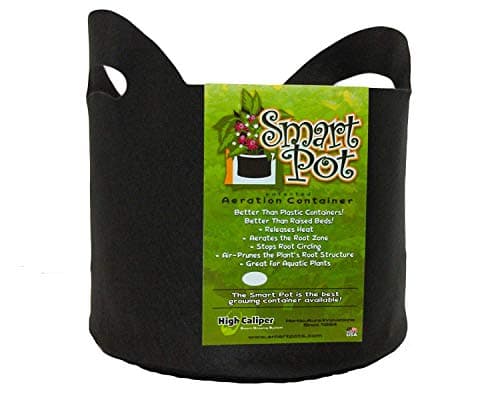 Top pickSmart Pot 10-Gallon Soft-Sided Container16 in across, 11.5 in tall, 1.33 cu ft | Bags you keep for years | 8.6 | $13.59 - View on Amazon |
| 2 | 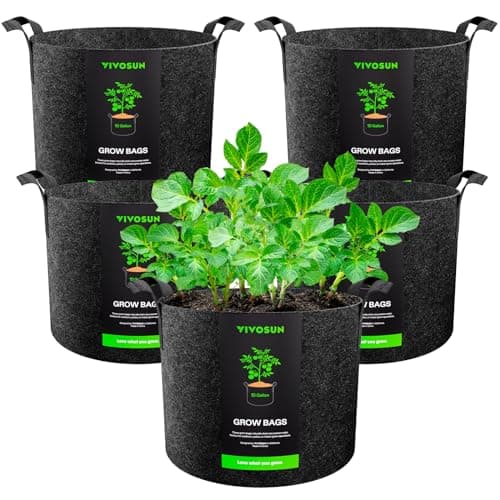 VIVOSUN 5-Pack 10 Gallon Grow BagsFive 10 gal bags with stitched handles | A first set of bags | 8.4 | $17.84 - View on Amazon |
| 3 | 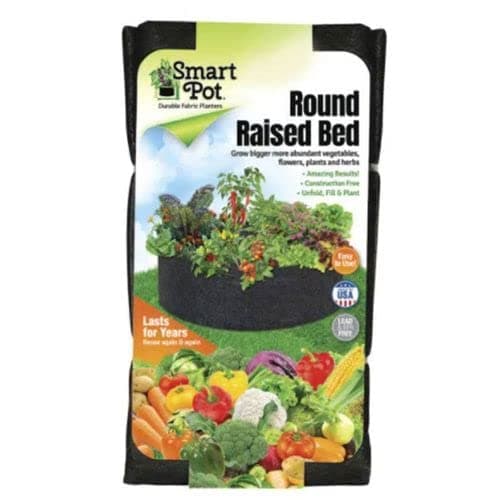 Smart Pot Round Raised Bed, 100 Gallon50 in across, 12 in deep, about 13.5 sq ft | A whole bed's worth | 8.8 | $69.95 - View on Amazon |
| 4 | 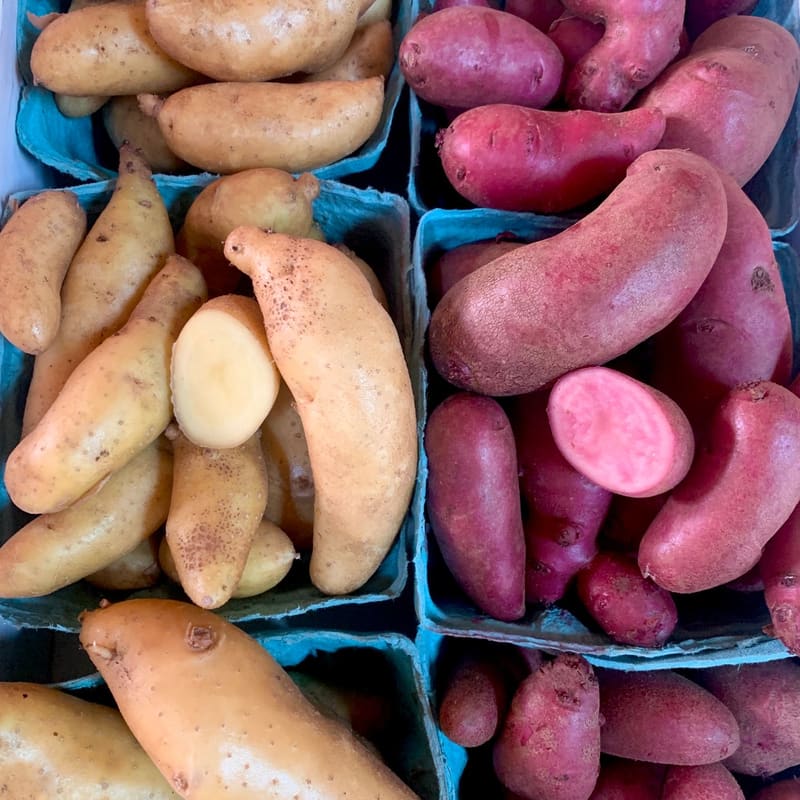 Potato Grow Bags with Harvest Flap10 gal with a side access window | Potatoes and sweet potatoes | 7.9 | Check price on Amazon |
#ad We may earn a commission - Price as of November 24, 2026
Scores are our own editorial judgment, formed from published specifications and independent sources. They are not aggregated customer ratings, and they are not the result of hands-on testing, which we do not currently do. See how we choose.
Size: how many potatoes per bag
The commonest mistake is putting too many seed potatoes in one bag because the surface looks roomy at planting time. The plants are not competing in April; they are competing in July, underground, and the result is a bag of marble-sized tubers.
| Bag size | Seed potatoes | Realistic yield | Best for |
|---|---|---|---|
| 5 to 7 gal | 1 | A meal or two of earlies | A balcony, or a test run |
| 10 gal | 2 | Several meals of earlies or salad types | The standard answer |
| 15 to 20 gal | 3 | A bucket of maincrop | People with room for fewer, bigger bags |
| 100 gal round bed | 8 to 10 | A proper row's worth | Replacing a bed, not a pot |
Oklahoma State University Extension's grow bag guidance makes the general point that bag-grown crops live in a limited volume and are therefore more sensitive to drying and nutrient exhaustion than the same crop in the ground. For potatoes that translates directly: fewer tubers per bag, more water, and feed once the plants are established.
Earthing up is why bag depth matters
- 1
Fill the bag about a third
Roll the sides down so the bag is short and the soil gets sun. Set the seed potatoes on the surface and cover with four inches of mix.
- 2
Let the shoots reach six to eight inches
Then unroll the sides a little and add enough mix to bury about half the stem. The buried stem is where new tubers form.
- 3
Repeat once more
Two earthings-up is usually enough. The bag should end close to full, with foliage above the rim.
- 4
Water consistently from flowering
Tuber bulking happens after flowering, and that is when inconsistent watering causes hollow centres and odd shapes.
- 5
Stop watering when the tops die back
Then tip the whole bag onto a tarp. That is the entire harvest, with nothing speared by a fork.
Fabric, plastic and the flap question
Most potato bags sold today are non-woven fabric, and that is the right material: it drains, it air-prunes roots so they do not circle, and it folds flat out of season. Solid plastic bags hold water far too well for a crop that rots if it sits wet.
The side access flap is the feature people buy and then rarely use. It is sold as a way to steal a few early tubers without disturbing the plant, and it does work for that, but it is also a seam -- one more place to leak and tear. If you want one, buy it knowing that is the trade; if you only ever harvest the whole bag at once, a plain bag is stronger and cheaper.
What goes in the bag matters as much as the bag. A free-draining, moderately rich mix is right; neat garden soil compacts and neat compost holds too much water. Best soil for grow bags has the mix, and raised beds vs grow bags is worth reading if you are still choosing between the formats.
The picks in full
Top pick
Smart Pot 10-Gallon Soft-Sided Container
Smart Pot
The original bonded-fabric pot, and the one still in use when the cheap multipacks have gone brittle and split at the seams.
Fabric pots are a commodity with one real quality variable: how long the fabric lasts outdoors in sun. A bag that splits at the seam in August, full of wet mix and a fruiting plant, is a bad afternoon.
At 16 inches across and 11.5 inches tall this holds about 1.33 cubic feet, which is one indeterminate tomato with a cage, or two peppers, or a generous clump of basil and chard. It is not a mixed planter.
The honest way to buy fabric pots is to split the difference: a couple of pots like this for the plants you grow every year, and a cheap multipack for the extras you are experimenting with.
What works
- Heavier fabric than the multipack bags, and it holds its shape when full
- UV stabilized, which is what decides whether a bag survives a second summer outdoors
- Aeration through the sidewall air-prunes roots instead of letting them circle
- Folds flat for storage like any fabric pot
What does not
- Costs several times what a bag from a five-pack costs
- Sixteen inches across is one plant, not a mixed planting
- Still needs daily watering in summer -- fabric does not change that
Skip it if: you want five bags today for the price of one. This is a single pot at a single-pot price, and the case for it is the fifth season rather than the first.
| Type | Bonded fabric aeration container |
|---|---|
| Capacity | 10 gal, about 1.33 cu ft |
| Size | 16 in across, 11.5 in tall |
| Fabric | UV-stabilized nonwoven, no plastic liner |
| Handles | Available with or without |
A first set of bags
VIVOSUN 5-Pack 10 Gallon Grow Bags
VIVOSUN
Five bags for about what one rigid planter costs, and 10 gallons is the size that actually grows a tomato rather than keeping one alive.
Ten gallons is the useful number here. University of Maryland Extension puts the minimum container size for a standard tomato, a pepper, an eggplant or a cucumber at 5 gallons, so a 10 gallon bag is comfortably above the floor rather than at it -- which in practice means fewer collapses on a hot afternoon.
The fabric is mid-weight: thicker than the throwaway bags sold ten to a pack, thinner than the bonded-fabric pots that last a decade. For a first season, while you are deciding whether you like growing this way, that is the right place on the scale.
Fill them with potting mix, not garden soil or raised bed mix. Soil in a container compacts and drains badly, which is the single most common reason a bag of tomatoes underperforms the same plant in the ground.
What works
- Ten gallons is the right size for one tomato, pepper or eggplant
- Handles are stitched rather than glued, so a full bag can be moved
- Five bags let you chase the sun around a patio
- Folds away flat at the end of the season
What does not
- Thinner fabric than the premium bags, so expect a shorter life
- Needs watering far more often than a bed of the same volume
- Dark fabric gets genuinely hot in full afternoon sun
Skip it if: you are growing root crops. Ten gallons is 11 or 12 inches of depth once settled, which is short for carrots and parsnips.
| Type | Nonwoven fabric pot with handles |
|---|---|
| Capacity | 10 gal each |
| Size | Roughly 16 in across and 12 in tall at 10 gal |
| Fabric | Mid-weight nonwoven polypropylene |
| Handles | Reinforced, stitched to the body |
| Pack | 5 bags |
A whole bed's worth
Smart Pot Round Raised Bed, 100 Gallon
Smart Pot
A fabric raised bed rather than a pot: wide enough to plant like a bed, cheap enough to buy two, and it folds flat in October.
This is the grow bag that behaves like a bed -- Smart Pot has also sold it as the Big Bag Bed. At roughly 50 inches across it gives you about 13.5 square feet of planting area -- the same growing area as a 4 x 4 ft frame -- in something that arrives folded in a flat parcel and needs no assembly at all.
Twelve inches of depth is the number that matters. That is enough for lettuce, beans, chard, bush cucumbers, peppers and determinate tomatoes, and it is shallow for carrots, parsnips and a serious potato crop. It is the same depth limit a shallow metal or vinyl bed has.
The cost is the fill. A bed-sized bag needs a bed-sized volume of potting mix, so the bag being inexpensive does not make the project inexpensive. Work out the mix cost first, using the soil calculator on this site, because that number rather than the bag decides whether this is the cheap option for you.
What works
- Gives you bed-scale planting area without a frame to assemble
- Twelve inches of depth is enough for most vegetables, including determinate tomatoes
- Folds flat for winter storage, which no rigid bed does
- Enclosed bottom means you can put it on a patio, gravel or a driveway
What does not
- Needs a full 13.5 sq ft of potting mix, which is the real cost of the format
- Dries out faster than a soil-filled frame of the same depth
- Fabric is a consumable -- plan on replacing it after a few seasons
Skip it if: you want the garden to look built. This is a black fabric circle sitting on the ground, and planting around it does not disguise that.
| Type | Round fabric raised bed |
|---|---|
| Capacity | 100 gal |
| Footprint | About 50 in across |
| Depth | 12 in |
| Growing area | About 13.5 sq ft |
| Base | Enclosed fabric bottom |
| Service life | Manufacturer states 3 to 5 years outdoors |
Potatoes and sweet potatoes
Potato Grow Bags with Harvest Flap
Various
#ad We may earn a commission - prices are shown by Amazon, not by us
The one grow bag with a feature you cannot get any other way: a flap at the base, so you can take new potatoes out without ending the plant.
Potatoes are the crop that justifies a grow bag on its own terms rather than as a substitute for a bed. They want depth, they want to be earthed up as they grow, and they are the one crop where harvesting means destroying the root zone anyway.
The flap is the real feature. Open it in midsummer, feel for the potatoes nearest the surface, take a meal's worth and close it again. The plant keeps growing and keeps setting tubers.
Buy on fabric weight rather than on the number of bags in the pack. The flap seam carries the load of wet mix, and that is where a thin bag gives out.
What works
- The harvest flap lets you pull early potatoes and leave the plant growing
- Deep enough to earth up a potato crop as it grows, which a shallow bed is not
- No digging, so no fork through a tuber
- Empties in one tip at the end of the season
What does not
- The flap is a weak point and the first place a bag fails
- Fabric quality varies a lot across brands in this category
- Needs steady watering -- potatoes in a dry bag crack and go knobbly
Skip it if: you are not growing potatoes. For everything else the flap is a seam waiting to leak, and a plain bag is the better buy.
| Type | Nonwoven fabric bag with hook-and-loop side flap |
|---|---|
| Capacity | Commonly 7 to 10 gal per bag |
| Access | Flap at the base for harvesting |
| Handles | Side handles for moving a full bag |
| Pack | Usually sold in multipacks |
Common questions
What size grow bag is best for potatoes?
Ten gallons per two seed potatoes is the standard that works. Five to seven gallons grows a single plant for a meal or two, and fifteen to twenty gallons will carry three. Going bigger per plant helps less than people expect; going smaller hurts a lot.
How many potatoes can you plant in a 10 gallon grow bag?
Two seed potatoes. Three will grow, flower and look healthy, then give you a bag of very small tubers, because the competition happens underground in midsummer rather than on the surface in spring.
Do potato grow bags need the side flap?
No. The flap lets you take a few early tubers without lifting the plant, which some people value, but it is an extra seam that can leak or tear. If you harvest the whole bag at once -- which most people do -- a plain bag is stronger and cheaper.
Can you reuse the soil from potato grow bags?
Not for potatoes. Spent potato compost can carry blight spores and eelworm, so it should go to an ornamental bed or the compost heap and the bags should be started with fresh mix each spring.
How often should potato grow bags be watered?
Often, and consistently, especially from flowering onwards when the tubers are bulking. A fabric bag in full sun can dry out in a day in hot weather, and an irregular wet-dry cycle is what produces hollow centres and misshapen tubers.
Sources
Factual claims on this page are backed by the published sources below, and product specifications are the manufacturers’ own. Where a figure is not published, we say so rather than estimating it.