Step 1 - Raised Beds
Raised Beds vs Grow Bags
Both grow food. One costs more to fill and far less to look after, and that single sentence decides most of this.
Janet H. - the hands-on owner behind Janet Media Group.
Published
This page contains affiliate links. If you buy through them we may earn a commission at no cost to you, and it never decides what we recommend. How this site is funded.
If you own the place and intend to keep gardening, build the bed. If you rent, have only a patio, or are not yet sure you will still be doing this in August, start with bags. The reason is not quality of harvest -- both formats grow good food -- it is that a bed costs far more to fill and far less to maintain, and bags are the reverse.
This page is about fabric grow bags specifically -- the soft-sided bags you fill with potting mix and fold away in winter. If the alternative you are weighing is rigid plastic planters, raised beds vs containers and grow bags covers all three formats together.
| Raised bed | Fabric grow bags | |
|---|---|---|
| Cost to start | Frame plus a large volume of mix | Bags plus one or two bags of potting mix |
| Mix needed per fruiting plant | Roughly 5 to 6 cu ft at bed spacing | About 1.3 cu ft in a 10 gal bag |
| Watering in July | Every two to three days | Daily, sometimes twice |
| Usable depth | 11 to 17 in and up | About 12 in at 10 gal |
| Root crops | Carrots and parsnips are fine in a deep bed | Not realistic |
| Lifespan | A decade or more for steel | One to five years depending on fabric |
| Works on a patio | Only if filled deep enough to ignore what is underneath | Yes, with an enclosed base |
| Portable | No | Yes -- the whole garden fits in a car |
| Heat and drought buffer | Good, volume moderates everything | Poor, fabric and small volume dry fast |
| Feeding | Often none in good mix | Regular liquid feed, because bags leach |
Quick picks
| # | Product | Best for | Score | Price |
|---|---|---|---|---|
| 1 | 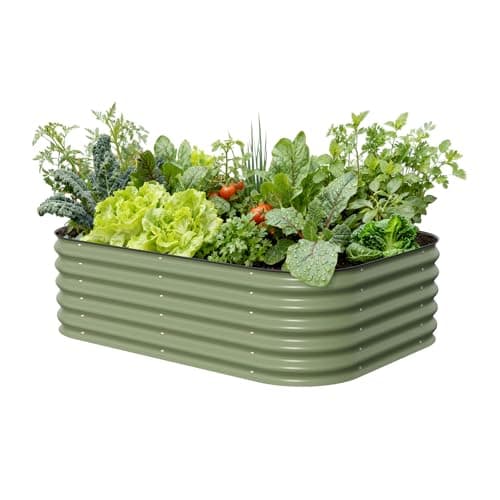 Top pickVego Garden 17" Modular Metal Raised Bed17 in deep, modular Aluzinc steel panels | Most first gardens | 9.2 | $159.95 - View on Amazon |
| 2 | 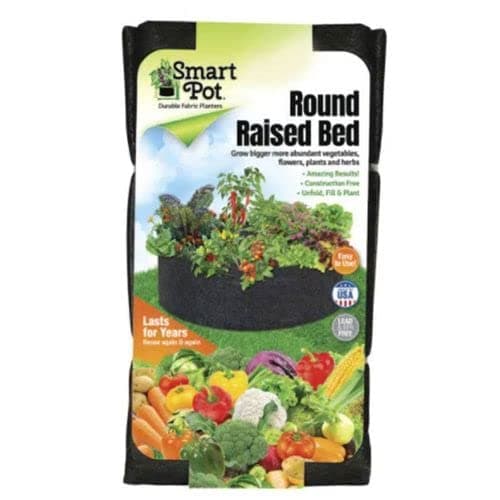 Smart Pot Round Raised Bed, 100 Gallon50 in across, 12 in deep, about 13.5 sq ft | A whole bed's worth | 8.8 | $69.95 - View on Amazon |
| 3 | 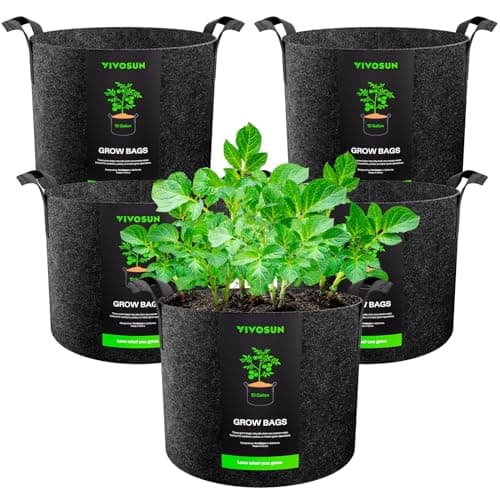 VIVOSUN 5-Pack 10 Gallon Grow BagsFive 10 gal bags with stitched handles | A first set of bags | 8.4 | $20.99 - View on Amazon |
#ad We may earn a commission - Price as of October 5, 2026
Scores are our own editorial judgment, formed from published specifications and independent sources. They are not aggregated customer ratings, and they are not the result of hands-on testing, which we do not currently do. See how we choose.
The soil math is what actually separates them
A 4 x 8 ft bed at 17 inches deep takes roughly 47 cubic feet of mix. Five 10 gallon grow bags take about 6.6 cubic feet in total, and will carry five fruiting plants -- two tomatoes, two peppers and a cucumber, say. Per plant, the bags need something like a quarter of the medium.
That gap is the honest argument for bags, because mix is the expensive part of a first garden. The frame is a one-time purchase; the fill is the bill that surprises people. Run your own numbers with the raised bed soil calculator before you decide, and if a bed is what you want but the fill cost is the obstacle, how to fill a raised garden bed cheaply deals with exactly that problem.
What a bed buys you back
Volume is a buffer. A deep bed holds enough water and enough thermal mass that a hot windy day is an inconvenience rather than an emergency, and extension guidance on containers is explicit that container plants should be checked daily in summer and may need watering twice a day in a small container in hot wind. A bed does not ask that of you.
A bed also keeps its nutrients. Water draining out of a fabric bag carries dissolved nutrients with it, which is why extension container guidance recommends feeding every couple of weeks for long-season crops. Good raised bed mix with compost worked in often carries a season on its own.
And a bed grows what bags cannot. Twelve inches of settled mix in a 10 gallon bag will not produce a decent carrot or parsnip crop. If root vegetables are on your list, that settles it -- see the raised bed size guide for the depths each crop group actually needs.
What bags buy you
- A reversible decision. Nothing is fixed to the property, nothing is dug, and the whole setup folds flat at the end of the season.
- Sun chasing. Fruiting crops want six hours of direct light. In a shaded yard, the ability to move a plant is worth more than any amount of soil depth.
- Hard surfaces. An enclosed-base bag works on a patio, a driveway or a flat roof. A bed on concrete has to be deep enough that the concrete stops mattering.
- A cheap trial. Spending a modest amount to find out whether you enjoy this is a legitimate strategy, and it is the one we would recommend to anyone who has never grown food before.
- Potatoes. A bag with a harvest flap lets you take new potatoes without ending the plant, which is something no bed does.
The hybrid most people end up with
In practice the two formats are not rivals. A bed takes the crops that need depth and continuity -- carrots, garlic, perennial herbs, a strawberry patch -- and bags take the ones you want to move, rotate or add on a whim. Bags are also the overflow when the bed is full in May and you have three tomato seedlings left over.
If you are starting from nothing this spring, the sequence we would follow is bags first, a bed the following year once you know which crops you actually eat. That is the same logic as the rest of this site: buy in the order that each decision gets easier.
Choose a raised bed if
- You own the space, or have permission to put something semi-permanent in it.
- You want carrots, parsnips, garlic or anything else that needs real depth.
- You will be away for the odd few days in summer and need the garden to survive it.
- You are planting more than about six plants, where the per-plant mix cost evens out.
- You want the growing area to look like part of the garden rather than like equipment.
Choose grow bags if
- You rent, or the growing space is a patio, deck or balcony.
- This is your first season and you would rather test the idea cheaply.
- Your sunniest spot moves through the day or across the season.
- You are growing mainly tomatoes, peppers, eggplant, cucumbers or potatoes.
- Daily watering is genuinely realistic for you, or you will run a drip line on a timer.
For specific bags and the size each crop needs, see the best grow bags for vegetables. For frames, the best raised bed kits ranks the metal, cedar and composite options, and raised beds vs containers covers the same decision with rigid pots instead of fabric.
The picks in full
Top pick
Vego Garden 17" Modular Metal Raised Bed
Vego Garden
The modular panel system is the reason to pay the premium: you can reshape the same bed into a different footprint next season without buying a second kit.
Vego is the brand most people meet first, and the modular panel system is the actual reason for that rather than the marketing. The kit arrives as flat corrugated panels plus corner pieces; you bolt them into whichever of the listed footprints suits your yard. If the 4 x 8 rectangle turns out to be wrong for your space, the same panels rebuild into a narrower or L-shaped bed next spring.
The steel matters more than the shape. Aluzinc is a zinc-aluminum-magnesium coating rather than plain galvanizing, and it is the finish you want on something that will sit in wet soil for years. That is the part of the price that buys durability rather than convenience.
Depth is the other thing to weigh. At 17 inches you can grow anything a beginner is likely to want, including carrots and potatoes, without hitting the bottom. The 32-inch version exists mainly so you can garden standing up, which is worth the extra soil cost if bending is the problem you are solving.
What works
- Panels unbolt and rebuild into a different shape
- Aluzinc coating is the better of the two steel finishes in this category
- 17 in is deep enough for carrots, potatoes and tomato roots
- Rolled safety edge along the top rail
What does not
- The most expensive metal bed of the ones we looked at
- Modularity is wasted if you build it once and leave it
- Steel warms fast in full afternoon sun in hot climates
Skip it if: you already know the exact shape you want and will never move it. You are paying for flexibility you would not use, and Vegega gives you the same steel for less.
| Material | Aluzinc-coated steel (zinc-aluminum-magnesium) |
|---|---|
| Depth | 17 in (a 32 in extra-tall version is also sold) |
| Shape | Modular panels, reconfigurable into several footprints |
| Assembly | Bolt-together panels, no cutting |
| Soil needed | About 32 cu ft for a 4 x 8 ft bed at 12 in of fill |
A whole bed's worth
Smart Pot Round Raised Bed, 100 Gallon
Smart Pot
A fabric raised bed rather than a pot: wide enough to plant like a bed, cheap enough to buy two, and it folds flat in October.
This is the grow bag that behaves like a bed -- Smart Pot has also sold it as the Big Bag Bed. At roughly 50 inches across it gives you about 13.5 square feet of planting area -- the same growing area as a 4 x 4 ft frame -- in something that arrives folded in a flat parcel and needs no assembly at all.
Twelve inches of depth is the number that matters. That is enough for lettuce, beans, chard, bush cucumbers, peppers and determinate tomatoes, and it is shallow for carrots, parsnips and a serious potato crop. It is the same depth limit a shallow metal or vinyl bed has.
The cost is the fill. A bed-sized bag needs a bed-sized volume of potting mix, so the bag being inexpensive does not make the project inexpensive. Work out the mix cost first, using the soil calculator on this site, because that number rather than the bag decides whether this is the cheap option for you.
What works
- Gives you bed-scale planting area without a frame to assemble
- Twelve inches of depth is enough for most vegetables, including determinate tomatoes
- Folds flat for winter storage, which no rigid bed does
- Enclosed bottom means you can put it on a patio, gravel or a driveway
What does not
- Needs a full 13.5 sq ft of potting mix, which is the real cost of the format
- Dries out faster than a soil-filled frame of the same depth
- Fabric is a consumable -- plan on replacing it after a few seasons
Skip it if: you want the garden to look built. This is a black fabric circle sitting on the ground, and planting around it does not disguise that.
| Type | Round fabric raised bed |
|---|---|
| Capacity | 100 gal |
| Footprint | About 50 in across |
| Depth | 12 in |
| Growing area | About 13.5 sq ft |
| Base | Enclosed fabric bottom |
| Service life | Manufacturer states 3 to 5 years outdoors |
A first set of bags
VIVOSUN 5-Pack 10 Gallon Grow Bags
VIVOSUN
Five bags for about what one rigid planter costs, and 10 gallons is the size that actually grows a tomato rather than keeping one alive.
Ten gallons is the useful number here. University of Maryland Extension puts the minimum container size for a standard tomato, a pepper, an eggplant or a cucumber at 5 gallons, so a 10 gallon bag is comfortably above the floor rather than at it -- which in practice means fewer collapses on a hot afternoon.
The fabric is mid-weight: thicker than the throwaway bags sold ten to a pack, thinner than the bonded-fabric pots that last a decade. For a first season, while you are deciding whether you like growing this way, that is the right place on the scale.
Fill them with potting mix, not garden soil or raised bed mix. Soil in a container compacts and drains badly, which is the single most common reason a bag of tomatoes underperforms the same plant in the ground.
What works
- Ten gallons is the right size for one tomato, pepper or eggplant
- Handles are stitched rather than glued, so a full bag can be moved
- Five bags let you chase the sun around a patio
- Folds away flat at the end of the season
What does not
- Thinner fabric than the premium bags, so expect a shorter life
- Needs watering far more often than a bed of the same volume
- Dark fabric gets genuinely hot in full afternoon sun
Skip it if: you are growing root crops. Ten gallons is 11 or 12 inches of depth once settled, which is short for carrots and parsnips.
| Type | Nonwoven fabric pot with handles |
|---|---|
| Capacity | 10 gal each |
| Size | Roughly 16 in across and 12 in tall at 10 gal |
| Fabric | Mid-weight nonwoven polypropylene |
| Handles | Reinforced, stitched to the body |
| Pack | 5 bags |
Common questions
Are grow bags as good as raised beds?
For tomatoes, peppers, eggplant, cucumbers and potatoes, a 10 gallon bag grows a comparable crop to a bed. For carrots, parsnips and anything else needing more than a foot of depth, it does not. The bigger practical difference is maintenance: bags need daily watering in summer and regular feeding, where a bed needs neither.
Is it cheaper to use grow bags or build a raised bed?
Bags are much cheaper to start, mainly because of the fill. A 4 x 8 ft bed at 17 inches deep needs roughly 47 cubic feet of mix; five 10 gallon bags need about 6.6 cubic feet and carry five fruiting plants. The bed wins over a decade, because steel lasts and fabric does not.
Can I put grow bags inside a raised bed?
You can, but there is little point -- the bag restricts roots that would otherwise use the bed's full depth. The one case where it helps is isolating a crop with a disease history, or growing something invasive such as mint inside a bed you want to keep clean.
Do grow bags work on a patio or balcony?
Yes, and this is where they are clearly the right answer. A bag with a sewn base holds its own mix and drains onto the surface, so nothing is needed underneath. Stand them on a tray or on feet if runoff staining matters, and remember a black bag on sunny concrete runs hot.
How deep does a raised bed need to be compared with a grow bag?
A 10 gallon grow bag settles at roughly 12 inches, which is the same usable depth as a shallow bed. Beds become genuinely better once you go deeper: 17 inches and up handles root crops, holds more water and gives a tomato root system room that no bag of a sensible size can match.
Sources
Factual claims on this page are backed by the published sources below, and product specifications are the manufacturers’ own. Where a figure is not published, we say so rather than estimating it.
- Growing vegetables in containers and salad tables - University of Maryland Extension
- Grow bags - Oklahoma State University Extension
- Care of plants growing in containers - Iowa State University Extension
- Raised bed gardens - University of Minnesota Extension
- Raised garden bed dimensions, C1027-4 - University of Georgia Extension