Step 4 - Composting
The Best Compost Bins for Leaves
A season of leaf fall is measured in cubic yards. Almost every bin sold for kitchen scraps is the wrong shape for it.
Janet H. - the hands-on owner behind Janet Media Group.
Published
This page contains affiliate links. If you buy through them we may earn a commission at no cost to you, and it never decides what we recommend. How this site is funded.
The short version. The GEOBIN expandable bin is the right buy for leaves and it is also the budget pick: it opens out to roughly two hundred gallons, costs less than most kitchen caddies, rolls up flat in July and can be unclipped and re-pegged next to the pile to turn it. For a tidier bin that keeps leaf litter contained and out of sight near a house, the Redmon 65-gallon is the enclosed alternative. The one thing worth adding to either is a digging fork -- turning is what converts a two-year leaf pile into a one-year one.
Leaves are the easiest material to compost and the hardest to find room for. A single mature maple drops more volume than a household produces in kitchen scraps all year, and that mismatch is why so many people buy a tumbler in October and are still filling bags in November. The bin for this job is big, cheap, and open at the top.
How we chose
The criteria come from Penn State Extension's guidance on composting leaves and the general composting material published by Penn State and Colorado State -- all of which point the same way: leaves are high-carbon, slow, and compost best in bulk, with air and nitrogen as the two limiting factors.
- Volume first. A bin that holds less than about a cubic yard will not hold a yard's leaf fall, and a pile that small struggles to heat.
- Open top, or a lid you can take right off. Leaves are loaded by the armful and watered from above. A hatch is the wrong door for this material.
- It can be moved or opened to turn. The practical way to turn leaves is to lift the bin off, set it down beside the pile and fork the pile back in.
- It folds away. The leaf bin is in use from October to spring. A bin that stores flat is a bin you will actually keep.
- A live price, now. Each pick carries a current price from our price layer, with the date it was checked.
Quick picks
| # | Product | Best for | Score | Price |
|---|---|---|---|---|
| 1 | 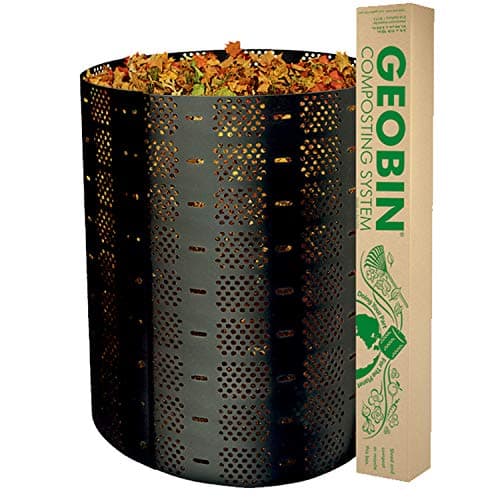 Top pickGEOBIN Expandable Compost BinExpands to roughly 216 gal, 36 in tall | Leaves and yard waste | 8.7 | $35.99 - View on Amazon |
| 2 | 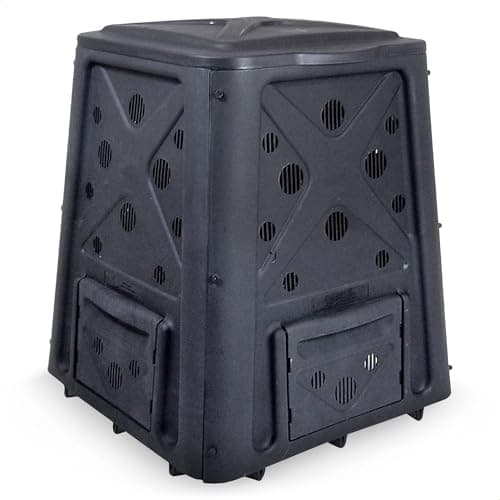 Redmon Green Culture 65-Gallon Compost Bin65 gal enclosed bin with lid and access doors | A lidded static bin | 8.1 | $69.99 - View on Amazon |
| 3 | 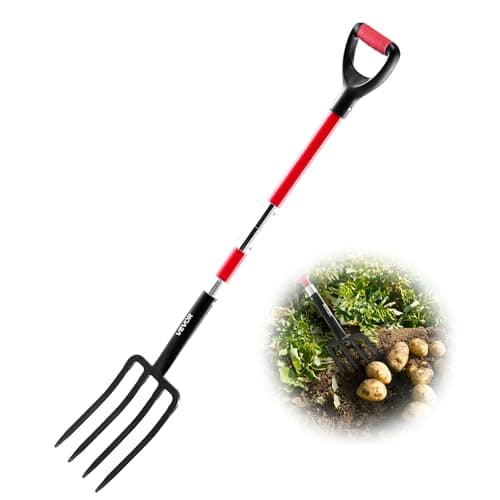 VEVOR 4-Tine Digging Fork, 45 in4 forged steel tines, 45 in fiberglass handle with a Y grip | Actually turning an open heap | 8.7 | $33.90 - View on Amazon |
| 4 |  Jobe's Organics Compost Starter4 lb granular bag, applied in layers as the pile is built | Nitrogen for a pile that is all brown material | 7.0 | $17.59 - View on Amazon |
| 5 | 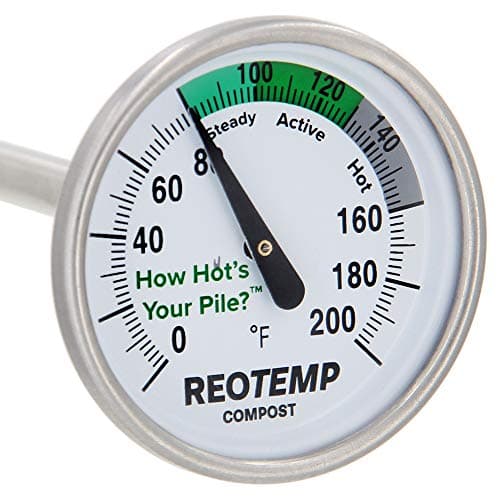 Reotemp 20 in Backyard Compost Thermometer20 in stem, Fahrenheit dial reading to 200°F | Knowing whether the pile is working | 9.1 | $23.99 - View on Amazon |
#ad We may earn a commission - Price as of November 24, 2026
Scores are our own editorial judgment, formed from published specifications and independent sources. They are not aggregated customer ratings, and they are not the result of hands-on testing, which we do not currently do. See how we choose.
Why leaves are slow, and what fixes it
Leaves are almost pure carbon with a tough, waxy structure. Left in a heap they will eventually become leaf mould -- excellent stuff, and the simplest soil improver there is -- but on their own timescale, which is one to two years. Everything you do to speed that up addresses one of three things.
| Limit | What it looks like | The fix |
|---|---|---|
| Carbon with no nitrogen | Pile sits cold and unchanged all winter | Layer in grass clippings, kitchen scraps or a nitrogen starter |
| Particle size | Whole leaves mat into waterproof sheets | Mow over them first; shredded leaves break down far faster |
| Air and moisture | Dry in the middle, slimy at the bottom | Turn it, and water it to the dampness of a wrung sponge |
Shredding is the single highest-return step. A mower run over a leaf pile on a hard surface, or a mulching mower on the lawn, cuts the volume dramatically and breaks the waxy surface so water and microbes can get in. How to compost leaves walks through the whole method; this page is about the container it happens in.
Leaf mould and compost are two different products
It is worth deciding which you want, because the route is different.
- Leaf mould is leaves alone, left damp in a bin or a bag for a year or two. It is a fungal process, not a hot one. The result is a dark crumbly soil conditioner that holds water beautifully but feeds almost nothing.
- Leaf compost is leaves mixed with nitrogen material and turned. It is a bacterial, warm process that finishes in months rather than years and produces a genuine fertility-building compost.
- Both are useful. Leaf mould is the best mulch there is for a raised bed surface; leaf compost is the thing you dig in.
- You can run both. One bin left alone, one bin layered and turned, is how most people end up doing it.
How much bin do you actually need?
Work in cubic yards, because that is how leaves arrive. A mature deciduous tree can drop several cubic yards of loose leaves; a typical suburban lot with a few trees produces somewhere between one and four. Shredding cuts that by roughly half to two thirds before it goes in the bin.
| Your yard | Loose leaves | Bin to buy |
|---|---|---|
| A few small trees | Under 1 cu yd | One 65-gallon enclosed bin is enough |
| Typical suburban lot | 1 to 3 cu yd | One expandable ring, shredded first |
| Mature trees, large lot | 3 cu yd and up | Two rings, or one ring plus a stockpile of bagged leaves |
| No yard, bags from a neighbour | As much as you collect | An expandable ring you can size to the pile |
The expandable ring wins this comparison precisely because it is adjustable: it can be run at three feet across in a small yard and opened out to five or six when the leaves arrive, then folded away in spring. That flexibility is worth more than a lid for this material.
The picks in full
Top pick
GEOBIN Expandable Compost Bin
GEOBIN
Barely a product -- a sheet of perforated plastic you roll into a circle -- and by far the most volume per dollar in composting.
If your composting problem is autumn leaves and grass clippings rather than kitchen scraps, this is the answer and a tumbler is not. Volume is what yard waste needs, and 216 gallons of volume costs less here than 40 gallons costs anywhere else.
The adjustable diameter is genuinely useful: start it small so the pile stays deep enough to heat, and expand it as the material accumulates.
Keep cooked food, meat and dairy out. An open bin with no floor is accessible to every rodent in the neighborhood, and the standard advice on that is not squeamishness, it is experience.
What works
- Enormous capacity for the money
- Adjustable diameter -- start small, expand as you fill it
- Perforations give good airflow through the pile
- Unclips and stores flat
What does not
- No lid, so heavy rain waterlogs it
- No rodent protection whatsoever
- Turning it means a fork and some effort
Skip it if: you are composting cooked food or meat. An open bin is an open invitation, and this one has no lid and no floor.
| Type | Open expandable bin |
|---|---|
| Capacity | Up to about 216 gal depending on diameter |
| Height | 36 in |
| Material | Perforated recycled plastic sheet |
| Assembly | Roll and clip, under five minutes |
A lidded static bin
Redmon Green Culture 65-Gallon Compost Bin
Redmon
The middle ground: more volume than a tumbler, a lid and a floor unlike an open bin, and no turning mechanism to go wrong.
A static bin is the traditional answer and it still works. You add material at the top, it breaks down, and finished compost comes out of the doors at the bottom months later.
The lid is the reason to choose this over an open bin. Composting needs the mix damp, not saturated, and an uncovered pile in a wet climate turns into an anaerobic, sour mess.
If you want it faster, fork it over every few weeks. Turning is what a tumbler does mechanically, and doing it by hand gets you most of the same speed for none of the money.
What works
- Lid keeps rain out and heat in
- Base doors let you take finished compost from the bottom
- Good capacity for a mixed kitchen and garden stream
- Nothing mechanical to break
What does not
- Slow unless you turn it with a fork
- Base doors clog if the material is too wet
- Panels can be fiddly to assemble
Skip it if: you want compost quickly. A static bin without regular forking is a year-long process, not a three-week one.
| Type | Static enclosed bin |
|---|---|
| Capacity | 65 gal |
| Access | Lid on top, sliding doors at the base |
| Material | Recycled plastic panels |
| Assembly | Snap-together panels |
Actually turning an open heap
VEVOR 4-Tine Digging Fork, 45 in
VEVOR
Nothing moves a compost heap like a fork. If you have an open pile and room beside it, this is the tool that does the real work -- everything else on this page is a workaround for not owning one.
It feels wrong to put a garden fork in a roundup of composting accessories, and it is also the most honest recommendation on the page. Colorado State University Extension's own instruction is to fluff or turn the material with a pitchfork or aerator tool at regular intervals, and between those two, the fork does far more per minute.
A proper turn means moving the heap sideways into a second bay or a space beside it, so the dry outside material ends up in the middle and the hot middle ends up where the air is. Nothing you push down into a bin achieves that. It is also the fastest way to even out moisture, which is usually the real problem with a stalled pile.
Four forged tines with a fiberglass handle is the sensible specification. Wooden handles are nicer to hold and worse at being left against the bin in February. The Y grip gives you something to twist against when the material is matted.
If your compost is in a closed bin or a tumbler, skip it and buy an aerator instead -- a fork needs an open heap to be any use at all.
What works
- Moves more material in five minutes than an aerator does in an hour
- A real turn -- outside to inside, bottom to top -- which is what speeds decomposition
- Earns its keep outside the compost bay: lifting potatoes, loosening beds, moving mulch
- Fiberglass handle shrugs off being left out in the rain the way a wooden one does not
- Four tines are wide-set enough to let compost fall through rather than clogging
What does not
- Needs an open heap and somewhere to turn it into -- useless for a sealed bin
- Turning a full heap is heavy work and not a small job
- A digging fork is not a manure fork; very loose, strawy material slips between the tines
- One more long-handled tool to store
Skip it if: your compost lives in a sealed bin or a tumbler. A fork needs an open heap and space to throw material into.
| Tines | 4, forged steel |
|---|---|
| Length | 45 in overall (manufacturer) |
| Handle | Fiberglass with a Y grip |
| Also used for | Lifting potatoes, moving hay, loosening soil |
Nitrogen for a pile that is all brown material
Jobe's Organics Compost Starter
Jobe's
Useful as a nitrogen source for a pile made mostly of leaves -- and genuinely unnecessary for anything else, which is not what the category name implies.
This entry is here with a warning attached, because the honest answer is that most people reading about compost starters do not need one. Colorado State University Extension states it without hedging: compost starters or inoculums are not needed to start decomposition. The microbes arrive on the material and in the soil underneath it.
There is one situation where a product like this genuinely helps, and it is common in October. If your pile is nothing but fallen leaves, it is almost all carbon, and Extension's target ratio of roughly thirty parts carbon to one part nitrogen is nowhere in sight. A pile like that sits there for a year. Adding nitrogen gets it moving.
What it is, then, is a nitrogen supplement in a convenient granular form. That is a reasonable thing to buy if you have no grass clippings, no kitchen waste going to the pile, and no access to manure. It is a waste of money if you have any of those, because they do the same job for nothing.
If a pile is not heating, check the three likelier causes first: too dry, too small, or too much brown material. Extension's minimum size for a pile that heats is 3 x 3 x 3 ft, and the moisture target is damp but not soggy -- no more than a few drops when you squeeze a handful. Fix those before buying anything.
What works
- A convenient nitrogen source when you have a mountain of leaves and nothing green
- Granular, so it goes on in layers without mixing or measuring
- One bag treats a substantial amount of material
- Much easier to store than keeping a bag of fresh manure around
- Harmless to the process -- the risk here is wasting money, not damaging the pile
What does not
- Not needed for a normal mixed pile: Extension states plainly that compost starters are not required to start decomposition
- It is really a nitrogen supplement; the word 'starter' oversells what it does
- Grass clippings, coffee grounds or a handful of garden soil do much the same job for nothing
- Easy to reach for instead of fixing the actual problem, which is usually too dry or too small a pile
Skip it if: your pile already gets kitchen scraps, grass clippings or any other green material. Extension is clear that starters are not needed to begin decomposition.
| Form | Granular |
|---|---|
| Size | 4 lb bag |
| Use | Sprinkled between layers as the pile is built |
| Category | Compost accelerator / starter |
Knowing whether the pile is working
Reotemp 20 in Backyard Compost Thermometer
Reotemp
The one composting accessory that tells you something you cannot guess. A 20 inch stem reaches the core of a backyard pile, which is the only place the reading means anything.
Almost everything else on this page speeds up a process you could do by hand. A thermometer does something different: it tells you what is going on in the middle of the pile, which is information you cannot get any other way.
The numbers are worth knowing before you buy one. Colorado State University Extension puts the working range of plant-digesting microbes at 70 to 140°F, notes that a well-managed summer pile quickly reaches 120 to 130°F, and warns that above about 160°F the microbes themselves start dying. It also sets the bar for killing weed seeds and pathogens high: only a pile that heats above 145°F and is turned regularly does that reliably.
Those three thresholds turn a reading into an action. Cold means the pile is short of nitrogen, short of water or too small. Hot and climbing past 160 means turn it now to shed heat. Steady in the 120s to 140s means leave it alone, which is the most useful instruction a thermometer ever gives.
Stem length is the one specification to get right. Twenty inches reaches the core of the 3 x 3 x 3 ft pile Extension describes as the minimum size for heating. If your heap is bigger or deeper than that, the 36 inch version is the one to buy -- a reading taken near the surface tells you about the weather, not the compost.
What works
- Twenty inches reaches the middle of a 3 x 3 ft pile, where the heat actually is
- A zoned dial means you can read it at a glance without memorizing numbers
- Settles the two questions that matter: is it working, and is it too hot
- No batteries, nothing to calibrate, nothing to go flat in a cold shed
- Cheap relative to everything else in a composting setup
What does not
- Only useful if you act on the reading -- it measures, it does not fix
- A 20 inch stem is short for a large or deep heap; the 36 inch version exists for that
- The probe bends if you force it into matted, woody material
- Fahrenheit-only dial, so check the model if you think in Celsius
Skip it if: you compost slowly in a bin and do not intend to manage the process. A thermometer is a tool for people who turn piles, not for people who fill a bin and wait.
| Stem length | 20 in |
|---|---|
| Scale | Fahrenheit |
| Range | Reads to 200°F (manufacturer) |
| Dial | Zoned face for steady, active and hot |
| Included | Digital composting guide (manufacturer) |
| Other sizes | 16 in and 36 in versions are sold separately |
Common questions
What kind of compost bin is best for leaves?
A large, open-topped ring or an expandable wrap-around bin. Leaves are loaded by the armful and need volume and air more than they need a lid, and the easiest way to turn them is to lift the bin off and fork the pile back in. Enclosed bins work for smaller quantities near a house.
How long do leaves take to compost?
One to two years on their own as leaf mould. Shredded, mixed with a nitrogen source such as grass clippings or kitchen scraps, kept damp and turned a few times, they can finish in a single season. The three limits are particle size, nitrogen and air.
Can you put leaves in a compost tumbler?
Not usefully. A tumbler is sized for dense, nitrogen-rich material that heats fast. Dry whole leaves are too bulky and too light, and they mat instead of tumbling. Use the tumbler for kitchen scraps and give the leaves their own open bin.
Should I shred leaves before composting?
Yes, if you can. Running a mower over them cuts the volume by half or more and breaks the waxy surface so water and microbes get in. It is the single biggest difference between leaves that compost in a season and leaves that sit there until the following autumn.
What is the difference between leaf mould and leaf compost?
Leaf mould is leaves alone, broken down slowly by fungi into a dark, water-holding soil conditioner with very little nutrient value. Leaf compost is leaves mixed with nitrogen material and turned, which runs a warmer bacterial process and produces a genuine fertility-building compost in a fraction of the time.
Sources
Factual claims on this page are backed by the published sources below, and product specifications are the manufacturers’ own. Where a figure is not published, we say so rather than estimating it.