Step 4 - Composting
Compost Bin vs Compost Pile
A pile is free and it composts. A bin buys tidiness, rain control, heat retention and -- if enclosed -- rodent resistance. Which of those you need decides it.
Janet H. - the hands-on owner behind Janet Media Group.
Published
This page contains affiliate links. If you buy through them we may earn a commission at no cost to you, and it never decides what we recommend. How this site is funded.
Use an open pile if you have space out of sight, plenty of yard waste, no rodent problem and no neighbours overlooking it -- it composts perfectly well and costs nothing. Use a bin if any one of those is untrue. The decomposition is the same biology either way; what you are buying is containment, rain control, heat retention and appearance.
| Open pile | Compost bin | |
|---|---|---|
| Cost | Nothing | From very little to substantial |
| Capacity | Unlimited -- as big as you build it | Fixed, from about 35 to over 200 gal |
| Speed | Fast if large and turned; slow if small | Similar, but heat is retained better |
| Rain | Soaks in winter, dries in summer | A lid controls both |
| Rodents | Accessible | Enclosed bins resist; open bins do not |
| Appearance | A heap | Contained and tidy |
| Turning | Fork, and it is real work | Fork, or a handle on a tumbler |
| Minimum size to heat up | Roughly a cubic yard | Smaller volumes still warm in an enclosed bin |
Quick picks
| # | Product | Best for | Score | Price |
|---|---|---|---|---|
| 1 | 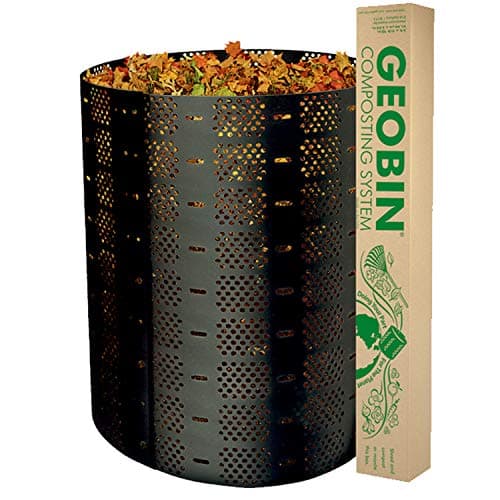 Top pickGEOBIN Expandable Compost BinExpands to roughly 216 gal, 36 in tall | Leaves and yard waste | 8.7 | $35.99 - View on Amazon |
| 2 | 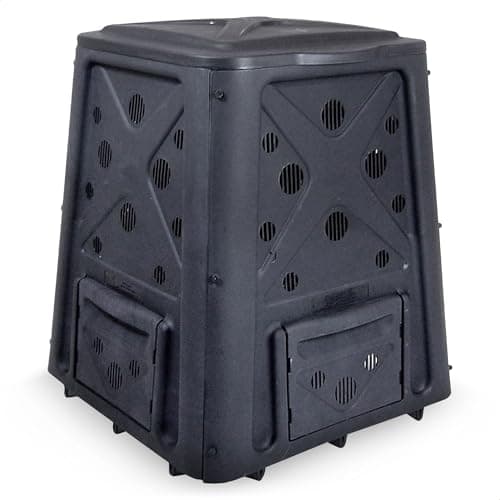 Redmon Green Culture 65-Gallon Compost Bin65 gal enclosed bin with lid and access doors | A lidded static bin | 8.1 | $69.99 - View on Amazon |
| 3 |  FCMP Outdoor IM4000 Tumbling ComposterDual chamber, roughly 37 gal total | Most backyards | 9.1 | Check price on Amazon |
#ad We may earn a commission - Price as of October 10, 2026
Scores are our own editorial judgment, formed from published specifications and independent sources. They are not aggregated customer ratings, and they are not the result of hands-on testing, which we do not currently do. See how we choose.
Why size matters more for a pile
A compost heap heats up because the mass insulates itself: the centre of a large pile holds the warmth the microbes generate, while a small heap loses it to the air as fast as it is made. Extension guidance puts the practical minimum for a pile that will heat at roughly a cubic yard -- about 3 feet in every direction.
That is the real limitation of a pile in a small garden. Below that volume you still get compost, but it is a slow cold process over many months rather than an active hot one over weeks. A bin's walls do some of the insulating work, so a smaller volume in a bin behaves better than the same volume heaped on the ground.
What a bin actually buys you
- Rain control. A lid is the most underrated feature in composting. An uncovered heap waterlogs in a wet winter and turns anaerobic and sour.
- Heat retention. Walls insulate. A bin gets going faster in spring and keeps going later into autumn than an exposed heap of the same size.
- Rodent resistance -- but only if enclosed. A sealed tumbler off the ground is genuinely resistant. An open-bottomed plastic bin is not; it is a tidy heap.
- Appearance and neighbours. Often the real reason, and a perfectly good one.
- Keeping the dog and the wildlife out. Also often the real reason.
Notice what is not on that list: faster composting, in itself. A well-built, well-turned heap of adequate size outperforms a neglected bin comfortably. The bin makes good practice easier; it does not substitute for it.
Three situations that settle it
You rake leaves. Autumn leaf fall from even one mature tree produces more material than a 37 gallon tumbler holds. Either heap it, or buy a large expandable open bin, which is essentially a tidy heap with a wall around it and the cheapest capacity per gallon you can buy.
Rodents are a known local problem. That alone is a reason for an enclosed system. An open heap -- and an open-bottomed bin -- is accessible, which is why the standard advice to keep meat, fish, dairy, oils and cooked food out matters more there.
The compost area is in view. A heap is a heap. If it is going to be visible from the patio or from next door, a bin is worth the money for that reason alone, and nobody should feel the need to justify it further.
The best of both
A great many gardens end up running two systems, and it is not redundant. A tumbler or a small enclosed bin takes the kitchen scraps near the house -- sealed, rodent-resistant, and fast. A large open bin or a heap at the bottom of the garden takes the leaves, grass and prunings, where volume matters and speed does not.
That pairing costs very little more than one good bin and it handles genuinely different material. The best compost bins ranks the enclosed options, and compost bin vs tumbler covers the speed-versus-volume question in detail.
Building a heap that actually works
A heap is not a mound of scraps, and the difference between a working heap and a wet lump is about ten minutes of thought. Start on bare soil rather than on a hard surface, so worms and soil organisms can move up into it and so excess water can drain away. Lay a base of coarse browns -- woody prunings or a thick layer of leaves -- which keeps air moving under the pile.
Then build in layers rather than tipping everything in a heap: greens, then a thicker layer of browns, repeated. Finish with browns on top, which is what stops flies and smell. Cover it if your winters are wet. If you can get it to roughly 3 feet in each direction in one go, it will heat; if you are adding to it gradually, accept that it is a cold slow pile and give it a year.
Turning it with a fork every few weeks reintroduces oxygen and mixes wet with dry, and closes most of the speed gap with any bin on the market for no cost at all.
Choose an open pile if
- You have room for something roughly 3 feet in every direction, out of sight.
- Most of your material is leaves, grass and garden waste.
- You will fork it over occasionally, or you are happy to wait a year.
- Rodents are not a known problem where you are.
- You would rather spend the money on soil or seeds.
Choose a bin if
- Space is limited or the area is on view.
- Your waste is mostly kitchen scraps rather than yard waste.
- Rodents, dogs or wildlife are a concern.
- You want compost this season rather than next.
- You want the lid, which handles both a wet winter and a dry summer.
Either way the material and the ratio are the same, and that is where the result is really decided -- what to put in a compost bin applies identically to a heap.
The picks in full
Top pick
GEOBIN Expandable Compost Bin
GEOBIN
Barely a product -- a sheet of perforated plastic you roll into a circle -- and by far the most volume per dollar in composting.
If your composting problem is autumn leaves and grass clippings rather than kitchen scraps, this is the answer and a tumbler is not. Volume is what yard waste needs, and 216 gallons of volume costs less here than 40 gallons costs anywhere else.
The adjustable diameter is genuinely useful: start it small so the pile stays deep enough to heat, and expand it as the material accumulates.
Keep cooked food, meat and dairy out. An open bin with no floor is accessible to every rodent in the neighborhood, and the standard advice on that is not squeamishness, it is experience.
What works
- Enormous capacity for the money
- Adjustable diameter -- start small, expand as you fill it
- Perforations give good airflow through the pile
- Unclips and stores flat
What does not
- No lid, so heavy rain waterlogs it
- No rodent protection whatsoever
- Turning it means a fork and some effort
Skip it if: you are composting cooked food or meat. An open bin is an open invitation, and this one has no lid and no floor.
| Type | Open expandable bin |
|---|---|
| Capacity | Up to about 216 gal depending on diameter |
| Height | 36 in |
| Material | Perforated recycled plastic sheet |
| Assembly | Roll and clip, under five minutes |
A lidded static bin
Redmon Green Culture 65-Gallon Compost Bin
Redmon
The middle ground: more volume than a tumbler, a lid and a floor unlike an open bin, and no turning mechanism to go wrong.
A static bin is the traditional answer and it still works. You add material at the top, it breaks down, and finished compost comes out of the doors at the bottom months later.
The lid is the reason to choose this over an open bin. Composting needs the mix damp, not saturated, and an uncovered pile in a wet climate turns into an anaerobic, sour mess.
If you want it faster, fork it over every few weeks. Turning is what a tumbler does mechanically, and doing it by hand gets you most of the same speed for none of the money.
What works
- Lid keeps rain out and heat in
- Base doors let you take finished compost from the bottom
- Good capacity for a mixed kitchen and garden stream
- Nothing mechanical to break
What does not
- Slow unless you turn it with a fork
- Base doors clog if the material is too wet
- Panels can be fiddly to assemble
Skip it if: you want compost quickly. A static bin without regular forking is a year-long process, not a three-week one.
| Type | Static enclosed bin |
|---|---|
| Capacity | 65 gal |
| Access | Lid on top, sliding doors at the base |
| Material | Recycled plastic panels |
| Assembly | Snap-together panels |
Most backyards
FCMP Outdoor IM4000 Tumbling Composter
FCMP Outdoor
#ad We may earn a commission - prices are shown by Amazon, not by us
Two chambers is the whole point: you keep adding to one side while the other finishes, so you get a batch out instead of a bin that is never quite ready.
The single-chamber problem is why most first composters give up. You keep adding kitchen scraps to the same bin, so the contents are always part-finished, and you can never take any out.
Two chambers solves it mechanically. Fill side A until it is full, then switch to side B and leave A alone. By the time B is full, A is finished compost you can empty in one go. In warm weather that cycle runs in a matter of weeks.
Understand the capacity limit going in. Around 37 gallons total is generous for kitchen scraps from a household, and small if you also want to compost lawn clippings and autumn leaves. Those belong in an open bin.
What works
- Dual chambers give you a finishing batch and an active batch at once
- Off the ground, so rodents are not the problem they are with an open pile
- Turning is a handle pull rather than a fork job
- Closed drum keeps rain from waterlogging the mix
What does not
- Capacity fills fast if you also compost yard waste
- Heavy to turn when a chamber is full and wet
- Assembly takes longer than the box suggests
Skip it if: you generate a lot of yard waste. A tumbler is volume-limited by design, and a big open pile handles leaves and grass far better.
| Type | Rotating dual-chamber tumbler |
|---|---|
| Capacity | About 37 gal across two chambers |
| Material | UV-resistant recycled polypropylene |
| Aeration | Deep fins and internal mixing bar |
| Assembly | Bolt-together frame and drum |
Common questions
Is a compost bin better than a compost pile?
Not biologically -- the decomposition is the same. A bin buys containment, rain control, heat retention, tidiness and, if it is fully enclosed, rodent resistance. A well-built and well-turned heap of adequate size outperforms a neglected bin, so the bin makes good practice easier rather than replacing it.
How big does a compost pile need to be to work?
Roughly a cubic yard -- about 3 feet in every direction -- for a pile that will heat up, because the mass has to insulate its own centre. Below that you still get compost, but as a slow cold process over many months rather than an active one over weeks. A bin's walls do some of that insulating work.
Do compost piles attract rats?
An open heap is accessible, so it can. The standard advice to keep meat, fish, dairy, oils and cooked food out matters more for a heap than for a sealed system, and burying fresh scraps under dry browns helps considerably. If rodents are a known local problem, choose an enclosed bin.
Should I cover my compost pile?
In a wet climate, yes. An uncovered heap waterlogs over winter and turns anaerobic and sour; a tarp or a lid prevents it. In a dry summer a cover also stops the heap drying out to the point where nothing happens. Rain control is the most underrated benefit of a bin.
Can I just pile up my kitchen scraps?
You can, but it is the one case where a heap is the weaker option. Kitchen scraps are wet and nitrogen-rich, so an uncontained pile of them goes sour and is attractive to rodents. Either mix in plenty of dry browns and bury each addition, or use an enclosed bin near the house.
Sources
Factual claims on this page are backed by the published sources below, and product specifications are the manufacturers’ own. Where a figure is not published, we say so rather than estimating it.