Step 1 - Raised Beds
The Best Raised Beds for Flowers
A vegetable bed is chosen on capacity. A flower bed is chosen on how it looks from the house -- and then has to grow something anyway.
Janet H. - the hands-on owner behind Janet Media Group.
Published
This page contains affiliate links. If you buy through them we may earn a commission at no cost to you, and it never decides what we recommend. How this site is funded.
The short version. For a flower bed that will be looked at every day, the Greenes Fence cedar kit is the pick: untreated cedar in a dovetailed frame reads as a garden feature rather than a container, and it is the only common material that improves as it weathers. If you want cedar's look without cedar's lifespan, the Frame It All composite is the long-run answer -- stackable, so you can build a two-tier bed with a planting edge. The budget pick is the Yaheetech elevated fir planter: waist height, finished on all four sides, and the easiest way to put flowers on a patio or beside a door.
Flowers change the brief in two ways. First, the bed is permanently on display, so the frame is part of the planting rather than a tray under it. Second, perennials stay put -- you are not emptying and refilling this bed each spring, so corner joints, frost heave and how the material ages matter far more than they do on a vegetable bed you rebuild anyway.
How we chose
- It has to look finished from every angle. A front-garden bed is seen from the street, the path and the window. Exposed brackets and bare bolt heads count against it.
- It has to hold a square corner for years. Perennials are not moved. A frame that bows at the long sides pulls planting out of line permanently.
- Depth enough for a mixed border. Eight inches runs annuals; twelve or more is what lets you mix shrubs, bulbs and perennials in one bed.
- Drainage without washout. Flower beds often sit on paving or against a house wall, where a bed that drains sideways stains the surface.
- A live price, now. Each pick carries a current price from our price layer.
- No invented awards. Scores are editorial judgment from published specifications, not testing or rating averages.
Quick picks
| # | Product | Best for | Score | Price |
|---|---|---|---|---|
| 1 | 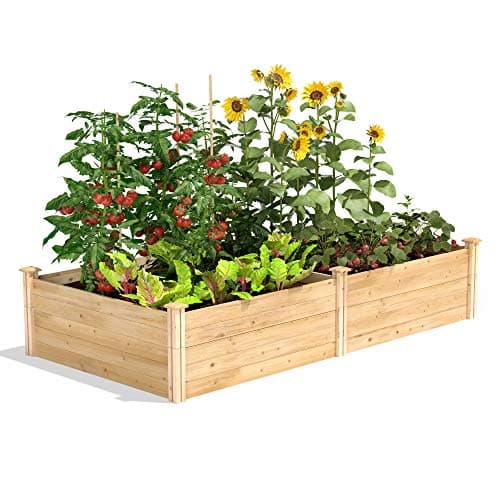 Top pickGreenes Fence Cedar Raised Garden Bed KitUntreated North American cedar, dovetail corners | People who want wood | 8.4 | $227.03 - View on Amazon |
| 2 | 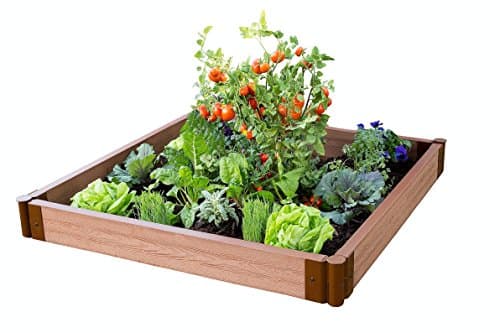 Frame It All Composite Raised BedRecycled composite boards, stackable system | Wood looks without wood rot | 8.3 | $103.47 - View on Amazon |
| 3 | 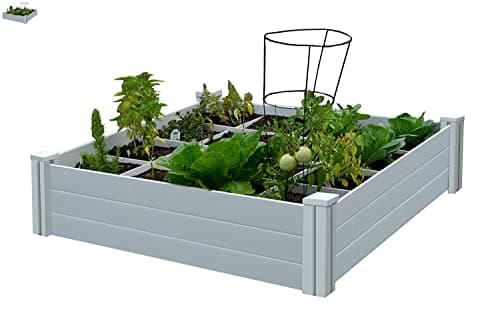 Vita Classic 4 x 4 ft Vinyl Raised Garden Bed11 in deep food-grade vinyl, tool-free posts | A tidy bed with no upkeep | 8.1 | $80.00 - View on Amazon |
| 4 | 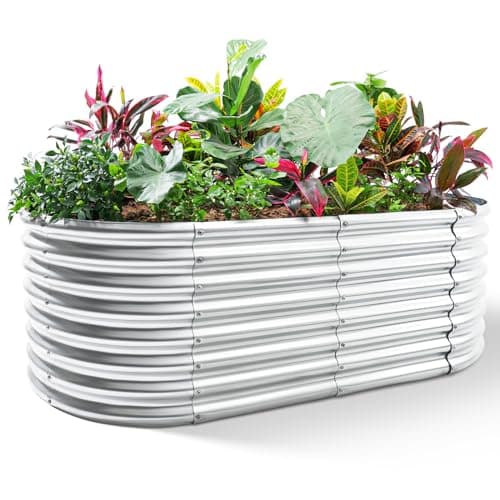 Land Guard Galvanized Raised Garden BedGalvanized steel, large footprints, budget price | Most growing area per dollar | 8.2 | $63.99 - View on Amazon |
| 5 | 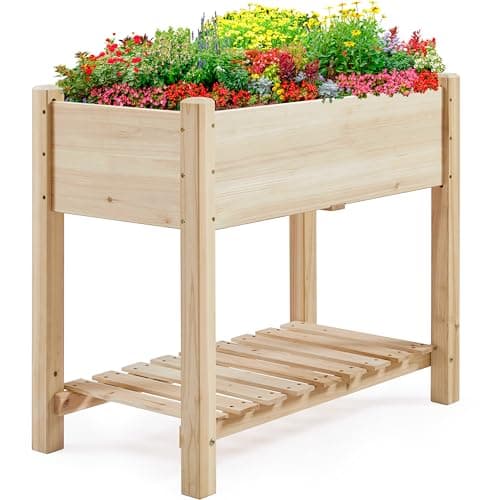 Yaheetech Elevated Wooden Planter BoxWaist-height fir planter with drainage liner | Balconies and bad backs | 8.0 | $47.99 - View on Amazon |
#ad We may earn a commission - Price as of November 24, 2026
Scores are our own editorial judgment, formed from published specifications and independent sources. They are not aggregated customer ratings, and they are not the result of hands-on testing, which we do not currently do. See how we choose.
Material decides how the bed ages
On a vegetable bed, material is a durability question. On a flower bed it is an appearance question that happens to also be a durability question, because the bed is in view for its whole life.
| Material | How it ages | Where it belongs |
|---|---|---|
| Untreated cedar | Silvers to grey, stays sound, softens into the planting | Front gardens, cottage borders, anywhere informal |
| Recycled composite | Holds its colour and edge; no silvering | Formal layouts, tiered beds, terraces |
| Food-grade vinyl | Stays white; wants an occasional wash | Tidy, modern, low-maintenance schemes |
| Galvanized steel | Dulls to matte grey, may spot at the seams | Contemporary gardens and cutting beds |
| Painted softwood | Needs repainting every two or three years | Only if you enjoy repainting |
There is no wrong answer here, only a mismatch -- steel in a cottage border and cedar against a rendered modern wall both look like the bed came from a different garden. If you are weighing the two most common choices, metal vs wood raised beds covers it in full.
Depth for a mixed border
Annual bedding will flower in eight inches. A mixed border will not, because the point of a border is layering -- bulbs under perennials under a small shrub -- and each of those occupies a different part of the profile.
- 8 in: annual bedding, violas, alyssum, a summer display you replant each year.
- 11 to 12 in: most herbaceous perennials, spring bulbs, dwarf grasses. This is the sensible default.
- 17 in and up: small shrubs, roses, peonies, anything you expect to leave alone for a decade.
- Elevated planters: treat as 8 to 10 in whatever the leg height. The growing box is shallow by necessity.
Siting: the part people get wrong
A vegetable bed goes where the sun is. A flower bed goes where it will be seen, which is often a shadier and more awkward spot -- against a north wall, along a path, in the strip between drive and fence. Two consequences follow.
The first is that plant choice has to follow the site rather than the other way round; no bed fixes four hours of light. The second is drainage. A bed sitting on paving or a drive will stain the surface below as fines wash through, so line the base with landscape fabric rather than plastic -- it holds the soil while letting water out. Do raised beds need a liner? goes through the cases where a liner helps and the ones where it causes a problem.
The picks in full
Top pick
Greenes Fence Cedar Raised Garden Bed Kit
Greenes Fence
Real untreated cedar with tool-free dovetail corners -- the honest wood option, with the shorter lifespan that comes with wood.
Cedar is chosen for looks and for the fact that it is untreated, which matters if you are uneasy about what a pressure-treated board leaches into a bed you eat from. Cedar's natural oils slow rot without any chemistry at all.
The dovetail corner system is the reason to buy this particular kit rather than cutting boards yourself: the ends slot together, no hardware, and a second kit stacks on top to take a 7-inch tier up to 14 inches. That is worth doing -- one tier is too shallow for much beyond lettuce and herbs.
Set expectations on lifespan. In a wet climate a cedar bed is a multi-year item, not a permanent structure, and the boards touching soil go first.
What works
- Genuinely untreated cedar, no chemical concerns for food crops
- Tool-free dovetail corners go together in minutes
- Stack a second kit to double the depth
- Looks right in an ornamental garden
What does not
- Wood is a consumable -- expect years, not decades
- A single tier is shallow for root crops
- Cedar prices move a lot season to season
Skip it if: you want to buy a bed once. Even cedar is a wearing part in a wet climate, and steel is the better long-run answer.
| Material | Untreated North American cedar |
|---|---|
| Depth | Stackable boards, commonly 7 in per tier |
| Assembly | Dovetail corner joints, no tools required |
| Expandable | Kits stack to add depth |
| Soil needed | About 18 cu ft for 4 x 8 ft at 7 in |
Wood looks without wood rot
Frame It All Composite Raised Bed
Frame It All
Composite boards that look like timber and do not rot, with a stacking system that lets you add depth a tier at a time.
Composite splits the difference between cedar and steel: it reads as timber from a few feet away and it does not rot. If the bed is going somewhere visible and steel looks too industrial for the setting, this is the option that solves that.
The stacking system is genuinely useful. Start with one 6-inch tier for salads and herbs, and add a second when you want to grow something with a deeper root, rather than committing to a full fill on day one.
Price is the real objection. Per square foot of growing area you are near premium steel territory, which makes this a choice about appearance more than value.
What works
- Will not rot, split or need re-staining
- Curved boards allow shapes steel kits cannot make
- Stacks to whatever depth you want
- Made from recycled material
What does not
- Expensive per square foot
- Heavier to move than steel panels
- Fewer color options than it first appears
Skip it if: cost per square foot is your deciding number. Composite is priced closer to premium steel than to cedar.
| Material | Recycled composite boards |
|---|---|
| Depth | Stackable tiers, commonly 6 in each |
| Shapes | Straight and curved boards for custom layouts |
| Assembly | Slot into corner joints |
| Soil needed | About 16 cu ft for 4 x 8 ft at 6 in |
A tidy bed with no upkeep
Vita Classic 4 x 4 ft Vinyl Raised Garden Bed
Vita
Board-and-post vinyl that goes together in about twenty minutes and never needs staining -- the lowest-maintenance of the kits sold on a store shelf.
Vinyl is the family most people overlook, and it earns its place on one argument: there is no maintenance at all. Cedar weathers and eventually rots, steel can scuff at the cut edges, and this does neither. The boards slide down into corner posts with no fasteners, so assembly is genuinely a twenty-minute job for one person.
The trade is depth. Eleven inches is enough for salad, bush beans, chard, herbs, strawberries and determinate tomatoes, and it is not enough for carrots, parsnips or a decent potato crop. Buy it knowing which half of the seed catalog it serves rather than discovering that in July.
Volume is modest too -- a 4 x 4 ft frame takes roughly 13.5 cubic feet of mix, which is one of the cheapest fills on this page and a real part of the appeal if the soil bill is what has been putting you off.
What works
- Tool-free assembly -- boards drop into the posts
- Nothing to stain, seal or re-treat, ever
- A white frame reflects more sun than dark steel in a hot yard
- The Grow Grid version marks out square-foot spacing for you
What does not
- Eleven inches is shallow for anything with a long root
- It reads as white vinyl fencing, which will not suit every garden
- A narrower range of sizes than the steel and cedar lines
Skip it if: you want carrots or potatoes. Eleven inches is the whole depth of the classic frame, and it does not stack the way a cedar or composite kit does.
| Material | Food-grade vinyl, BPA and phthalate free (manufacturer's figures) |
|---|---|
| Size | About 48 x 48 in, 11 in high |
| Assembly | Boards slide into corner posts, no tools |
| Warranty | 20-year limited, per the manufacturer |
| Soil needed | About 13.5 cu ft to fill |
Most growing area per dollar
Land Guard Galvanized Raised Garden Bed
Land Guard
The cheapest honest way to get a large steel bed, as long as you accept plain galvanizing instead of an Aluzinc coating.
If the goal is to grow the most food this year for the least money, area beats coating. A large cheap bed you can actually fill will feed you better than a small premium one, and Land Guard exists for exactly that calculation.
Understand what you are giving up. Plain galvanizing is a zinc coating; Aluzinc adds aluminum and magnesium and holds up considerably better at the soil line, which is where beds fail. Expect good years rather than decades.
The panels are thinner too, so use the supplied braces and do not skip the center support on the long sizes.
What works
- Lowest cost per square foot of growing area
- Large sizes available in one kit
- Simple assembly with basic tools
- Good way to trial a big bed before committing
What does not
- Plain galvanizing, not the longer-lived Aluzinc
- Thinner panels flex more when filled
- Edges deserve a careful check during assembly
Skip it if: you want the bed to outlive the mortgage. Plain galvanized steel is fine for years, not decades, especially where soil stays wet.
| Material | Galvanized steel |
|---|---|
| Depth | Commonly 12 in and 17 in |
| Footprint | Large rectangles including 8 x 4 ft |
| Assembly | Bolt-together panels |
| Soil needed | About 32 cu ft for 8 x 4 ft at 12 in |
Balconies and bad backs
Yaheetech Elevated Wooden Planter Box
Yaheetech
A standing-height planter on legs for patios and balconies, where the point is reach rather than growing volume.
An elevated planter is a different product from a raised bed, even though the categories get mixed together. You are buying reach: a box at waist height that you can work at standing up, on a surface where digging is not an option.
The trade is depth. Eight to ten inches of soil is plenty for salad leaves, bush beans, herbs, chard and dwarf tomatoes, and not enough for anything that makes a long root. Plan the planting list around that instead of fighting it.
Small soil volumes dry fast, so this is the one bed type where a mulch layer and a watering habit really are the difference between a crop and a disappointment.
What works
- No bending at all -- true standing height
- Fits a balcony, deck or patio where a ground bed cannot go
- Small soil volume keeps the fill cost low
- Easy one-person assembly
What does not
- Shallow box rules out carrots, parsnips and potatoes
- Dries out quickly in summer and needs frequent watering
- Softwood frame will weather faster than cedar
Skip it if: you want to grow root crops. The growing box on an elevated planter is shallow by design -- it has to be, or the legs could not hold it.
| Material | Fir wood frame with liner |
|---|---|
| Working height | About 30 in to the rim |
| Soil depth | Typically 8 to 10 in in the box |
| Drainage | Slatted base with liner |
| Soil needed | Usually under 6 cu ft |
Common questions
How deep should a raised flower bed be?
Eleven to twelve inches suits most herbaceous perennials and spring bulbs and is the sensible default. Eight inches is enough for annual bedding only. Go to seventeen inches or more if you want to plant small shrubs or roses and leave them undisturbed for years.
What is the best material for a raised flower bed?
Untreated cedar if you want the bed to soften into the planting as it silvers, recycled composite if you want it to hold its colour and edge, food-grade vinyl if you want it to stay white with almost no upkeep. Galvanized steel is durable and suits contemporary gardens but reads as modern wherever you put it.
Can I use raised bed soil mix for flowers?
You can, but most purpose-made mixes are richer than ornamental perennials want, and over-fed perennials grow soft and flop. Cut a bagged bed mix with topsoil or a mineral component, and feed a flower bed far less often than you would a vegetable bed.
Can a raised flower bed sit on a patio or driveway?
Yes. Line the base with landscape fabric rather than plastic so water drains but fines do not wash through and stain the paving, and leave an air gap or feet under a timber frame so the bottom boards are not permanently wet.
Do raised beds work for perennials, or only annuals?
They work well for perennials provided the depth is there and the frame holds a square corner. Perennials are not lifted each year, so joint quality and resistance to bowing matter far more than they do on a vegetable bed you empty and refill anyway.
Sources
Factual claims on this page are backed by the published sources below, and product specifications are the manufacturers’ own. Where a figure is not published, we say so rather than estimating it.