Step 1 - Raised Beds
The Best Raised Beds for Carrots
Carrots do not care how your bed looks. They care about depth, texture and whether anything in the soil makes the root turn a corner.
Janet H. - the hands-on owner behind Janet Media Group.
Published
This page contains affiliate links. If you buy through them we may earn a commission at no cost to you, and it never decides what we recommend. How this site is funded.
The short version. For most gardens the Vego Garden 17 in modular bed is the right bed for carrots: seventeen inches of depth is more than any home carrot variety needs, the panels let you build a long narrow bed that is easy to thin from both sides, and steel sides put nothing into the root zone. If you want full-length parsnips and long carrots without thinking about it again, the Anleolife 8 x 4 goes deeper still. The budget pick is the Smart Pot 100-gallon round bed -- twelve inches of depth, no assembly, and the cheapest way to find out whether you enjoy growing roots at all.
Carrots are the crop that exposes a bed. Leafy greens forgive shallow fill and a few stones; a carrot records every obstruction it met as a fork, a stub or a corkscrew. That makes this a depth-and-texture decision rather than a brand decision, which is why the picks below are sorted by what is under the plant rather than by how the bed looks from the patio.
How we chose
We have not grown a trial row in each of these beds and are not going to imply we have. What this page does is take the raised bed depth and soil guidance published by University of Minnesota Extension, Penn State Extension and University of Georgia Extension, work out what it means for root crops specifically, and check currently purchasable beds against it.
- Twelve inches of usable depth, minimum. Not twelve inches of frame -- twelve inches of fill that stays loose after it settles. Anything shallower grows short carrots whatever the seed packet promises.
- A width you can thin from both sides. Carrots are thinned, repeatedly, on your knees. A bed you can only reach halfway across has a weedy, crowded middle by July.
- Sides that shed nothing into the root zone. Steel, cedar and food-grade vinyl all qualify. This matters more for roots than for tomatoes because you eat the part that grew against the soil.
- A live price, now. Every pick carries a current price read from our price layer. Nothing here is listed on a number we remember.
- No invented testing. Scores are editorial judgment from published specifications and Extension guidance, not hands-on trials or customer-rating averages.
Quick picks
| # | Product | Best for | Score | Price |
|---|---|---|---|---|
| 1 | 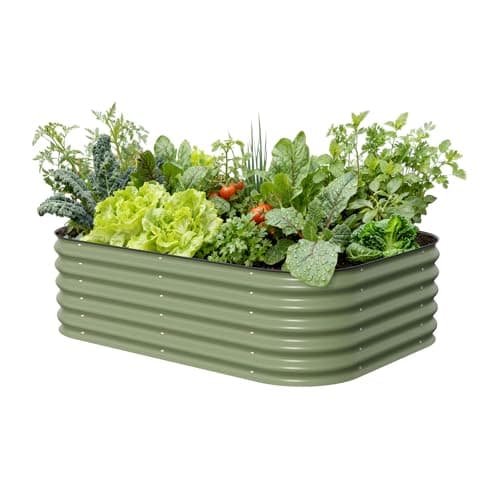 Top pickVego Garden 17" Modular Metal Raised Bed17 in deep, modular Aluzinc steel panels | Most first gardens | 9.2 | $129.15 - View on Amazon |
| 2 | 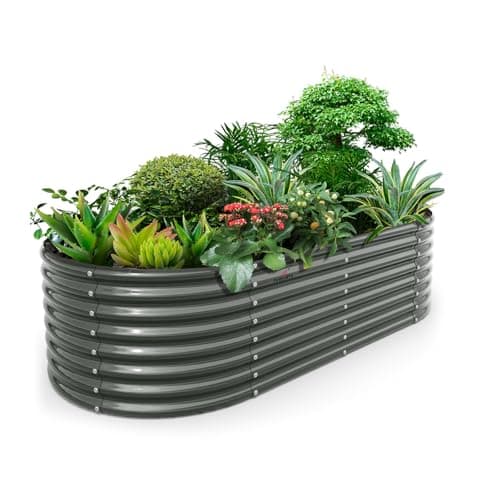 Anleolife 8 x 4 ft Metal Raised Garden BedUp to 24 in deep, 22-gauge corrugated steel | Deep beds for root crops | 8.8 | $148.85 - View on Amazon |
| 3 | 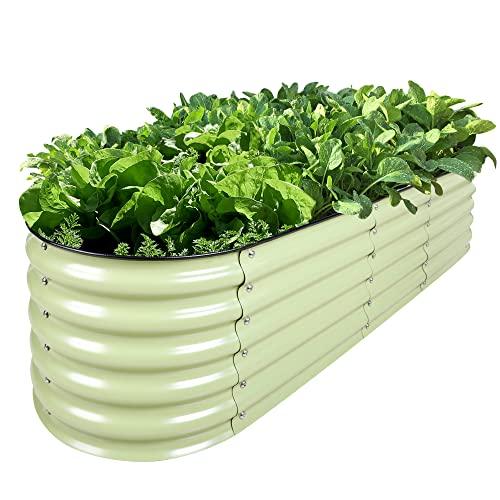 Olle 12-in-1 Galvanized Raised Garden Bed, 17 in Tall17 in tall, 12 configurations from one kit | The closest like-for-like swap | 8.8 | $142.47 - View on Amazon |
| 4 | 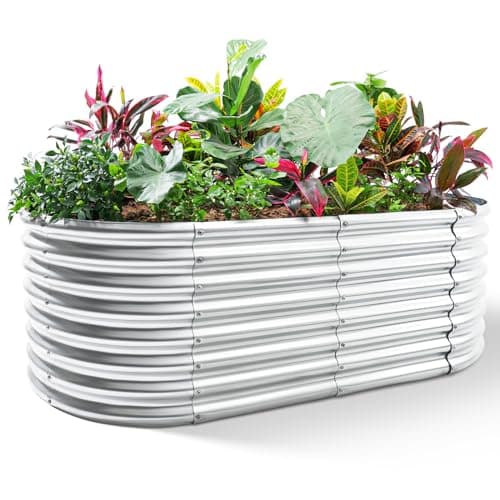 Land Guard Galvanized Raised Garden BedGalvanized steel, large footprints, budget price | Most growing area per dollar | 8.2 | $63.99 - View on Amazon |
| 5 | 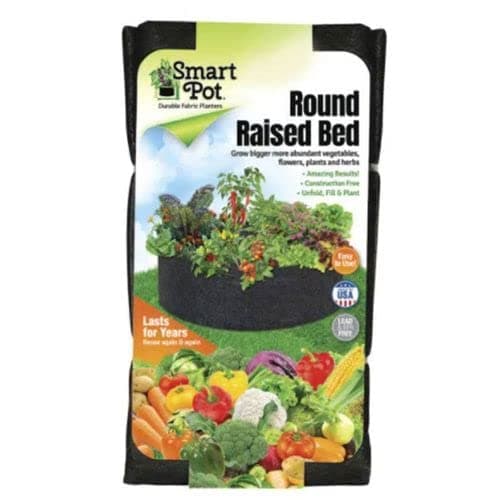 Smart Pot Round Raised Bed, 100 Gallon50 in across, 12 in deep, about 13.5 sq ft | A whole bed's worth | 8.8 | $69.95 - View on Amazon |
#ad We may earn a commission - Price as of November 24, 2026
Scores are our own editorial judgment, formed from published specifications and independent sources. They are not aggregated customer ratings, and they are not the result of hands-on testing, which we do not currently do. See how we choose.
Depth is the whole decision
Root crops are the one group where a frame's advertised height and its useful growing depth come apart. Fill settles. A bed filled flush in April is an inch or two down by June, and a bed built on hard ground over a weed barrier has exactly as much root room as the fill you put in -- no more.
| Usable depth after settling | Root crops it suits | What goes wrong above that |
|---|---|---|
| 8 to 10 in | Radish, baby carrots, turnip, beet | Full-size carrots stub and go broad instead of long |
| 12 in | Nantes and Chantenay carrots, beet, kohlrabi | Imperator types and parsnips hit the floor |
| 17 in | Almost every home carrot variety, parsnip, daikon | Nothing -- this is comfortable room |
| 24 in | Long parsnips, horseradish, full-length daikon | You are buying a lot of soil for little extra return |
The practical reading: twelve inches is the floor, seventeen is the sweet spot, twenty-four is for people who specifically want parsnips. Past that you are mostly paying for fill. If the soil bill is what makes you hesitate, how to fill a raised garden bed cheap is the page to read before you order, and what to put at the bottom of a raised garden bed covers the decision that most affects root depth.
Texture beats depth once you are past twelve inches
A forked carrot is almost never a depth problem. It is a stone, a clod, an undecomposed lump of woody material or a slug of fresh manure that the growing tip hit and went around. That makes the fill at least as important as the bed, and it is why a deep bed filled with lumpy bulk topsoil grows worse carrots than a twelve-inch bed filled properly.
- Screen the top eight inches. Everything below can be rougher; the top layer is where the root actually forms.
- Skip fresh manure in a carrot bed. High-nitrogen, half-rotted material grows leaf at the expense of root and encourages branching.
- Do not add sand to clay to loosen it. You get something closer to concrete. Add compost and let structure build.
- Avoid a wood-filled layer under a root bed. It breaks down unevenly and leaves voids and lumps exactly where you do not want them. Save hugelkultur for squash.
Width, length and the thinning problem
Carrots are sown thickly and thinned twice. That is a job done kneeling, face close to the bed, pulling seedlings out of a row with your fingertips. Any bed deeper than about four feet across has a middle you can only reach by standing in it, and standing in a carrot bed compacts exactly the soil the roots were about to grow into.
University of Georgia Extension's bed dimension guidance arrives at the same place from the other direction: build beds you reach into from the side rather than beds you have to enter. For root crops the practical shape is long and narrow -- a 2 ft or 3 ft wide run gives two comfortable thinning sides and the full length for successive sowings. A modular kit makes that shape without buying a special product, which is most of why the modular beds rank where they do.
| Shape | Thinning access | Verdict for carrots |
|---|---|---|
| 2 to 3 ft wide, long | Both sides, every row within reach | Best -- this is the shape to build |
| 4 ft wide | Both sides, middle rows a stretch | Workable; expect the middle row to be crowded |
| Wider than 4 ft | You have to step in | Avoid for roots; fine for squash |
| Round, 50 in across | Reach in from any point of the circle | Good, and the cheapest way to start |
What to fill it with
A carrot bed wants a finer, lower-nitrogen fill than a tomato bed. Most purpose-made raised bed mixes are close enough once screened, and the usual recipe -- compost, a mineral component, and something to hold air -- is what a root crop wants anyway. Our raised bed soil mix recipe has the proportions, and the soil calculator will tell you how many bags a seventeen-inch bed swallows, which is usually the number that changes people's minds about depth.
The picks in full
Top pick
Vego Garden 17" Modular Metal Raised Bed
Vego Garden
The modular panel system is the reason to pay the premium: you can reshape the same bed into a different footprint next season without buying a second kit.
Vego is the brand most people meet first, and the modular panel system is the actual reason for that rather than the marketing. The kit arrives as flat corrugated panels plus corner pieces; you bolt them into whichever of the listed footprints suits your yard. If the 4 x 8 rectangle turns out to be wrong for your space, the same panels rebuild into a narrower or L-shaped bed next spring.
The steel matters more than the shape. Aluzinc is a zinc-aluminum-magnesium coating rather than plain galvanizing, and it is the finish you want on something that will sit in wet soil for years. That is the part of the price that buys durability rather than convenience.
Depth is the other thing to weigh. At 17 inches you can grow anything a beginner is likely to want, including carrots and potatoes, without hitting the bottom. The 32-inch version exists mainly so you can garden standing up, which is worth the extra soil cost if bending is the problem you are solving.
What works
- Panels unbolt and rebuild into a different shape
- Aluzinc coating is the better of the two steel finishes in this category
- 17 in is deep enough for carrots, potatoes and tomato roots
- Rolled safety edge along the top rail
What does not
- The most expensive metal bed of the ones we looked at
- Modularity is wasted if you build it once and leave it
- Steel warms fast in full afternoon sun in hot climates
Skip it if: you already know the exact shape you want and will never move it. You are paying for flexibility you would not use, and Vegega gives you the same steel for less.
| Material | Aluzinc-coated steel (zinc-aluminum-magnesium) |
|---|---|
| Depth | 17 in (a 32 in extra-tall version is also sold) |
| Shape | Modular panels, reconfigurable into several footprints |
| Assembly | Bolt-together panels, no cutting |
| Soil needed | About 32 cu ft for a 4 x 8 ft bed at 12 in of fill |
Deep beds for root crops
Anleolife 8 x 4 ft Metal Raised Garden Bed
Anleolife
Thicker gauge steel and a deeper box than most kits, which is what stops a long bed bowing outward once it is full of wet soil.
Gauge is the specification nobody reads and everybody should. Steel gauge runs backwards -- a lower number is thicker metal -- and Anleolife's 22-gauge panels are noticeably more rigid than the thin budget beds that bulge in the middle after the first heavy watering.
That rigidity matters most on an 8-foot run, where soil pressure has the most leverage. The center brace on the long sizes is not decoration; leave it out and the sides will slowly bow.
Be realistic about the depth. A 24-inch bed at 8 x 4 ft holds around 64 cubic feet of fill. You do not have to buy 64 cubic feet of bagged mix -- the bottom third can be coarse organic material, which is what the hugelkultur and cheap-fill guides are for -- but you do have to plan it.
What works
- Heavier 22-gauge steel resists bowing on long runs
- 24 in depth suits potatoes, parsnips and long carrots
- Large growing area in one kit
- Center brace included on the long sizes
What does not
- Deep beds need a lot of fill, and fill is the real cost
- Galvanized rather than Aluzinc coating
- Long panels are awkward to handle solo
Skip it if: your budget is tight. The extra depth is real, but it also means roughly twice the soil of a 12-inch bed, and soil is the bigger bill.
| Material | 22-gauge corrugated galvanized steel |
|---|---|
| Depth | Sold in several heights, including 24 in |
| Footprint | 8 x 4 ft and other sizes |
| Assembly | Bolt-together panels with center support |
| Soil needed | About 64 cu ft for 8 x 4 ft at 24 in of fill |
The closest like-for-like swap
Olle 12-in-1 Galvanized Raised Garden Bed, 17 in Tall
Olle
The nearest thing on Amazon to the modular metal bed everyone pictures: same 17 inch working height, same reconfigurable panel system, a different badge on the box.
If what you liked about the premium modular beds was the idea rather than the brand, this is the same idea. Seventeen inches of height, a panel system that bolts into several shapes, galvanized steel, open bottom.
Be realistic about the modularity. It is genuinely useful on the day you lay the garden out, because you can match the bed to an awkward corner instead of matching the corner to the bed. After it is full of soil it is a fixed object, and the twelve configurations become one.
The height is the part that earns its money every season. A 17 inch bed takes root crops without hitting compacted subsoil, holds enough volume to ride out a hot week, and sits at a height you can weed from a kneeler rather than lying down.
What works
- Seventeen inches is the height that suits carrots, potatoes and a comfortable reach
- Modular panels mean an L, a U or a long rectangle from the same box
- Galvanized steel will outlast any timber bed at the same price
- Open bottom lets roots go past the fill and drain into the ground beneath
What does not
- Modularity is a one-time benefit -- almost nobody reconfigures a filled bed
- Soil volume at 17 inches is substantial; budget for the fill before the bed
- Metal edges need care during assembly, and gloves are not always included
- A tall bed in full sun warms its edges faster than timber does, so edge rows dry first
Skip it if: you want one fixed rectangle and nothing else. You are paying for configurability you will use exactly once.
| Height | 17 in |
|---|---|
| Configurations | 12-in-1 modular panel system |
| Material | Galvanized steel |
| Finish | Sage green (other colors listed separately) |
| Bottom | Open to the ground |
Most growing area per dollar
Land Guard Galvanized Raised Garden Bed
Land Guard
The cheapest honest way to get a large steel bed, as long as you accept plain galvanizing instead of an Aluzinc coating.
If the goal is to grow the most food this year for the least money, area beats coating. A large cheap bed you can actually fill will feed you better than a small premium one, and Land Guard exists for exactly that calculation.
Understand what you are giving up. Plain galvanizing is a zinc coating; Aluzinc adds aluminum and magnesium and holds up considerably better at the soil line, which is where beds fail. Expect good years rather than decades.
The panels are thinner too, so use the supplied braces and do not skip the center support on the long sizes.
What works
- Lowest cost per square foot of growing area
- Large sizes available in one kit
- Simple assembly with basic tools
- Good way to trial a big bed before committing
What does not
- Plain galvanizing, not the longer-lived Aluzinc
- Thinner panels flex more when filled
- Edges deserve a careful check during assembly
Skip it if: you want the bed to outlive the mortgage. Plain galvanized steel is fine for years, not decades, especially where soil stays wet.
| Material | Galvanized steel |
|---|---|
| Depth | Commonly 12 in and 17 in |
| Footprint | Large rectangles including 8 x 4 ft |
| Assembly | Bolt-together panels |
| Soil needed | About 32 cu ft for 8 x 4 ft at 12 in |
A whole bed's worth
Smart Pot Round Raised Bed, 100 Gallon
Smart Pot
A fabric raised bed rather than a pot: wide enough to plant like a bed, cheap enough to buy two, and it folds flat in October.
This is the grow bag that behaves like a bed -- Smart Pot has also sold it as the Big Bag Bed. At roughly 50 inches across it gives you about 13.5 square feet of planting area -- the same growing area as a 4 x 4 ft frame -- in something that arrives folded in a flat parcel and needs no assembly at all.
Twelve inches of depth is the number that matters. That is enough for lettuce, beans, chard, bush cucumbers, peppers and determinate tomatoes, and it is shallow for carrots, parsnips and a serious potato crop. It is the same depth limit a shallow metal or vinyl bed has.
The cost is the fill. A bed-sized bag needs a bed-sized volume of potting mix, so the bag being inexpensive does not make the project inexpensive. Work out the mix cost first, using the soil calculator on this site, because that number rather than the bag decides whether this is the cheap option for you.
What works
- Gives you bed-scale planting area without a frame to assemble
- Twelve inches of depth is enough for most vegetables, including determinate tomatoes
- Folds flat for winter storage, which no rigid bed does
- Enclosed bottom means you can put it on a patio, gravel or a driveway
What does not
- Needs a full 13.5 sq ft of potting mix, which is the real cost of the format
- Dries out faster than a soil-filled frame of the same depth
- Fabric is a consumable -- plan on replacing it after a few seasons
Skip it if: you want the garden to look built. This is a black fabric circle sitting on the ground, and planting around it does not disguise that.
| Type | Round fabric raised bed |
|---|---|
| Capacity | 100 gal |
| Footprint | About 50 in across |
| Depth | 12 in |
| Growing area | About 13.5 sq ft |
| Base | Enclosed fabric bottom |
| Service life | Manufacturer states 3 to 5 years outdoors |
Common questions
How deep does a raised bed need to be for carrots?
Twelve inches of settled fill grows most home varieties well. Seventeen inches removes the question entirely and suits long types and parsnips. Measure the fill rather than the frame -- a bed sitting on hard ground or a weed barrier has only as much root room as the soil you put in it.
Why are my carrots forked or stubby?
Almost always something the growing tip met: a stone, a clod, a lump of undecomposed material, or compacted fill. Fresh manure and high-nitrogen feed are the other common cause -- they push leaf growth and encourage branching. Screen the top eight inches of the bed and feed lightly.
Can you grow carrots in a grow bag or fabric bed?
Yes, as long as the depth is there. A twelve-inch fabric bed grows good Nantes and Chantenay types, and fabric drains freely, which carrots like. A ten-gallon bag is short for full-length varieties but fine for round and half-long ones.
What soil is best for carrots in a raised bed?
A fine, well-drained mix with compost worked through it and no large particles in the top layer. Avoid fresh manure, avoid adding sand to clay, and do not build a wood-filled layer under a root bed -- it decomposes unevenly and leaves the voids and lumps that cause forking.
How wide should a carrot bed be?
Two to three feet, long rather than wide. Carrots need thinning twice, done kneeling from the side, and any bed you have to step into to reach the middle gets compacted exactly where the roots were about to grow.
Sources
Factual claims on this page are backed by the published sources below, and product specifications are the manufacturers’ own. Where a figure is not published, we say so rather than estimating it.