Step 5 - Greenhouses
The Best Greenhouse for Tomatoes
Tomatoes are the crop that justifies a greenhouse and the crop that exposes a bad one. Headroom and airflow decide it, not glazing thickness.
Janet H. - the hands-on owner behind Janet Media Group.
Published
This page contains affiliate links. If you buy through them we may earn a commission at no cost to you, and it never decides what we recommend. How this site is funded.
The short version. For a serious tomato crop the GarveeHome 6 x 8 is the right greenhouse: enough eave height to train cordons, a roof vent that sheds the worst of the midday heat, and a footprint that leaves a path down the middle so you can get at both sides of the plants. If you have the ground, the Polar Aurora 8 x 12 gives you two full rows instead of one. The thing most tomato growers underestimate is air movement, which is why an oscillating clip fan earns a place on this list. And the budget pick is the Ohuhu lean-to tomato greenhouse -- a tall, narrow cover against a warm wall, for a single row, at a fraction of the price of any walk-in.
Tomatoes are the reason most home greenhouses get bought, and they ask for a specific combination: height, because an indeterminate plant will reach the roof; warmth, which any structure provides; and ventilation, because the same structure that gives you an early crop gives you blossom drop and fungal disease if the air never moves.
How we chose
The growing targets are Colorado State University Extension's figures for a hobby greenhouse and University of Minnesota Extension's guidance on growing tomatoes; the ventilation reasoning is University of Georgia Extension's greenhouse ventilation material. The structural criteria follow from those.
- Headroom at the plant, not at the ridge. An indeterminate tomato wants six feet of vertical run. A low eave means topping the plant in July.
- A vent that actually opens. Heat is the enemy of fruit set. A roof vent plus a door is the minimum; an automatic opener removes the weekday problem.
- Air movement inside. Still, humid air causes blossom drop and spreads fungal disease. A small fan does more for a tomato crop than thicker glazing.
- Access to both sides of the row. Tomatoes are pruned, tied and picked constantly. A bed you can only reach from one side is a crop you manage badly.
- A live price, now. Each pick carries a current price from our price layer, with the date shown.
Quick picks
| # | Product | Best for | Score | Price |
|---|---|---|---|---|
| 1 | 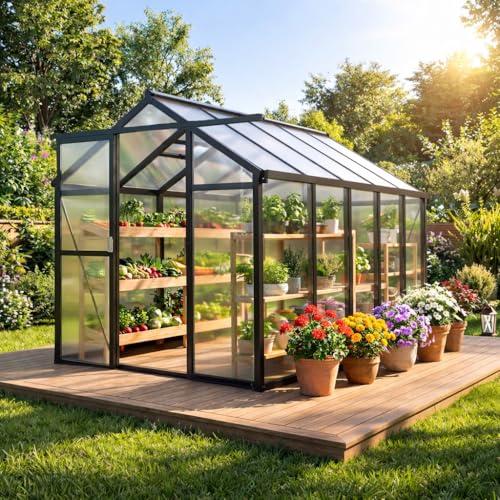 Top pickGarveeHome 6 x 8 ft Polycarbonate GreenhouseAluminum frame, polycarbonate panels, roof vent, sliding door | A first hard-sided greenhouse | 8.7 | $291.99 - View on Amazon |
| 2 | 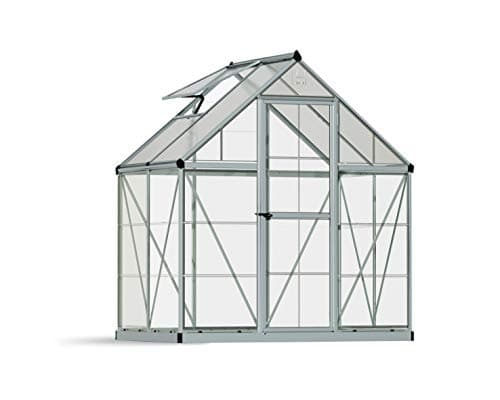 Palram Canopia Hybrid GreenhouseClear side panels, twin-wall roof | Seeing in, and light diffusion | 8.8 | $449.99 - View on Amazon |
| 3 | 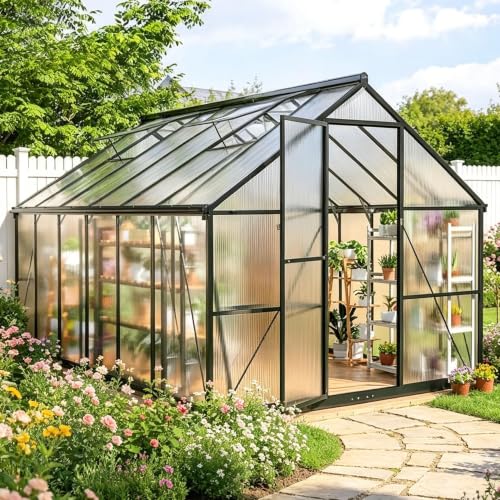 Polar Aurora 8 x 12 ft Walk-In Polycarbonate Greenhouse96 sq ft, aluminum frame, polycarbonate, ventilated windows | The most floor area under the cap | 8.5 | $419.99 - View on Amazon |
| 4 | 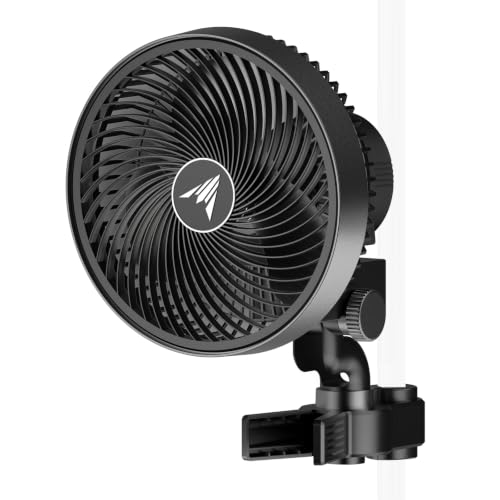 AC Infinity CLOUDRAY S6 Oscillating Clip Fan6 in oscillating clip fan, EC motor, 10 speeds, built-in timer | Moving air on days the vents stay shut | 8.3 | $49.99 - View on Amazon |
| 5 | 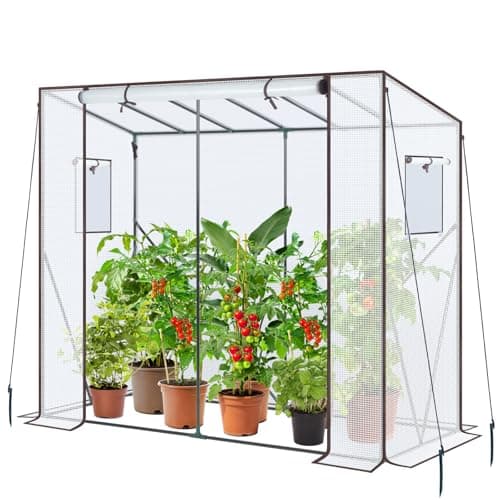 Ohuhu Lean-To Tomato Greenhouse6.6 x 2.5 x 5.6 ft, PE cover, 7 top rods to limit snow and water pooling | A warm wall for a row of tomatoes, at minimum cost | 7.2 | $46.01 - View on Amazon |
#ad We may earn a commission - Price as of November 24, 2026
Scores are our own editorial judgment, formed from published specifications and independent sources. They are not aggregated customer ratings, and they are not the result of hands-on testing, which we do not currently do. See how we choose.
Height is the specification that matters
Determinate (bush) tomatoes stop at a set height and suit a low structure. Indeterminate (cordon) tomatoes -- which is most of the varieties worth growing under cover -- keep going until something stops them, and under glass that is usually the roof.
| Usable height | What it grows | What happens at the top |
|---|---|---|
| Under 4 ft | Dwarf and patio varieties only | Cordons are topped before they fruit properly |
| 5 to 6 ft | Determinate bush types, trained cordons | You top a cordon once, late in the season |
| 6 to 7 ft at the eave | Full cordon growing with room to tie in | The plant finishes naturally |
| Lean-to against a wall | One tall row, trained flat | Works well; the wall holds heat overnight |
That last row is why the cheap lean-to belongs on this page rather than being dismissed. A tall narrow cover against a south or west wall is close to an ideal tomato environment: the wall radiates stored heat at night, the plants train flat against it, and the whole thing costs less than a bag of good potting mix and a pot.
Ventilation is the difference between a crop and a disappointment
This is where tomato growing under cover goes wrong most often, and it is worth being specific about the two separate problems.
- Heat. Pollen viability falls away at high temperatures, which is why a sealed greenhouse in July flowers heavily and sets nothing. Roof vents, an open door and shade cloth all address this. Greenhouse ventilation covers the hardware.
- Still, humid air. Tomatoes are wind-pollinated in effect -- the flower needs movement to shed pollen. Still air means poor set even at the right temperature, and humid still air means botrytis and leaf mould.
- The fix for both is airflow, not cooling. An oscillating fan moving air across the plants solves the pollination problem and dries leaf surfaces at the same time.
- An automatic vent opener handles weekdays. A non-electric heat-driven cylinder opens the roof vent when it gets hot whether you are home or not, which is the single most useful accessory a tomato greenhouse can have.
What to grow them in, inside the greenhouse
Three options, in increasing order of how well they work. Pots dry out fastest and need watering twice a day in July. Grow bags hold more and are the traditional greenhouse answer. A raised bed inside the structure holds the most water, roots deepest and gives the most forgiving crop -- and it is the reason the staging layout matters when you choose a footprint.
Raised beds in a greenhouse covers the layout question, and best raised beds for tomatoes covers the bed itself. Whichever you choose, consistency of watering is what prevents blossom end rot and splitting -- a drip line on a timer is worth more than any upgrade to the structure.
The picks in full
Top pick
GarveeHome 6 x 8 ft Polycarbonate Greenhouse
GarveeHome
The specification most people picture when they say greenhouse -- aluminum frame, rigid panels, a roof vent and a lockable sliding door -- at a price that leaves room for the base and the staging.
The jump from a covered frame to a rigid kit is the biggest single step in this category, and it happens well below the thousand dollar line. An aluminum frame does not rust, rigid panels do not flap or tear, and a hinged or sliding door with a latch stays shut in wind that would have a zipper door open all afternoon.
The roof vent is the detail worth noticing on the spec sheet. A sealed greenhouse in April sun will pass 100 degrees Fahrenheit by mid-morning, and a kit without a vent has to be propped open by hand every day. One included vent is the difference between a greenhouse you run and a greenhouse you babysit.
What you do not get at this price is a published wind or snow rating, heavier frame section, or glazing thick enough to hold heat overnight. That is the honest ceiling of the bracket, and it is why the premium kits exist.
What works
- Rigid panels and an aluminum frame, not a cover over hoops -- it is a structure
- Roof vent included rather than sold as an accessory, which matters more than it sounds
- Sliding door takes no swing space, which suits a kit squeezed against a fence
- The common 6 x 8 footprint means staging and shelving are easy to size
What does not
- No published wind or snow rating, so treat it as a three-season structure
- Panels are thin compared with a premium kit; they diffuse light but insulate little
- Assembly is a long afternoon and genuinely needs a second person
- Needs a level base and ground anchors, neither of which is in the box
Skip it if: you get real snow load. This is a three-season specification, and no budget kit publishes a snow rating because none of them would like the number.
| Footprint | 6 x 8 ft |
|---|---|
| Frame | Aluminum |
| Glazing | Polycarbonate panels |
| Ventilation | Adjustable roof vent |
| Door | Sliding, with a lock |
Seeing in, and light diffusion
Palram Canopia Hybrid Greenhouse
Palram Canopia
Clear walls so you can see what is happening inside, with a diffusing twin-wall roof over the plants that need protection from hard overhead sun.
The Hybrid name refers to two glazing types in one kit: crystal-clear panels on the walls, twin-wall on the roof. In practice that means high light levels from the sides and diffused light from above, which is a good compromise in a northern or cloudy garden.
It also means you can see in. That sounds trivial until you have walked out in the rain three times a week to check whether anything needs water.
In a hot, south-facing, unshaded spot the clear walls become a liability. If that is your site, choose the fully diffused model or plan on shade cloth from midsummer.
What works
- You can see the plants without opening the door
- High light transmission through the clear walls
- Twin-wall roof still protects from midday sun
- Same aluminum frame as the rest of the range
What does not
- Clear walls run hotter than fully diffused glazing
- Shows dirt and algae sooner
- Needs shading in a hot, exposed spot
Skip it if: your site bakes in afternoon sun. Clear walls transmit far more light, and heat follows light.
| Frame | Rust-resistant aluminum |
|---|---|
| Glazing | Clear polycarbonate walls, twin-wall roof |
| Sizes | 6 ft wide, multiple lengths |
| Ventilation | Roof vent plus hinged door |
| Base | Integrated base, anchoring required |
The most floor area under the cap
Polar Aurora 8 x 12 ft Walk-In Polycarbonate Greenhouse
Polar Aurora
Ninety-six square feet of hard-sided greenhouse for well under the cap -- benches down both sides, a real path between them, and room to work with the door shut.
Width is the dimension worth paying for and length is the one that is cheap, which is exactly what this kit's proportions say. At 8 ft wide you get a bench down each side and a path you can turn around in with a tray in your hands; at 12 ft long you get enough bench to run early crops at one end and tomatoes at the other.
That makes it the most greenhouse per dollar in this roundup by a distance, with one condition attached: the base. A 96 square foot structure wants a level, drained pad -- gravel over a compacted base, paving slabs, or a timber frame -- and getting 12 feet of ground flat is real work or real money.
The specification is otherwise the same bracket as the 6 x 8: aluminum frame, rigid polycarbonate, window ventilation, no published structural ratings. Bigger, not stronger.
What works
- Twice the floor area of a 6 x 8 for well under double the money
- Eight feet of width is the point where you get benches both sides and still turn around
- Length is the cheap dimension in any greenhouse -- this is where the value sits
- Aluminum frame with rigid glazing rather than a covered hoop structure
What does not
- Needs a 12 ft run of genuinely level ground; leveling is the hidden cost
- No published wind or snow rating, same as every kit in this bracket
- A bigger structure is a bigger sail -- anchoring is not optional here
- More panels means a longer build; set aside a full day and a helper
Skip it if: you have not measured the site and the base. A 12 ft run needs 12 ft of level ground, and leveling that is the expensive part people forget.
| Footprint | 8 x 12 ft, about 96 sq ft |
|---|---|
| Frame | Aluminum |
| Glazing | Polycarbonate panels |
| Ventilation | Ventilated windows |
| Finish | Black frame |
Moving air on days the vents stay shut
AC Infinity CLOUDRAY S6 Oscillating Clip Fan
AC Infinity
The cheap fix for the still, damp air that causes greenhouse disease: a clip fan that keeps the whole volume moving even when it is too cold to open anything.
Ventilation and circulation are two different jobs, and the second one is the one hobby growers skip. Extension guidance on greenhouse environments is consistent that high humidity causes condensation on cool surfaces and increases leaf and flower disease, and in winter you cannot fix that by opening a vent -- the heat goes with it.
A circulation fan fixes it without the heat loss. Moving air dries leaf surfaces, stops the layer of saturated air that sits against the foliage, and evens out the five or ten degrees of difference between the ridge and the bench.
Run it on low and leave it. The target is gentle, constant movement -- enough that the leaves stir -- not a wind. In a 6 x 8 house, one unit at one end, pointed along the length rather than at a plant, is enough.
What works
- Breaks up the still, humid air that fungal disease needs, which is the winter failure mode
- Evens out the temperature between the roof and the floor of the house
- Runs for pennies, so it can stay on all day
- Clamp mount means no drilling and easy repositioning as plants grow
- Also the right fan over a seed-starting shelf indoors
What does not
- Does nothing at all about heat -- it is not a substitute for an exhaust fan
- Small houses may need two to get movement at both ends
- Clamp needs something to grip, which some pipe-frame kits do not offer
- Blades collect dust and need an occasional wipe to stay quiet
Skip it if: you are trying to cool the greenhouse. A circulation fan moves the heat around; it does not remove any of it.
| Size | 6 in blade, clip or hanging mount |
|---|---|
| Oscillation | Automatic, with a fixed-position option |
| Motor | EC motor, 10 wind speeds |
| Timer | Built-in cycle timer |
| Power | Low-wattage, runs continuously without a meaningful bill |
| Mount | Clamp fits greenhouse framing and shelf uprights |
A warm wall for a row of tomatoes, at minimum cost
Ohuhu Lean-To Tomato Greenhouse
Ohuhu
The cheapest way to put cover on a wall: a narrow film shell for a row of tomato pots, and no pretence of being anything more.
This is the bottom of the category and it is included because the bottom of the category is sometimes the right answer. A south-facing wall, six pots of tomatoes, and a film shell to keep rain off the leaves and a few degrees in the air is a combination that works, and it costs almost nothing.
The height is the useful part. Most cheap covers are knee-high or waist-high, which is useless for a cordon tomato by August. At five and a half feet you can grow a plant up a string inside it.
Everything else is a compromise you should go in knowing about. No gutter. No rigid panel. No standing room. A cover that will not survive many summers of UV. If any of those matter to you, the rigid kits above are where to spend.
One practical note that applies to every film structure against a wall: tie it to something. A tall narrow shell with a big face is the easiest thing in the garden for wind to flip, and a wall gives it a surface to slam against.
What works
- Costs less than a single bag of good potting mix
- Tall enough for cordon tomatoes, which most mini greenhouses are not
- Narrow profile suits a path, a balcony edge or the gap beside a shed
- Roll-up door means you can leave the whole front open through a hot week
- Low enough risk that getting it wrong costs very little
What does not
- PE film is the cheapest glazing there is and will not last like a panel
- No gutter, so rain sheets straight off onto whatever is below it
- Very little thermal mass or insulation -- it buys a few degrees and some wind shelter, not frost protection
- Narrow, light and tall is the worst combination for wind; it must be tied and weighted
- Zips and seams are the usual failure points and are not repairable in any serious way
Skip it if: you need to get inside and work. At two and a half feet deep with a roll-up door, this is a cover for a row of pots rather than a place to stand.
| Footprint | 6.6 x 2.5 ft, 5.6 ft tall (manufacturer) |
|---|---|
| Cover | PE film |
| Door | Roll-up |
| Roof | 7 top rods, intended to limit snow and water buildup (manufacturer) |
| Use | Wall-side cover for tall crops in pots |
| Storage | Dismantles for off-season storage |
Common questions
What size greenhouse do I need for tomatoes?
A 6 x 8 walk-in grows one good row with a path beside it and enough eave height to train cordons. An 8 x 12 gives you two rows. The dimension that matters most is height at the side wall rather than total floor area, because that is what limits an indeterminate plant.
Why are my greenhouse tomatoes flowering but not setting fruit?
Usually heat, still air, or both. High temperatures reduce pollen viability and completely still air means the flower never sheds its pollen. Vent hard in hot weather and move air across the plants with a small fan -- that combination fixes most set failures.
Do greenhouse tomatoes need a fan?
They benefit enormously from one. Moving air helps the flowers shed pollen, which improves fruit set, and it dries leaf surfaces, which reduces botrytis and leaf mould. For a tomato crop a small oscillating fan is a better upgrade than thicker glazing.
Can you grow tomatoes in a mini or lean-to greenhouse?
Yes, and a tall lean-to against a south or west-facing wall is particularly good: the wall stores heat and releases it overnight, and the plants can be trained flat against it. Height is the limit on a shelf-type mini greenhouse, which suits dwarf varieties rather than cordons.
How hot is too hot for tomatoes in a greenhouse?
Sustained high temperatures are the problem rather than a single spike. Colorado State University Extension's hobby greenhouse figures put the comfortable working range well below the temperatures an unvented greenhouse reaches by mid-morning in summer, which is why venting and shade cloth matter more than heating does for a tomato crop.
Sources
Factual claims on this page are backed by the published sources below, and product specifications are the manufacturers’ own. Where a figure is not published, we say so rather than estimating it.