Step 1 - Raised Beds
The Best Garden Kneelers and Kneeling Pads
A kneeler is the cheap fix for a bed that is too low. Here is which format solves which problem, and the bed height that means you never need one.
Janet H. - the hands-on owner behind Janet Media Group.
Published
This page contains affiliate links. If you buy through them we may earn a commission at no cost to you, and it never decides what we recommend. How this site is funded.
Start with the uncomfortable version of the advice, because it will save some readers the purchase entirely: if kneeling at your beds hurts, the first thing to fix is the bed, not the knees. University of Georgia Extension's dimensions guidance is specific about it -- beds should be 24 inches tall for wheelchair access, and a bed 36 inches off the ground helps avoid excessive bending over.
Most people are not rebuilding the garden this weekend, though, and a 10 or 17 inch bed is still a bed you have to get down to. That is what this page is for. The TomCare kneeler is the pick, because it publishes a 450 lb capacity and its side rails are what you push up on -- and standing up, not kneeling, is the part that actually hurts. The VEVOR kneeler is the same format for less, with no published rating. The Gorilla Grip pad is the budget pick and is genuinely the right answer if getting up is fine and gravel is the problem. And the VEVOR rolling seat takes kneeling out of the job altogether, provided you have a firm path to roll on.
How we chose
We have not load-tested a kneeler frame and will not pretend to have. What this page does is separate the three jobs these products do, check each product against the one it claims, and read the published numbers where a maker gives them.
- Which problem it solves. Cushioning the knee, getting back up, and not kneeling at all are three different problems with three different answers. Most disappointed reviews are someone who bought the answer to a problem they did not have.
- A published load rating, if there is one. You put your whole weight through two rails when you push up off a kneeler frame. Some makers publish a figure; most do not, and we say which is which.
- Pad area and thickness. A pad narrower than both knees is half a pad, and thin foam bottoms out on gravel.
- What surface it needs. Frames need firm ground. Rolling seats need a firm, level path -- which many gardens simply do not have.
- Storage and weight. The kneeler you leave in the shed because it is awkward to carry is not helping anyone.
- Currently purchasable. Every product here was confirmed in stock before it went on the page.
Quick picks
| # | Product | Best for | Score | Price |
|---|---|---|---|---|
| 1 | 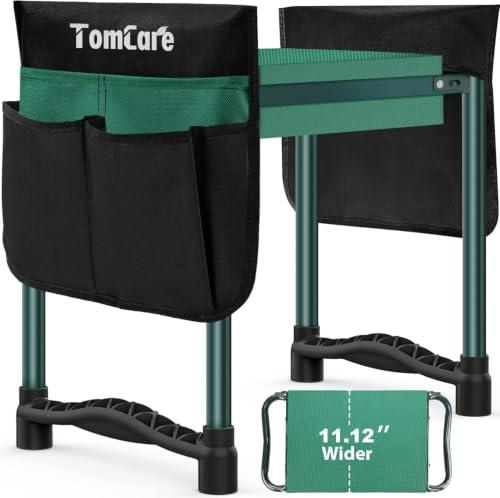 Top pickTomCare Garden Kneeler and Seat450 lb capacity, 11.12 in pad, two tool pouches | Getting back up again | 9.0 | $49.99 - View on Amazon |
| 2 | 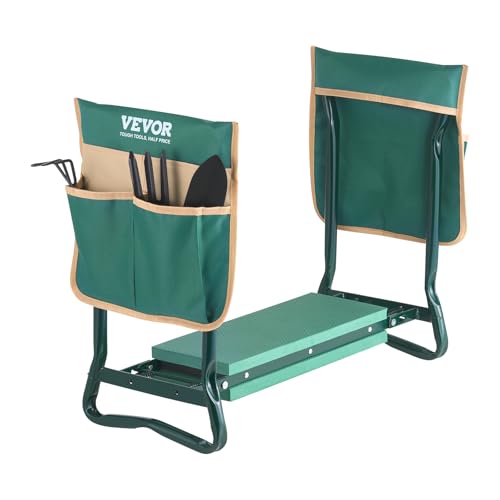 VEVOR Garden Kneeler and SeatFlip-over bench with pad and two tool bags | The same format for less | 8.3 | $33.90 - View on Amazon |
| 3 | 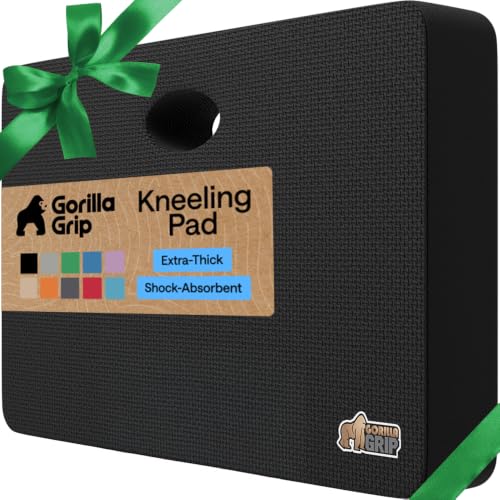 Gorilla Grip Extra Thick Foam Kneeling Pad17.5 x 11 in foam pad | The cheapest fix that actually works | 8.5 | $11.98 - View on Amazon |
| 4 | 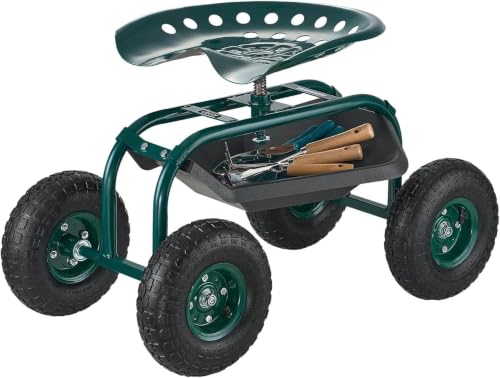 VEVOR Rolling Garden Cart with Swivel Seat300 lb capacity, swivel seat, tool tray and basket | Working a long bed without getting up | 8.4 | $74.90 - View on Amazon |
#ad We may earn a commission - Price as of November 24, 2026
Scores are our own editorial judgment, formed from published specifications and independent sources. They are not aggregated customer ratings, and they are not the result of hands-on testing, which we do not currently do. See how we choose.
The three formats, and who each is for
| Format | Solves | Does not solve | Needs |
|---|---|---|---|
| Foam kneeling pad | Hard, cold, wet or stony ground under the knees | Getting up again | Nothing |
| Flip-over kneeler bench | Getting up, plus a seat at working height | Long sessions on soft ground | Firm, level footing |
| Rolling garden seat | Kneeling at all, over a long bed | Beds with no path beside them | A firm, level path |
| A taller bed | All of the above, permanently | Your budget this season | Rebuilding or replacing the bed |
Be honest about which row you are in before spending anything. A great many people buy a frame when a pad would have done, and a smaller number buy a pad when what they needed was something to push up on.
Why the frame matters more than the cushion
The flip-over kneeler is a simple idea: a padded platform with a steel rail at each end, which turns over to become a low stool. Nearly every one on sale looks the same in the photographs, and the thing that separates them is whether the frame is built to be leaned on.
That is the actual use. You kneel on the pad, you work, and then you put a hand on each rail and push yourself upright -- which sends your entire body weight through two thin tubes and the joints at their base. A maker that publishes a capacity figure, like the 450 lb on the TomCare, is telling you the frame was designed for that. A listing that publishes nothing is not necessarily weak, but it is not telling you anything either.
What a kneeling pad is for, and why it is often enough
A thick closed-cell foam pad costs a fraction of any frame, weighs nothing, never rusts and cannot fail. If your knees are fine but your paths are gravel, it is the entire solution, and buying a frame instead gets you something bulkier that you will use less.
Two specifications decide whether a pad is any good. Area, because both knees have to fit -- 17 by 11 inches comfortably takes both, and the small pads sold in multipacks mean one knee is permanently on the edge. And material, because closed-cell foam shrugs off water while an open-cell cushion soaks it up and stays cold and heavy for the rest of the day.
Buy two if you garden over any distance. Pads migrate: one ends up at the compost bin, one under the car, and neither is where you are kneeling.
Rolling seats, and the path question
A rolling seat is the most comfortable of these formats and the most dependent on your garden's layout. You sit at roughly the height of a tall bed's edge, work in front of you, and push along the row with your feet. For a long bed of onions or strawberries that is a transformation.
It only works on a firm, level path, and Extension's path figures are the right sanity check. The absolute minimum between beds is 12 inches, which works when space is tight; 18 to 24 inches is described as ideal for comfortable access; and for paths with enough room for carts, wheelbarrows and wheelchairs, the figure is 4 feet between beds. A rolling seat with a tool tray wants the wheelbarrow end of that range, on gravel, pavers or packed stone -- not lawn, not bark mulch, not bare soil.
If your paths are grass and you are laying out new beds anyway, this is worth designing in: raised bed size guide covers bed width and spacing together, and the path you leave now decides what equipment you can use for the next decade.
The permanent fix: bed height and bed width
Gear manages the symptom. Bed geometry removes it, and the published numbers are clear enough to design from.
| Dimension | Figure | What it is for |
|---|---|---|
| Bed height | 24 in | Wheelchair access |
| Bed height | 36 in | Avoiding excessive bending over |
| Bed width | 4 ft | An adult reaching in from both sides |
| Bed width | 3 ft | An adult working from a wheelchair |
| Path width | 18 to 24 in | Comfortable access on foot |
| Path width | 4 ft | Carts, wheelbarrows and wheelchairs |
Width matters as much as height for a body that does not want to twist. A bed any wider than your reach from one side means leaning in over the frame, which is harder on a back than kneeling ever was. Extension's figure is 4 feet for an adult reaching from both sides and 3 feet where someone is working from a wheelchair -- and the stated goal behind those numbers is that nobody should need to step into the bed at all.
If the beds are not built yet, or one of them is due for replacement, buy the height instead of the kneeler. Raised garden beds for seniors covers the taller kits specifically, and elevated raised beds covers the legged planters that put a 10 inch soil depth at waist height -- Extension notes that raised planters 10 inches deep but elevated on legs or blocks are ideal for wheelchair access and also save on imported soil, as long as the base is strong enough to hold wet soil and still drain.
Making a low bed easier without buying anything
- Work from a path, not the bed. A 4 ft bed is reachable from both sides. If you are climbing in, the bed is too wide, and no kneeler fixes that.
- Bring the job up. Fill modules and pot on at a bench or table rather than on the ground. Most of the time spent kneeling is not weeding, it is fiddling.
- Mulch the paths. A firm, dry path is easier on knees than bare soil, and it is what makes a rolling seat possible later.
- Cut the weeding. Mulch on the bed surface and close spacing between plants is less weeding to kneel for. What to put at the bottom of a raised garden bed covers the layer that suppresses the worst of it from the start.
- Split the session. Twenty minutes twice is easier on a back than forty minutes once, and the beds do not notice the difference.
What to buy, in order
- 1
If kneeling is uncomfortable but standing up is fine
Buy a thick foam pad and stop there. It solves the whole problem for very little money and nothing about it can break.
- 2
If getting up is the hard part
Buy the kneeler frame with a published load rating. The rails are the product; the pad is a detail.
- 3
If kneeling is off the table entirely
Buy the rolling seat -- but walk the paths first and be honest about whether small hard wheels will move on them.
- 4
If you are buying or building beds this season
Spend the money on height instead. A 24 to 36 inch bed removes the problem for as long as the bed lasts.
- 5
If someone unsteady gardens here
Rated frame, firm footing underneath it, and a bed height that does not require getting down to the ground in the first place.
The picks in full
Top pick
TomCare Garden Kneeler and Seat
TomCare
The flip-over bench done properly: a published 450 lb rating and steel side rails that take your weight when you push yourself upright, which is the whole point of the format.
The flip-over kneeler bench is one of those products that looks like a gimmick and turns out to be the single most used thing in the shed. Kneeling is not usually the hard part. Standing up again is, and a frame with rails on both sides turns that from a struggle into a push.
What separates this from the dozens of near-identical units is a published capacity figure. Four hundred and fifty pounds is a real number from the manufacturer rather than a vague claim about heavy-duty steel, and it tells you the frame is intended to be leaned on hard rather than just knelt on.
Use it with the seat function too. A raised bed at 17 inches and a kneeler used as a stool put the soil surface at a height where you are working in front of you instead of down at your feet, which is easier on a back than either kneeling or bending.
What works
- A published load rating, which most kneelers in this category simply do not give
- Side rails are the feature that matters -- they are the handles you push up on
- Flips to a seat at a height that suits a tall raised bed or a potting job
- Folds flat, so it lives in a shed rather than taking up floor space
What does not
- Heavier than a foam pad, and you have to carry it to the bed
- Narrow feet press into soft lawn and wet soil, so it wants a firm path or a board
- Pad is comfortable for a session, not for an afternoon -- it is thinner than a dedicated pad
- Folded size is flat but wide; it does not hang on a small hook
Skip it if: you garden on soft ground. Narrow feet sink into a wet lawn and the frame stops being level.
| Load capacity | 450 lb (manufacturer) |
|---|---|
| Kneeling pad | 11.12 in |
| Pouches | Two, removable |
| Folding | Folds flat for storage |
| Dual use | Flips over to become a seat |
The same format for less
VEVOR Garden Kneeler and Seat
VEVOR
The flip-over bench at a noticeably lower price, with the pad and the tool bags included and no published load figure to go with it.
If the flip-over bench is the format you want and the budget is the constraint, this is the honest version of the compromise. The geometry is the same, the tool bags are included, and it folds the same way.
The difference is what the listing tells you. Where the TomCare publishes a 450 lb capacity, this one does not publish a capacity at all, and a frame you are going to put your whole weight on through two narrow rails is exactly where you would like a number.
That is not a reason to avoid it -- plenty of unrated frames are perfectly adequate for an average adult leaning on them a few times a session. It is a reason to buy the rated one if you are at the heavier end, or if someone unsteady is going to be relying on it.
What works
- Does the same job as the pick above for substantially less money
- Tool bags included rather than sold separately
- Folds flat the same way, so storage is no worse
- Light enough to carry out to a bed in one hand
What does not
- No published load rating -- the one specification that matters most here is missing
- Lighter frame section, which you feel when you lean hard on the rails
- Powder coat over budget steel will rust where it gets chipped
- Pad is thin enough that a long session on gravel still hurts
Skip it if: you need a stated weight rating. This listing does not publish one, and that is a real difference from the pick above.
| Format | Flip-over kneeler and seat |
|---|---|
| Pouches | Two tool bags included |
| Frame | Powder-coated steel, folding |
| Pad | Foam kneeling pad, fitted |
| Load capacity | Not published on the listing |
The cheapest fix that actually works
Gorilla Grip Extra Thick Foam Kneeling Pad
Gorilla Grip
The budget pick, and genuinely the right answer for many people: a thick closed-cell pad costs very little, weighs nothing, and solves the knee problem without solving the standing-up problem.
Before buying a frame, be honest about which problem you have. If kneeling on gravel is uncomfortable but getting up is fine, a pad is the whole answer and the frame is a thing you will trip over in the shed.
Thickness and area are the two specifications. Thin pads bottom out on a stone path, and narrow ones mean one knee is always off the edge. At 17.5 by 11 inches with thick closed-cell foam, this clears both bars.
Buy two. One lives by the beds and one ends up under the car, in the greenhouse, or wherever the last job was, which is where it will be when you want it.
What works
- Costs a fraction of any frame and does the main job well
- Closed-cell foam does not soak up water the way an old cushion does
- Wide enough for both knees, which cheaper pads are not
- Nothing to rust, fold, break or assemble
What does not
- No handles and no frame, so standing up is entirely on you
- Gets kicked around the bed and left out in the rain -- foam pads go missing
- Foam compresses over seasons and eventually stops cushioning
- On gravel or a hard path it is comfortable; on a cold wet lawn it still gets cold
Skip it if: getting off the ground is the hard part. A pad makes kneeling comfortable; it gives you nothing to push up on.
| Dimensions | 17.5 x 11 in |
|---|---|
| Material | Thick closed-cell foam |
| Resistance | Dirt and water resistant, per the maker |
| Weight | Light enough to carry in one hand with tools |
| Other uses | Bathing a baby, workouts, floor work |
Working a long bed without getting up
VEVOR Rolling Garden Cart with Swivel Seat
VEVOR
For anyone who should not be kneeling at all: a rolling seat with a published 300 lb rating that lets you work a bed edge sitting down and scoot along it.
A rolling seat is a different answer to the same question. Instead of making kneeling tolerable, it removes it: you sit at roughly the height of a tall raised bed's edge and move along the row with your feet.
That only works if the ground cooperates. Small hard casters are fine on a packed gravel path or pavers and useless on lawn, bark mulch or anything soft. Walk the route you would actually use before buying one.
Where it comes into its own is a long bed with a firm path beside it -- exactly the layout that a row of raised beds produces. Pair it with beds at a height you can reach sitting down and a long weeding session stops being a physical event.
What works
- Takes kneeling out of the equation entirely rather than cushioning it
- Published 300 lb capacity, so the frame rating is not a guess
- Swivel seat means you can work in front of you and turn instead of twisting
- Basket and tray stop the trowel being three steps away all afternoon
What does not
- Hard small wheels bog down in grass, mulch and wet soil
- Needs a path along the bed, which many gardens do not have
- Bulky to store compared with a pad or a folding frame
- Seat height suits a tall bed, not a bed at ground level
Skip it if: your paths are soft, narrow or stepped. Small hard wheels need firm, level ground to be any use.
| Load capacity | 300 lb (manufacturer) |
|---|---|
| Seat | Swivel seat on a wheeled frame |
| Storage | Basket and tool tray |
| Use | Weeding, planting and harvesting from seated height |
| Surface | Firm, level ground -- paths rather than lawn |
Common questions
Are garden kneeler benches worth it?
They are if standing back up is the part that hurts -- that is what the side rails are for, and no amount of padding substitutes for something to push against. If your knees are the only complaint and you get up easily, a thick foam pad does the same job for a fraction of the price and takes up no room.
What height should a raised bed be to avoid kneeling?
University of Georgia Extension's figures are 24 inches tall for wheelchair access and 36 inches off the ground to help avoid excessive bending over. Extension also suggests a mix of bed heights in a shared garden so different gardeners are accommodated rather than everyone working at one compromise height.
How wide should a raised bed be if I cannot lean over far?
Four feet for an adult reaching in from both sides, and 3 feet where someone is working from a wheelchair. The goal behind those numbers is that nobody should have to step into the bed -- if you are climbing in to reach the middle, the bed is wider than it should be.
Do rolling garden seats work on grass?
Poorly. Small hard casters need a firm, level surface -- gravel, pavers or packed stone. On lawn, bark mulch or soft soil they bog down and you end up dragging the seat rather than rolling it. Walk the route you would actually use before buying one.
How wide do paths between raised beds need to be?
Twelve inches is the absolute minimum where space is tight, 18 to 24 inches is ideal for comfortable access on foot, and 4 feet is what Extension gives for paths that need to take carts, wheelbarrows or a wheelchair. If you want to use a rolling seat or a barrow, design for the 4 foot figure.
What is the best kneeling pad for gardening?
One big enough for both knees -- around 17 by 11 inches -- in thick closed-cell foam, which sheds water instead of soaking it up. Beyond that there is little to choose between them, which is why this is the one place on the page where the cheapest sensible option is also the recommendation.
Sources
Factual claims on this page are backed by the published sources below, and product specifications are the manufacturers’ own. Where a figure is not published, we say so rather than estimating it.