Step 5 - Greenhouses
The Best Mini Greenhouses
A mini greenhouse is not a small greenhouse. It is a propagator you can stand next to, and that is a genuinely useful thing to own.
Janet H. - the hands-on owner behind Janet Media Group.
Published
This page contains affiliate links. If you buy through them we may earn a commission at no cost to you, and it never decides what we recommend. How this site is funded.
The short version. The Ohuhu mini greenhouse is the one to buy: four shelves under a zip cover, assembled in minutes, and the right shape for the job these things actually do -- holding seed trays and young plants somewhere warmer and more sheltered than outdoors. The budget pick is the Outsunny 7 x 3 mini tunnel, which costs even less and sits over a bed or a bench instead of standing upright. If what you want is a warm wall for a row of tall plants, the Ohuhu lean-to is a better shape than either.
The reason mini greenhouses get bad reviews is almost always a mismatch of expectation. They have very little thermal mass, so they heat fast in sun and lose it all overnight; they are light, so they move in wind; and the cover is a consumable measured in seasons. None of that matters for the jobs they are good at, and all of it matters if you expected a small version of a walk-in.
How we chose
- Shelf depth that takes a standard tray. A 1020 tray is about 11 by 21 inches. A shelf narrower than that is a shelf you cannot use properly.
- A cover that opens properly. Roll-up and zip fronts both work; a cover you have to lift off entirely gets left off.
- Something to tie it down. Every unit in this class needs securing. Guy lines, pegs or a wall fixing -- the ones with nothing count against themselves.
- A frame worth keeping. Covers fail first. A steel or coated frame means you replace a cover rather than the whole unit.
- A live price, now. Each pick carries a current price from our price layer, with the date shown. Where a listing has no live offer, the page shows a check-price link rather than a number.
Quick picks
| # | Product | Best for | Score | Price |
|---|---|---|---|---|
| 1 | 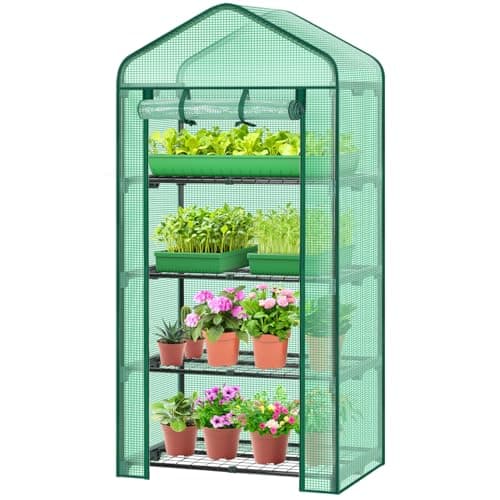 Top pickOhuhu Mini Greenhouse with Shelves4-tier shelf frame with zip cover | Balconies and seedling trays | 7.5 | $36.54 - View on Amazon |
| 2 | 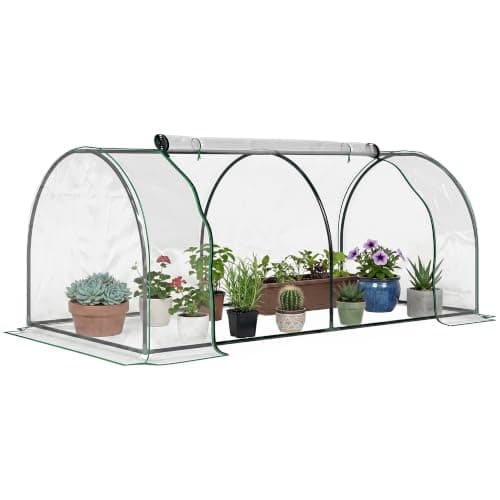 Outsunny 7 x 3 ft Mini Greenhouse Tunnel7 x 3 x 2.5 ft tunnel, clear PE cover, roll-up zippered door | A clear cover you do not have to build | 8.1 | $34.19 - View on Amazon |
| 3 | 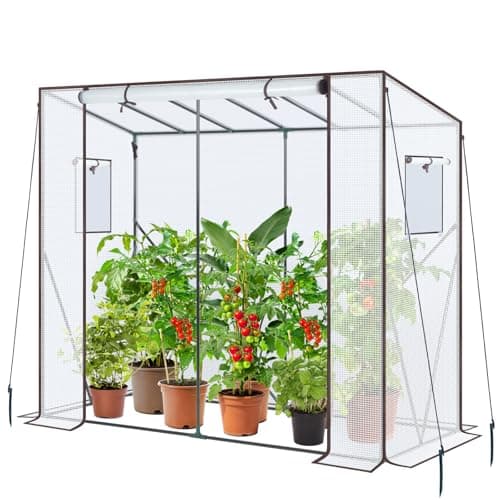 Ohuhu Lean-To Tomato Greenhouse6.6 x 2.5 x 5.6 ft, PE cover, 7 top rods to limit snow and water pooling | A warm wall for a row of tomatoes, at minimum cost | 7.2 | $46.01 - View on Amazon |
| 4 | 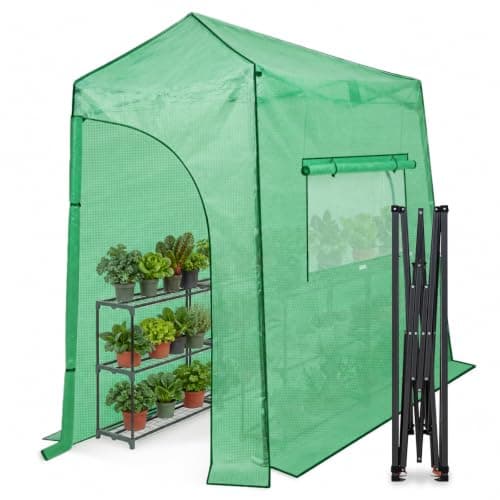 EAGLE PEAK 9 x 4 ft Pop-Up Lean-To Greenhouse9 x 4 ft pop-up frame with PE cover, one-person setup | Covering a wall this weekend without drilling anything | 7.6 | $139.99 - View on Amazon |
| 5 |  VIVOSUN Cold Frame Mini GreenhouseLow-profile frame with hinged clear lid | Extending the season over a bed | 8.0 | Check price on Amazon |
#ad We may earn a commission - Price as of November 24, 2026
Scores are our own editorial judgment, formed from published specifications and independent sources. They are not aggregated customer ratings, and they are not the result of hands-on testing, which we do not currently do. See how we choose.
What a mini greenhouse is genuinely good at
| Job | Verdict | Why |
|---|---|---|
| Hardening off seedlings | Excellent | Shelter and light without the full outdoor exposure |
| Holding trays in early spring | Excellent | Several degrees of shelter, right outside the back door |
| Overwintering tender pots | Good, with fleece | Keeps frost off, but it does not hold warmth alone |
| Growing tomatoes to maturity | Poor | Not enough height, and too much temperature swing |
| Winter growing | Poor | No thermal mass; it is the same as outside by dawn |
| Protecting a bed from frost | Good, in tunnel form | A low tunnel over a bed is the right shape for this |
Read that table as a shopping list rather than a criticism. If the first two rows describe what you want, a mini greenhouse is one of the best-value things on this site. If the fourth or fifth describes what you want, small greenhouse kits covers the walk-ins with a small footprint, which is a different product entirely.
The temperature swing is the thing to understand
A mini greenhouse contains perhaps a few cubic feet of air and nothing heavy. That means it can be twenty degrees warmer than outside by mid-morning on a sunny March day, and the same temperature as outside by five the next morning. Both halves of that have consequences.
- Vent it on sunny days, even cold ones. An unopened mini greenhouse in March sun will cook seedlings. Unzip the front in the morning.
- Do not trust it against frost on its own. Add a layer of fleece over the trays inside on a frosty night; the cover alone buys very little.
- Put something heavy inside. A couple of water-filled bottles or a slab under the trays moderates both ends of the swing considerably.
- Watch watering. Small volumes of mix in a warm, bright box dry out alarmingly fast. Check daily.
Mini greenhouse, cold frame or low tunnel?
Three cheap structures, three different shapes, and they are not interchangeable. A shelf unit stands upright and holds trays at working height. A cold frame is low, lidded and sits on the ground over a bed or a bench. A low tunnel covers a run of ground along a bed.
Pick by what you are protecting: trays and pots want the shelves, a sown bed wants the tunnel, and a small area of established plants wants the frame. Greenhouse vs cold frame sets out the comparison properly, and cold frames is the roundup for that format.
The picks in full
Top pick
Ohuhu Mini Greenhouse with Shelves
Ohuhu
A shelved cover for seed trays rather than a greenhouse you walk into, and the right answer where there is no room for anything larger.
Calling this a greenhouse oversells it, which is why it disappoints people who expected one. What it actually is: a shelf unit with a cover, sized for standard seed trays, that fits on a balcony or against a wall.
For that job it is good. Seedlings started indoors need somewhere sheltered to harden off, and this gives them a few protected degrees and shelter from wind and heavy rain.
Tie it to something. An empty covered shelf unit is remarkably light and catches wind like a sail.
What works
- Holds several seed trays in almost no floor space
- Cheap enough to be a seasonal purchase
- Zip front rolls up for ventilation
- Folds flat for storage
What does not
- Blows over easily unless tied to something solid
- Very little thermal mass -- it buys a few degrees, not many
- Cover is the first thing to fail
Skip it if: you want to grow plants to maturity. This is a propagation space and a frost blanket, not a growing house.
| Frame | Steel tube shelving |
|---|---|
| Cover | Zip-front PE cover |
| Shelves | Typically 4 tiers |
| Footprint | Fits against a wall or balcony rail |
| Anchoring | Tie to a wall or rail -- essential |
A clear cover you do not have to build
Outsunny 7 x 3 ft Mini Greenhouse Tunnel
Outsunny
The step up from fabric: a steel-frame tunnel with a clear cover that traps real warmth over one bed, with a zip to vent it before it cooks.
Fabric slows heat loss. Clear plastic actually collects heat, and that is a different order of protection. On a sunny March day a closed clear tunnel over a bed of salad will run well above the air outside, which is what pulls a sowing forward by weeks rather than days.
The same property is the warning. A sealed clear tunnel in April sun overheats fast, and the roll-up panel is not a convenience feature -- it is the thing that stops the crop cooking. If nobody is home on weekdays, leave the door open and accept a smaller gain rather than closing it and hoping.
Treat it as a one-bed tool. At 3 ft wide it suits a narrow bed, a half of a wide one, or a nursery area for hardening off. For a whole 4 x 8 bed, hoops plus heavyweight fabric cost less and cover more; for a structure you can stand in, you are into cold frame and greenhouse territory instead.
What works
- Clear plastic traps far more daytime warmth than any fabric cover does
- Zip and roll-up panel make venting a five-second job, which fabric covers do not allow
- Assembles in well under an hour with no tools
- Small enough to move between beds through the season
- Keeps heavy rain off winter salad, which matters as much as the warmth does
What does not
- Needs venting on any sunny day, and will cook a crop if you forget
- 3 ft wide suits a narrow bed or a half-bed, not a standard 4 ft one
- Light PE cover is a wearing part; expect to replace it before the frame
- Must be staked and guyed properly or wind will roll it across the yard
Skip it if: your beds are wider than 3 ft. The frame is a fixed size and it will not span a standard 4 ft bed.
| Footprint | About 7 ft long x 3 ft wide |
|---|---|
| Height | About 2.5 ft at the ridge |
| Cover | Clear UV-treated PE, roll-up zippered door panel |
| Frame | Powder-coated steel tube, push-fit assembly |
| Access | Roll-up front panel for venting and watering |
| Anchoring | Ground stakes and guy ropes included |
A warm wall for a row of tomatoes, at minimum cost
Ohuhu Lean-To Tomato Greenhouse
Ohuhu
The cheapest way to put cover on a wall: a narrow film shell for a row of tomato pots, and no pretence of being anything more.
This is the bottom of the category and it is included because the bottom of the category is sometimes the right answer. A south-facing wall, six pots of tomatoes, and a film shell to keep rain off the leaves and a few degrees in the air is a combination that works, and it costs almost nothing.
The height is the useful part. Most cheap covers are knee-high or waist-high, which is useless for a cordon tomato by August. At five and a half feet you can grow a plant up a string inside it.
Everything else is a compromise you should go in knowing about. No gutter. No rigid panel. No standing room. A cover that will not survive many summers of UV. If any of those matter to you, the rigid kits above are where to spend.
One practical note that applies to every film structure against a wall: tie it to something. A tall narrow shell with a big face is the easiest thing in the garden for wind to flip, and a wall gives it a surface to slam against.
What works
- Costs less than a single bag of good potting mix
- Tall enough for cordon tomatoes, which most mini greenhouses are not
- Narrow profile suits a path, a balcony edge or the gap beside a shed
- Roll-up door means you can leave the whole front open through a hot week
- Low enough risk that getting it wrong costs very little
What does not
- PE film is the cheapest glazing there is and will not last like a panel
- No gutter, so rain sheets straight off onto whatever is below it
- Very little thermal mass or insulation -- it buys a few degrees and some wind shelter, not frost protection
- Narrow, light and tall is the worst combination for wind; it must be tied and weighted
- Zips and seams are the usual failure points and are not repairable in any serious way
Skip it if: you need to get inside and work. At two and a half feet deep with a roll-up door, this is a cover for a row of pots rather than a place to stand.
| Footprint | 6.6 x 2.5 ft, 5.6 ft tall (manufacturer) |
|---|---|
| Cover | PE film |
| Door | Roll-up |
| Roof | 7 top rods, intended to limit snow and water buildup (manufacturer) |
| Use | Wall-side cover for tall crops in pots |
| Storage | Dismantles for off-season storage |
Covering a wall this weekend without drilling anything
EAGLE PEAK 9 x 4 ft Pop-Up Lean-To Greenhouse
EAGLE PEAK
A film lean-to that opens like a tent: no assembly to speak of, no fixings into the wall, and it folds away when the season ends.
Not every wall problem deserves a bolted-on structure. If you are renting, if the wall is rendered and you would rather not drill it, or if you simply want cover for one winter, a pop-up lean-to does the job for the price of a few bags of mix.
The format is a tent against a wall. The frame opens out, the PE cover is already on it, and the whole thing is weighted or pegged rather than fixed. Nine feet of wall gets covered in the time a rigid kit takes to unpack.
Two honest limits. The first is heat: film with mesh windows is a wind-break and a frost buffer, not an insulated structure, and the difference from outside on a clear night is small. The second is wind. A light frame with a big flat face against a wall is exactly the shape that gets lifted, so weight it properly and do not assume the wall will hold it.
Judged for what it is -- temporary, cheap, and reversible -- it is the most sensible thing in this roundup for a lot of people. Judged as a greenhouse, it is the weakest. Both statements are true at once.
What works
- Up in minutes with no tools, no foundation and no holes in anyone's wall
- Nine feet of wall coverage for a fraction of any rigid kit here
- Mesh windows and a roll-up door give you more ventilation openings than the rigid kits do
- Folds away in summer, which suits a rented house or an HOA you would rather not consult
- The obvious choice if you need shelter for one hard winter rather than for ten years
What does not
- A PE cover degrades in UV and is the part that fails -- plan on replacing it, not repairing it
- Pop-up frames are light, so this must be weighted or pegged properly or wind will take it
- Film plus mesh windows leak heat badly compared with any rigid panel
- The cover flexes and flaps, which is noisy against a bedroom wall and wears at the contact points
- Not a snow structure: a flexible frame against a wall collects drift and sheds load poorly
Skip it if: you want something permanent. A PE cover is a wearing part measured in seasons, and this one is held down rather than built in.
| Footprint | 9 x 4 ft (manufacturer) |
|---|---|
| Cover | PE film, clear and green panels |
| Frame | Pop-up, collapsible |
| Setup | One-person setup (manufacturer) |
| Door | Roll-up |
| Windows | Mesh windows |
| Storage | Folds down for off-season storage |
Extending the season over a bed
VIVOSUN Cold Frame Mini Greenhouse
VIVOSUN
#ad We may earn a commission - prices are shown by Amazon, not by us
A lid for a corner of a raised bed: no assembly worth the name, and the cheapest few weeks of extra season you can buy.
A cold frame is the least glamorous and most cost-effective piece of season-extending equipment in the garden. It is a box with a transparent lid: sunlight in, wind off, a few degrees of overnight protection.
Used over the corner of a raised bed it will carry spinach, mache, and hardy lettuces through a cold spell, harden off seedlings before they go out, and start spring sowings a couple of weeks early.
The one discipline it demands is venting. A closed frame on a sunny March day can cook its contents by lunchtime. Prop the lid in the morning, close it in the late afternoon.
What works
- Cheapest real season extension there is
- Works over an existing raised bed with no site prep
- Good for hardening off and for overwintering hardy greens
- Stores flat out of season
What does not
- Overheats fast on a sunny day if you forget to vent it
- Small growing area
- No standing room at all
Skip it if: you need headroom. A cold frame is worked from above, kneeling, with the lid propped open.
| Type | Low cold frame with hinged lid |
|---|---|
| Glazing | Clear panel lid |
| Ventilation | Lid props open -- manual, and it matters |
| Footprint | Sits on a bed or on the ground |
| Assembly | Minimal |
Common questions
Are mini greenhouses any good?
For hardening off seedlings, holding trays in early spring and keeping frost off tender pots, they are excellent value. For growing a crop to maturity or for winter growing they are not, because they have almost no thermal mass and too little height. The product is fine; the expectation is usually the problem.
How warm does a mini greenhouse get?
Much warmer than outside on a sunny day -- enough to cook seedlings if it is left shut in March -- and the same as outside by dawn. The swing is the defining characteristic. Venting in the morning and fleece at night are both necessary rather than optional.
Will a mini greenhouse protect plants from frost?
Only a little on its own. The cover keeps off wind and frost settling directly on leaves, but with no thermal mass the air inside falls to the outside temperature overnight. Add a layer of fleece over the trays, and put water bottles or a slab inside to moderate the swing.
Can you grow tomatoes in a mini greenhouse?
Dwarf and patio varieties, yes. Cordon tomatoes need around six feet of vertical run, which a shelf unit does not have. A tall narrow lean-to against a warm wall is the cheap structure that does suit tomatoes.
What is the difference between a mini greenhouse and a cold frame?
Shape and what they protect. A mini greenhouse stands upright with shelves and holds trays and pots at working height. A cold frame is low and lidded and sits on the ground over a bed or a bench. Choose the shelves for trays and the frame for established plants in the ground.
Sources
Factual claims on this page are backed by the published sources below, and product specifications are the manufacturers’ own. Where a figure is not published, we say so rather than estimating it.