Step 4 - Composting
The Best Compost Sifters and Garden Sieves
Screening is what turns the contents of a bin into something you can actually spread. The format you buy decides whether that is an afternoon or ten minutes.
Janet H. - the hands-on owner behind Janet Media Group.
Published
This page contains affiliate links. If you buy through them we may earn a commission at no cost to you, and it never decides what we recommend. How this site is funded.
The short version. If you are emptying a full bin, the large wheelbarrow sifter is the right tool: it spans the barrow, takes a shovel load at a time, and turns the job from fiddly to rhythmic. The budget pick is the bucket-mount pair -- it costs about what a bag of compost does, stores inside the bucket it works on, and does everything a small garden needs. If what you want is compost fine enough for seed trays, the Practicool sieve with its 3 mm screen is the one that gets you there, and the Ferrochef five-grade set goes finer still. The Spear & Jackson riddle is the traditional answer: one mesh, nothing to break, hangs on a nail.
Sifting is the step most home composters skip and then wish they had not. A bin that looks finished on top is almost always a mix of three things: dark crumbly compost, half-rotted material that needs more time, and the things that never break down -- twigs, avocado stones, fruit stickers, the corner of a compostable bag. Screening separates them in one pass, and the first thing you notice is that you have more usable compost than you thought.
How we chose
We have not run screening trials with these tools and are not going to imply we have. Mesh sizes quoted below are each manufacturer's own figures. What this page contributes is the format and grade decision -- which shape of sifter suits which volume, and what mesh produces what material -- applied to currently purchasable tools.
- Match the format to your volume. A hand pan is right for a bucket and wrong for a 65-gallon bin. Most of the disappointment in this category is a format mismatch.
- A stated mesh size. Without it you cannot tell whether a sifter produces bed-grade or seed-grade material, and the difference is the whole point.
- Stainless where it will sit damp. Compost screens live outdoors in wet material. Plain steel is fine under cover and rusts if left out.
- Something that stays put while you work it. A screen that slides off the barrow or tips off the bucket is a tool you stop using.
- A live price, now. Every pick carries a current price read from our price layer. Nothing here is listed on a number we remember.
- No invented testing. Scores are editorial judgment from published specifications, not hands-on trials or rating averages.
Quick picks
| # | Product | Best for | Score | Price |
|---|---|---|---|---|
| 1 | 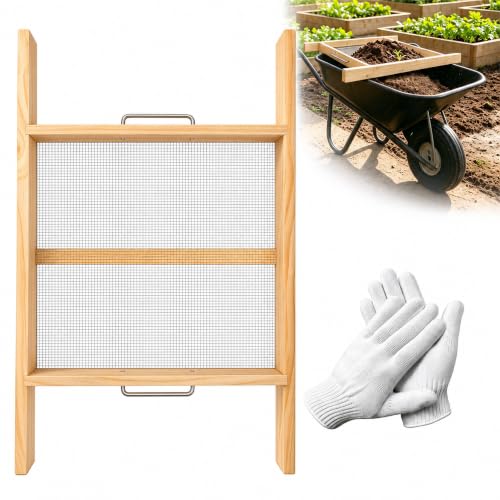 Top pickLarge Soil Sifter for a Wheelbarrow, 34 x 19 in34 x 19 in steel frame with stainless mesh, sits on a wheelbarrow | Screening a whole bin in one session | 8.8 | $46.39 - View on Amazon |
| 2 | 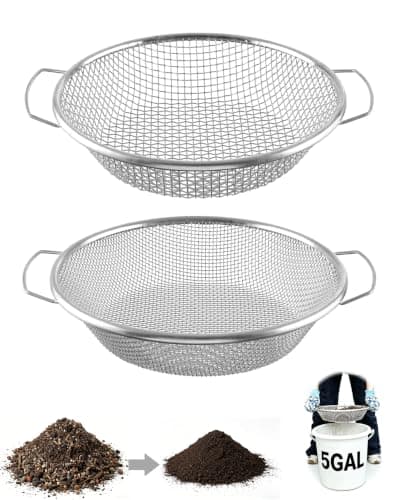 Bucket-Mount Compost Sifter Set1/4 in and 1/8 in stainless mesh screens sized for a 5-gallon bucket | Getting usable compost out of a half-finished pile | 7.8 | $18.99 - View on Amazon |
| 3 | 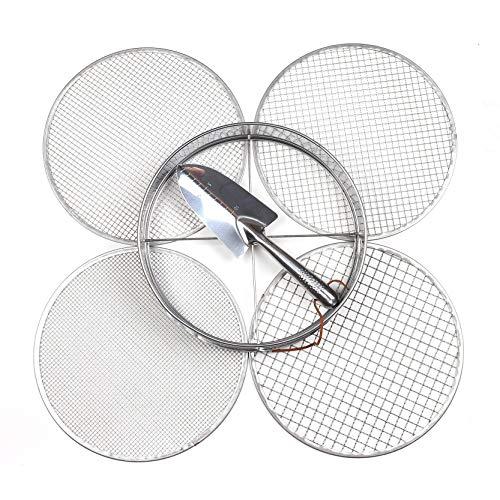 Practicool Garden Potting Mix Sieve, 4 Mesh SizesStainless riddle pan with 3, 6, 9 and 12 mm interchangeable meshes | Getting compost fine enough for seed trays | 8.5 | $17.99 - View on Amazon |
| 4 | 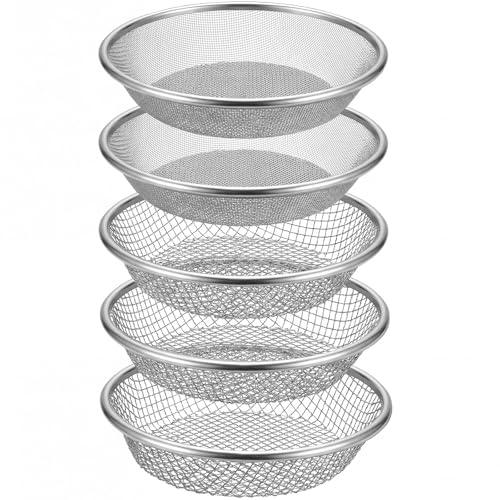 Ferrochef 11.8 in Soil Sifter Set, 5 Mesh GradesFive screens, 2 to 10 mm, sized for a 5-gallon bucket | Grading one batch into several materials | 8.3 | $35.99 - View on Amazon |
| 5 | 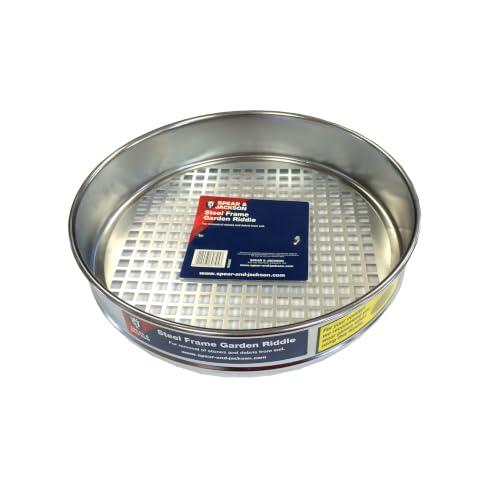 Spear & Jackson Steel Frame Garden RiddleSteel-framed round riddle, single fixed mesh | A single tool that will outlive the garden | 8.1 | $21.88 - View on Amazon |
#ad We may earn a commission - Price as of November 24, 2026
Scores are our own editorial judgment, formed from published specifications and independent sources. They are not aggregated customer ratings, and they are not the result of hands-on testing, which we do not currently do. See how we choose.
Mesh grade is the decision, format is the convenience
Two sifters with the same frame and different screens produce different products. This is the table to read before you buy anything.
| Mesh | What comes through | Use it for |
|---|---|---|
| 2 to 3 mm | Fine, almost fluffy material | Covering sown seed, blending a seed mix |
| 5 to 6 mm | Crumbly compost, no visible lumps | Potting mix, top-dressing containers |
| 1/4 in (about 6 mm) | The general-purpose grade | Most garden jobs; the default if you buy one screen |
| 10 to 12 mm | Compost with small fragments left in | Spreading on beds, mulching, filling |
| 1/2 in (about 12 mm) | Takes out sticks and stones only | Fast bulk screening before a bed goes in |
The reason finer is not simply better comes out of the composting science. Cornell's compost physics material explains that microbial activity happens on the surface of particles, so reducing particle size increases surface area and speeds decomposition -- but that when particles are too small and compact, air circulation through the pile is inhibited, oxygen available to the microorganisms falls, and the rate of microbial activity drops with it. Screen everything to dust and you have made a material that packs, goes airless and sours.
Three formats, three different jobs
| Format | Realistic throughput | Best for |
|---|---|---|
| Bucket-mount screen | A few gallons per pass | Small gardens, worm bin harvests, potting work |
| Hand riddle or pan | A trowel to a scoop at a time | Fine grades, seed mix, bonsai soil |
| Wheelbarrow frame | Shovel loads; a whole bin in a session | Emptying a static bin or a tumbler batch |
| Rotary or powered screen | Yard-scale continuous | More machine than a home garden needs |
The honest advice for most readers is to own two: a wheelbarrow frame for harvest day, and something fine for the potting bench. They cost less together than a single load of bagged compost and they do not overlap.
How to actually screen a bin without making a mess
- 1
Let the material dry a little first
Soaking compost smears rather than falls through a screen. A day or two with the lid off makes the whole job faster.
- 2
Set the frame over the barrow, and the barrow where the compost is going
You only want to move this material once.
- 3
Work in shovel loads, not bucketfuls
Spread it thin across the mesh. A heaped screen just sits there.
- 4
Push with a gloved hand or a short board, never a rake
Tines catch and tear mesh. A flat palm or a scrap of timber moves material across the screen without damaging it.
- 5
Tip the oversize straight into the next bin
It is bulking agent and starter culture in one. Add it as you go rather than piling it on the lawn.
- 6
Cure the fines before they meet seedlings
Screened compost is not automatically mature. Cornell describes curing as a long mesophilic phase during which chemical reactions continue to make the remaining organic matter more stable and suitable for use with plants.
What screened compost is good for, and what it is not
Screening improves handling, not maturity. Fine, dark, sieved material that came out of a bin three weeks ago is still young compost, and young compost in a seed tray will stunt seedlings. The screen sorts by particle size; only time sorts by stability.
- Top-dressing beds: screened at a quarter inch, spread an inch deep. The best use of home compost there is.
- Potting mix component: screened at 5 to 6 mm, up to about a third of the mix. Our best raised bed soil page covers the proportions.
- Seed starting: only well-cured compost, screened fine, and only as part of a mix -- never neat. Best seed starting mix explains why.
- Lawn top-dressing: fine screening matters here because lumps sit on the surface and smother grass.
- Filling a new bed: do not bother screening. Lumps are an advantage in bulk fill, and how to fill a raised garden bed works through the cheaper ways to get volume.
Do you need one at all?
A fair question, and the answer depends on your bin. Hot-composted material that was chopped before it went in often comes out uniform enough to use as it is. A cold heap fed kitchen scraps and whole leaves for two years never will -- it finishes as a mix of beautiful compost and recognizable avocado stones, and a screen is the only way to get the first without the second.
Tumblers sit in between. A batch that ran properly comes out close to uniform; a batch that was fed continuously comes out layered. If you are still choosing a bin, compost tumblers and best compost bins are the roundups, and compost accessories covers the thermometer and aerator that make a bin finish evenly in the first place -- which is the real way to need less screening.
The picks in full
Top pick
Large Soil Sifter for a Wheelbarrow, 34 x 19 in
Various
The only format that keeps up with a full compost bin: it sits across the barrow and you work with both hands.
The thing nobody warns you about screening compost is how slow a small sieve is. A finished 65-gallon bin is a lot of material, and pushing it through an 11-inch pan a trowel at a time is an afternoon. A frame that spans a wheelbarrow changes the job from fiddly to rhythmic: shovel on, work it across with a gloved hand or a short board, tip the oversize into the next bin, repeat.
This one is a steel frame with a stainless screen, 34 by 19 inches, designed to rest on the barrow rails rather than clamp to them. In practice that means it slides if you get aggressive, so it suits a sweeping motion rather than a scrubbing one.
Buy it if you are harvesting a static bin or a tumbler batch at least a couple of times a year. If you mostly want fine material for seed trays, a riddle with interchangeable meshes will serve you better -- and there is no reason not to own both, since they do not compete.
What works
- Sits on the barrow, so sifted compost lands where you were going to wheel it anyway
- Big enough to take a shovel load at a time
- Both hands free to work material across the screen
- Steel frame rather than a wooden one you build and then replace
What does not
- Needs a wheelbarrow to be useful at all
- Awkward to store -- it is a large flat object
- A single fixed mesh, so you cannot go finer for seed mix
- Most expensive pick on this page
Skip it if: You compost in a kitchen caddy or a single small tumbler. This is sized for yard-scale volume.
| Frame size | 34 x 19 in |
|---|---|
| Mesh | Stainless steel screen |
| Support | Rests across a standard wheelbarrow |
| Throughput | Bin-scale -- shovel loads, not trowel loads |
| Storage | Flat; needs wall or shed space |
Getting usable compost out of a half-finished pile
Bucket-Mount Compost Sifter Set
Various
The cheapest way to make a pile useful before it is finished: screen out the lumps, use what falls through, and throw the rest back in.
Garden compost is never uniformly finished. The middle is dark and crumbly, the edges are still recognizable twigs, and the whole batch sits there looking like it needs another three months. Screening is how you get the finished part out now.
Mesh size decides what the compost is for. A quarter-inch screen gives you material for top-dressing beds and mulching, which is what most of it is used for. An eighth-inch screen gives something fine enough to blend into a potting or seed-starting mix, where lumps and sticks are a nuisance.
The oversize material is not waste. Everything that stays on the screen goes back into the bin, already colonized by the fungi and bacteria doing the work, which gives the next batch a head start. That is the free version of the compost starter two entries up.
Manage expectations on throughput. This is a bucket-scale tool, and screening enough compost to fill a raised bed would be a long weekend. For a few buckets to finish a seed mix or top off beds in spring, it is exactly right.
What works
- Turns a pile that is 'nearly there' into compost you can use this weekend
- The 1/4 in screen is right for bed top-dressing; the 1/8 in is right for seed and potting mixes
- Oversize material goes back in the bin and inoculates the next batch
- Sits on a bucket, so there is nothing to build and nowhere for it to spill
- Stainless mesh does not rust out after a wet winter in a shed
What does not
- Slow and dusty work -- a bucket at a time is genuinely a bucket at a time
- A 5-gallon bucket is a small unit for anyone filling raised beds
- Damp compost clogs fine mesh; it wants to be crumbly before you start
- Entirely unnecessary if you are mulching rather than making a seed mix
Skip it if: you spread compost as a rough mulch on beds. Unsifted compost is perfectly good on a raised bed -- sifting matters for seed mixes and fine top-dressing.
| Screens | 1/4 in and 1/8 in mesh (manufacturer) |
|---|---|
| Material | Stainless steel mesh |
| Fit | Sits on a standard 5-gallon bucket |
| Quantity | Two sieves |
| Also used for | Screening soil, gravel and worm castings |
Getting compost fine enough for seed trays
Practicool Garden Potting Mix Sieve, 4 Mesh Sizes
Practicool
Four interchangeable screens from 3 mm to 12 mm, which is the whole range between bed mulch and seed mix.
Mesh size, not frame style, is what decides whether a sifter is useful to you. A 12 mm screen takes sticks and stones out of bed-fill compost and leaves everything else. A 3 mm screen gives you a fine, crumbly material you can sprinkle over a sown tray. Those are different jobs, and a single-mesh sifter can only do one of them.
This is a stainless pan with four screens that swap out, covering the full range. The 3 mm is the one that justifies the purchase for anyone starting seed: home compost is the cheapest ingredient in a seed mix and the worst behaved, because one twiggy lump will shoulder a seedling sideways. Screened to 3 mm it behaves.
It is a hand tool and it works at hand-tool pace. Pair it with the wheelbarrow frame if you are also harvesting bins -- coarse screen first on the barrow, fine screen afterwards on whatever you want for trays.
What works
- The 3 mm screen produces material fine enough to cover sown seed
- Four grades means one tool covers potting, seed and bed work
- Stainless, so it does not rust sitting in a damp shed
- Small enough to use at a potting bench rather than on the ground
What does not
- Slow for anything bigger than a bucket at a time
- Interchangeable screens are another small thing to lose
- A 9.5 in pan fills quickly with wet compost
Skip it if: You need to get through a whole bin. A hand pan is the wrong format for shovel-scale volume.
| Format | Hand-held stainless riddle pan |
|---|---|
| Meshes | 3, 6, 9 and 12 mm, interchangeable |
| Material | Stainless steel |
| Extras | Hand spade included |
| Best use | Potting mix, seed mix, bonsai soil |
Grading one batch into several materials
Ferrochef 11.8 in Soil Sifter Set, 5 Mesh Grades
Ferrochef
Five screens from 2 mm to 10 mm that sit on a five-gallon bucket, so the sifted material has somewhere to go.
This is the set for the gardener who has realized that one bin of finished compost is actually three materials: a fine fraction for seed and potting work, a medium fraction for topping beds, and an oversize fraction of twigs and shells that belongs back in the bin. Five screens from 2 to 10 mm separates all of it in one pass down the stack.
Sitting on a five-gallon bucket is the practical part. The bucket catches what falls through, carries it, and stores it; you are never holding a heavy pan over a tarp. The limitation is the same -- a bucket is a few gallons, so this is a potting-bench tool, not a bin-harvest tool.
If you only ever want one screen, the cheaper bucket pair below does the same job for less. Buy this set when you have found yourself wishing you could go finer than a quarter inch.
What works
- The 2 mm screen is finer than most sifters go
- Bucket-mounted, so you are not holding a loaded pan
- Five grades lets you separate seed-grade, potting-grade and mulch-grade from one batch
- Nests for storage
What does not
- Five screens is overkill for a gardener who just wants sticks out
- Bucket capacity caps each pass at a few gallons
- No handle, so you work it with a gloved hand or a block
Skip it if: You want one screen and no decisions. Five grades is more sorting than most gardens need.
| Format | Bucket-top screens, 11.8 in |
|---|---|
| Meshes | 2, 4, 6, 8 and 10 mm |
| Material | Stainless steel |
| Support | Sits on a 5-gallon bucket |
| Best use | Grading compost, sand, seed mix ingredients |
A single tool that will outlive the garden
Spear & Jackson Steel Frame Garden Riddle
Spear & Jackson
The traditional round garden riddle from a tool brand that has been making them for a very long time.
A riddle is the oldest form of this tool: a round frame, one mesh, two handles' worth of rim to hold. You load it, hold it over a barrow and shake sideways. For medium-grade work -- taking the lumps out of compost before it goes on a bed -- it is quicker than any pan you have to push material through, because gravity and the shake do the work.
The limitation is built into the design. One mesh means one output grade. You cannot take this down to seed-mix fineness, and there is no insert to swap. That is the trade for a tool with nothing to go wrong.
It is a steel frame rather than stainless. Keep it under cover and it will last decades; leave it out in the rain all winter and it will not.
What works
- The simplest possible version of the tool, with nothing to lose or break
- Two-handed shake is faster than pushing material through a pan
- Long-established garden tool brand rather than an unbranded import
- Hangs on a shed nail and stays out of the way
What does not
- One mesh grade only -- no fine screen for seed work
- Steel frame rather than stainless, so keep it dry
- Round shape wastes some space over a square barrow
Skip it if: You want a choice of mesh grades. A riddle is one screen and that is the design.
| Format | Round hand riddle, steel frame |
|---|---|
| Meshes | One fixed grade |
| Material | Steel |
| Use | Two-handed shake over a barrow or tarp |
| Storage | Hangs on a nail |
Common questions
What mesh size is best for sifting compost?
A quarter inch, about 6 mm, is the best single grade -- fine enough for top-dressing beds and potting work, coarse enough to move quickly. Go to 2 or 3 mm only for seed work, and 1/2 inch if all you want is sticks and stones out of bulk compost before it goes on a bed.
Do I need to sift my compost?
Not always. Hot-composted material made from chopped inputs often comes out uniform enough to use straight. A cold heap fed whole leaves and kitchen scraps does not, and screening is the only practical way to separate the finished compost from the fragments that need more time.
What do you do with the material left on the screen?
Put it straight back in the next batch. Coarse woody fragments keep air moving through a pile, which composting science identifies as essential, and the lumps are already carrying the microbes that broke down the last batch, so they inoculate the new one. Throwing them away wastes both functions.
Can you sift compost when it is wet?
You can, but it smears through the mesh and clogs it. A day or two with the lid off, or a dry spell, makes the job markedly faster and the result more uniform.
Is a wheelbarrow sifter worth it for a small garden?
Only if you have a wheelbarrow and a full-size bin. For a tumbler, a worm bin or a couple of raised beds, a bucket-mount screen or a hand riddle does the same work, costs less and stores in a corner.
Is sifted compost safe for seedlings?
Only if it is mature. Screening makes compost finer, not more stable -- curing is a long, cooler phase in which the remaining organic matter becomes genuinely suitable for plants. Use well-cured compost as part of a seed mix rather than neat, however fine you have screened it.
Sources
Factual claims on this page are backed by the published sources below, and product specifications are the manufacturers’ own. Where a figure is not published, we say so rather than estimating it.