Step 4 - Composting
Are Compost Bins Worth It?
Yes, but not for the reason most people buy one. The money case is weaker than it looks, and the real payoff is somewhere else entirely.
Janet H. - the hands-on owner behind Janet Media Group.
Published
This page contains affiliate links. If you buy through them we may earn a commission at no cost to you, and it never decides what we recommend. How this site is funded.
A compost bin is worth it if you have a garden to feed and somewhere to put the bin. It is not worth it as a money-saving appliance: a household bin makes a few cubic feet of finished compost in a year, which is less than one raised bed wants, so it supplements what you buy rather than replacing it. The real returns are that your kitchen scraps and yard waste stop leaving the property, and that the compost you make is better than most of what is sold in a bag.
The other honest answer is that the bin itself is the least important part. What makes composting work is what you put in and how often you turn it, and both of those are free. A bin is a container that keeps the process tidy, warm and away from rodents. If none of those three things is a problem where you live, you do not need to buy anything at all.
The money case, run honestly
This is where most articles stop at the words compost is free and move on. It is worth doing the arithmetic, because the arithmetic is what tells you which bin to buy and whether to buy one at all.
A household composting kitchen scraps plus some yard waste produces somewhere in the region of three to six cubic feet of finished compost a year. The material loses a large share of its volume as it breaks down, which is the part people do not expect: a bin you have filled to the brim four times over a season yields a fraction of that in usable compost at the end.
| Use | Volume it wants | A year of home compost covers |
|---|---|---|
| Topping up one 4 x 8 ft raised bed | About 4 to 8 cu ft a year | Most or all of it |
| Filling one new 4 x 8 ft bed to 12 in | About 32 cu ft | A fraction -- buy the rest |
| Side-dressing a dozen vegetable plants | A few cu ft | Comfortably |
| Mulching beds and borders | Tens of cu ft | Nowhere near -- use bark or leaves |
| Potting mix for containers | Varies | As an ingredient, not the whole mix |
Read that table the right way round. A bin earns its keep on the maintenance job -- the annual top-up an established bed needs -- and it does not earn its keep on the filling job. If you are building beds this spring you are buying soil regardless, and the raised bed soil calculator will tell you how much. The bin is for the years after that.
What a bin does that a free pile does not
A heap on the ground composts perfectly well. The EPA and the extension services describe open-pile composting as a standard method, and it costs nothing. So the question is not whether a bin composts better. It is which of these four problems you have.
- Rodents. An enclosed bin with a lid and small ventilation openings is a genuine deterrent in a way a heap is not. If rats are the reason you are shopping, read how to keep rats out of a compost bin before you buy, because the bin alone does not solve it.
- Neighbors, HOAs and sight lines. A tidy dark cylinder reads as garden equipment. A heap reads as a heap. This is a real reason to spend money and nobody should feel silly about it.
- Heat retention. Enclosed sides hold warmth, which speeds the process in spring and fall and keeps a pile working later into the cold. How to compost in winter covers what that is worth in a real climate.
- Moisture control. A lid keeps a pile from drowning in a wet week and from drying to straw in a hot one. In the Pacific Northwest the first problem is the one you will have.
If you have a corner of a yard nobody sees, no rodent pressure and no rules about it, the honest recommendation is a free pile. The compost bin vs pile comparison sets the two side by side without pretending the paid option always wins.
The costs the product pages leave out
- Time, mostly in turning. A pile that is never turned still composts, but slowly -- think a year rather than a season. Turning weekly is what gets you finished compost in a few months, and it is real physical work with a fork.
- Browns. Almost every failed compost bin failed because it was all kitchen scraps and no carbon. You want roughly two to three parts dry brown material to one part green by volume, which means saving leaves in fall or keeping cardboard aside. What to put in a compost bin has the working list.
- Water. A pile needs to stay about as damp as a wrung-out sponge. In a dry summer that means hosing it, which is a chore people do not anticipate.
- Patience. Six to twelve months is normal for a cold pile, two to three for a well-managed hot one. The first batch always takes longer than you expect, because you are still learning the ratio.
- Space. A working system is really two spaces: one you are filling and one that is finishing. A single bin means pausing additions while a batch matures, which is the most common frustration with a one-bin setup.
When buying a compost bin is the wrong move
Three situations, and they are common enough to be worth naming plainly.
- Your city collects food waste. If there is a green-bin program, it already takes meat, bones and dairy that a home pile cannot handle safely. Compost at home for the garden, not for the disposal, and size the bin accordingly.
- You need compost in bulk, now. Filling new beds takes tens of cubic feet, and no household bin produces that in year one. Buy it, bagged or by the yard -- the best compost for raised beds and bulk soil vs bagged soil cover how to do that without overpaying.
- You generate almost no greens. A household that eats out most nights produces very little to compost. A small worm bin under the sink suits that pattern far better than a yard bin that sits half empty.
How we chose the four below
- Each one answers a different version of the question. The cheapest thing that genuinely works, the enclosed bin for pest and neighbor problems, the indoor option for a home with no yard, and the kitchen caddy that decides whether any of it gets used.
- Currently sold, checked on the day of publication. Every listing here was confirmed live by this site's price run on 2026-10-19. Where Amazon returns a current figure the price layer shows it; where it does not, the link goes to the live listing rather than quoting a stale number.
- No electric machines in the main list. They are a different purchase with a different answer, which we gave separately in are electric composters worth it.
- A real downside on every pick. Bins fail in predictable ways, and the failure mode is usually the thing that decides between two of them.
Quick picks
| # | Product | Best for | Score | Price |
|---|---|---|---|---|
| 1 | 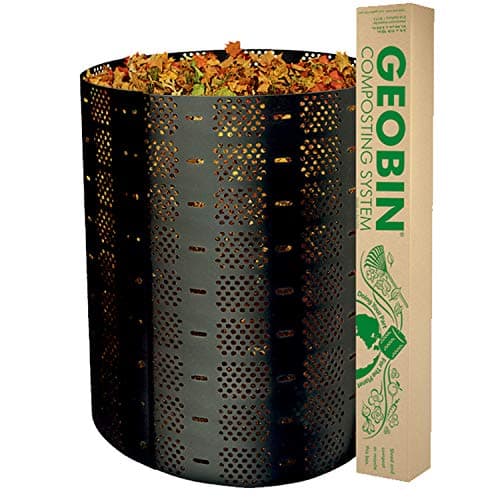 Top pickGEOBIN Expandable Compost BinExpands to roughly 216 gal, 36 in tall | Leaves and yard waste | 8.7 | $35.99 - View on Amazon |
| 2 | 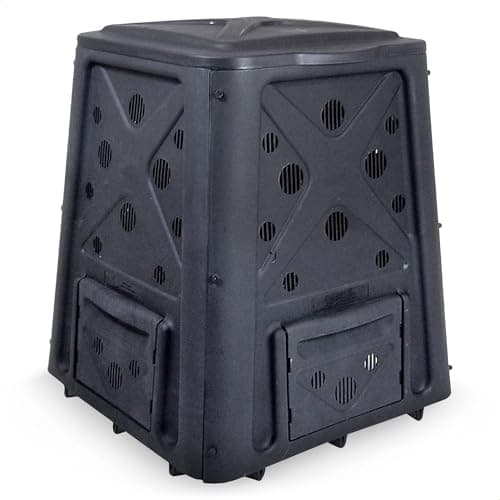 Redmon Green Culture 65-Gallon Compost Bin65 gal enclosed bin with lid and access doors | A lidded static bin | 8.1 | $69.99 - View on Amazon |
| 3 | 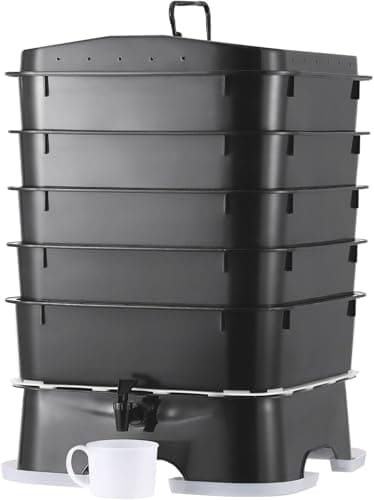 VermiHut Plus 5-Tray Worm Composter5 stacking trays with moisture and odor boards | Indoor composting, no yard | 8.6 | $79.95 - View on Amazon |
| 4 | 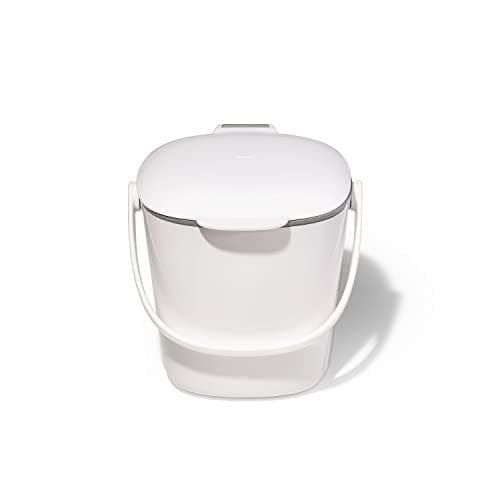 OXO Good Grips Easy-Clean Compost BinSmall lidded pail, smooth-walled for rinsing | The counter caddy | 8.3 | $25.18 - View on Amazon |
#ad We may earn a commission - Price as of October 19, 2026
Scores are our own editorial judgment, formed from published specifications and independent sources. They are not aggregated customer ratings, and they are not the result of hands-on testing, which we do not currently do. See how we choose.
Which one is worth it for you
| Your situation | What is worth buying | Why |
|---|---|---|
| Yard, no pest problem, tight budget | An expandable wire bin, or nothing at all | Contains the heap for very little money; a bare pile is a legitimate alternative |
| Rats, raccoons or close neighbors | An enclosed bin with a lid | The lid and solid walls are the whole point; open wire does not help here |
| Apartment or no outdoor space | A worm bin | Works indoors, odor-free when run correctly, and the castings are excellent |
| You already compost but keep forgetting | A kitchen caddy | The failure point is the walk to the bin, not the bin |
| You want compost faster, in small batches | A tumbler, with expectations managed | Quicker than a static bin, but the drum is small and heavy to spin when full |
If you want the full field rather than these four, the best compost bins ranks the category, compost tumblers covers the rotating units, and kitchen compost bins handles the countertop end.
The payoff that actually justifies it
Here is the case for a bin that survives contact with the arithmetic. Finished home compost is a living material: it carries microbiology that bagged products lose in storage, it holds water in a way a peat-based mix does not, and it feeds a bed slowly instead of in one hit. Extension guidance treats compost as a soil conditioner first and a fertilizer second, and that is the right way to think about it -- you are improving structure, not replacing feeding. Where feeding is the actual job, do you need to fertilize raised beds is the better page.
For a raised bed that loses two or three inches of volume a year to settling and harvest, a bucket of your own compost spread each spring is the right input at the right time. That is the job a bin does well, cheaply, and for as long as you keep feeding it. Measured against that, the purchase is easy to justify. Measured against bagged soil prices on a bed you have not built yet, it is not, and anyone telling you otherwise has not done the volumes.
If this is your first season, start with composting for beginners and how to use a compost bin. The bin is the easy decision. The habit is the one that decides whether it was worth it.
Common questions
Are compost bins worth it for a small garden?
Usually yes, because a small garden's annual compost need is small too. A couple of raised beds want a few cubic feet of top-up a year, which is roughly what one household bin produces. The mismatch only appears when you are filling new beds from scratch, which takes an order of magnitude more material.
Is a compost bin cheaper than buying compost?
Over several years, for maintenance quantities, yes. In the first year, usually no -- the bin costs money up front and produces nothing for months. Treat it as an investment in the garden's soil rather than as a way to save on this spring's shopping.
Are tumbling compost bins worth the extra money?
They are worth it if turning a heap with a fork is the thing that would stop you composting at all. A tumbler is easier to turn and faster as a result, but the drum is small, the batches are correspondingly small, and a full drum is heavy to spin. Our compost tumblers roundup sets out when that trade is worth making.
Do compost bins smell?
A correctly run bin smells of damp woodland and nothing else. Bad smells almost always mean too much wet green material and not enough air: ammonia points to excess nitrogen, sour or rotten smells mean the pile has gone anaerobic. Add dry browns, turn it, and the smell usually goes within a day or two.
Can I compost without buying a bin?
Yes. An open heap in a corner of the yard composts perfectly well, and extension services treat it as a standard method. A bin is worth buying when rodents, neighbors, rules or weather make an open heap impractical, not because it composts better.
How long before a compost bin produces anything usable?
Six to twelve months for a cold pile you add to as you go, two to three months for a hot pile built in one go and turned weekly. The first batch is nearly always the slowest, because that is the batch where you are still learning the green-to-brown ratio.
Sources
Factual claims on this page are backed by the published sources below, and product specifications are the manufacturers’ own. Where a figure is not published, we say so rather than estimating it.