Step 1 - Raised Beds
The Best Plastic Raised Garden Beds
Plastic covers three very different products and one real hazard. Food-grade vinyl, UV-stabilized resin and recycled composite are not the same purchase.
Janet H. - the hands-on owner behind Janet Media Group.
Published
This page contains affiliate links. If you buy through them we may earn a commission at no cost to you, and it never decides what we recommend. How this site is funded.
The best plastic raised garden bed for most people is a food-grade vinyl kit like the Vita Classic 4 x 4 -- it assembles tool-free, it needs no treatment, staining or replacement boards ever, and the material is specified for food contact. If you want the look of timber without the rot, recycled composite boards are the better-built option and cost accordingly. The thing to avoid is a thin, un-stabilized plastic planter with no material specification at all: those go chalky and brittle after two or three summers of UV and crack when you lean on them.
Three different materials, all called plastic
- Food-grade vinyl (PVC). Rigid boards that slot into corner posts. Light, bright white or tan, completely inert, and the format most people picture when they search for a plastic bed.
- UV-stabilized resin (polypropylene / HDPE). Molded planters, often with a self-watering reservoir in the base. Usually smaller and often elevated, and the resin units are where the clever features live.
- Recycled composite. Wood fiber and recycled plastic pressed into boards. Looks and handles like timber, stacks into deeper beds, and lasts indefinitely. The most expensive of the three.
- Not the same as: a thin flexible planter bag or a plant pot. If the listing gives no material and no thickness, assume the cheapest unstabilized plastic available.
Quick picks
| # | Product | Best for | Score | Price |
|---|---|---|---|---|
| 1 | 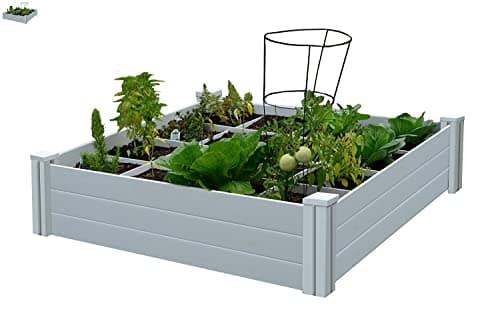 Top pickVita Classic 4 x 4 ft Vinyl Raised Garden Bed11 in deep food-grade vinyl, tool-free posts | A tidy bed with no upkeep | 8.1 | $90.00 - View on Amazon |
| 2 |  Keter Easy Grow Elevated Garden BedResin planter with self-watering reservoir | Low-maintenance patio growing | 8.1 | Check price on Amazon |
| 3 | 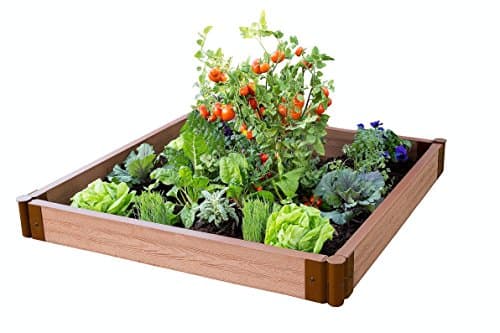 Frame It All Composite Raised BedRecycled composite boards, stackable system | Wood looks without wood rot | 8.3 | $103.47 - View on Amazon |
#ad We may earn a commission - Price as of October 11, 2026
Scores are our own editorial judgment, formed from published specifications and independent sources. They are not aggregated customer ratings, and they are not the result of hands-on testing, which we do not currently do. See how we choose.
What to compare them on
| Food-grade vinyl | UV-stabilized resin | Recycled composite | |
|---|---|---|---|
| Typical depth | 11 to 12 in | 8 to 12 in, often on legs | 6 in per board, stackable |
| Lifespan | 15 to 20 years | 10 to 15 years | 20+ years |
| Upkeep | None | None | None |
| Looks like | Painted timber | Molded furniture | Real timber |
| Deep beds? | Limited | No | Yes -- stack boards |
| Hoops and trellis | Awkward -- no screwing into it | No | Yes, screws fine |
| Cost | Mid | Mid to high | Highest |
The safety question, answered properly
This is the only genuine reason to be careful shopping in this category. Not all plastic is suitable for soil in full sun next to something you will eat, and the distinction is between plastics specified for food contact and plastics specified for nothing.
What to look for: an explicit food-grade or food-safe specification, a named material -- rigid PVC, polypropylene, HDPE -- and a stated UV stabilization. Vinyl beds sold for vegetable growing are normally specified that way, and a reputable maker will say so plainly. What to avoid: unmarked thin plastic, anything built from reclaimed industrial containers whose previous contents you cannot establish, and plastics that have already gone chalky, which is the visible sign that UV degradation is underway.
The same caution people apply to coated steel applies here, and it has the same answer in both cases -- buy the product sold for the job, not the one repurposed into it. Metal raised garden beds addresses the steel version of the question.
Where plastic genuinely wins
- Zero maintenance, forever. No staining, no replacement bottom board in year eight, no rust line in year sixteen. For a bed you want to install and then ignore, this is the whole argument.
- Light to move and to ship. A vinyl kit is carried by one person and reconfigured in an afternoon, which matters on a patio or in a rented garden.
- Cool and bright. Pale boards reflect rather than absorb heat, which is a small advantage in a hot climate and a small disadvantage in a short season.
- Self-watering, in resin. A reservoir in the base is the one feature no steel or timber bed offers, and on a patio in July it changes the maintenance picture.
- Tidy appearance close to the house. Many people buy these for the front yard or a terrace, where a weathering timber frame or a rusting steel one would not be welcome.
Where it loses
Depth and rigidity. A 4-foot vinyl board holds back a lot of wet soil, and the thinner kits bow outward in the middle of a long run unless the maker has included a cross-brace -- which is why 4 x 4 is the sweet spot for vinyl and longer beds are better in steel. You also cannot easily screw into vinyl or resin, so hoops, trellis panels, covers and bird netting all become clamp-and-cable-tie jobs rather than two screws.
And depth is limited. Most plastic kits are 8 to 12 inches, which is fine for the large majority of vegetables but short for potatoes, parsnips, long carrots and anything perennial. If you want 17 or 24 inches, you are back to steel or stacked composite -- see the raised bed size guide for depth by crop.
Plastic against the alternatives
Against coated steel: steel gives you more depth for the money, takes screws, and comes in larger footprints; plastic is lighter, brighter and will never show a rust line. Against cedar: cedar looks better and insulates slightly more, but it is on a 7-to-10-year clock and plastic is not. The fuller version of that second comparison is in metal vs wood, and cedar raised garden beds ranks the timber kits.
One honest note on cost. Plastic kits are not the cheap option -- a food-grade vinyl 4 x 4 typically lands above a budget galvanized bed of the same footprint, and composite well above both. If price is the binding constraint, cheap raised garden beds is the page to read instead, and the fill is the real bill in every case.
Assembly and siting
Vinyl kits are the easiest assembly of any bed format -- boards slide into slotted corner posts, no tools, no fasteners, and the whole thing goes together in under half an hour. Composite boards bolt or pin together and take slightly longer. Resin planters usually arrive as two or three parts that clip.
Site them on level ground, because a slotted-post system relies on the boards sitting square. Lay cardboard in the base to kill the grass beneath, exactly as with any other bed, and skip gravel and plastic liners -- what to put at the bottom of a raised garden bed explains why both make it worse.
The picks in full
Top pick
Vita Classic 4 x 4 ft Vinyl Raised Garden Bed
Vita
Board-and-post vinyl that goes together in about twenty minutes and never needs staining -- the lowest-maintenance of the kits sold on a store shelf.
Vinyl is the family most people overlook, and it earns its place on one argument: there is no maintenance at all. Cedar weathers and eventually rots, steel can scuff at the cut edges, and this does neither. The boards slide down into corner posts with no fasteners, so assembly is genuinely a twenty-minute job for one person.
The trade is depth. Eleven inches is enough for salad, bush beans, chard, herbs, strawberries and determinate tomatoes, and it is not enough for carrots, parsnips or a decent potato crop. Buy it knowing which half of the seed catalog it serves rather than discovering that in July.
Volume is modest too -- a 4 x 4 ft frame takes roughly 13.5 cubic feet of mix, which is one of the cheapest fills on this page and a real part of the appeal if the soil bill is what has been putting you off.
What works
- Tool-free assembly -- boards drop into the posts
- Nothing to stain, seal or re-treat, ever
- A white frame reflects more sun than dark steel in a hot yard
- The Grow Grid version marks out square-foot spacing for you
What does not
- Eleven inches is shallow for anything with a long root
- It reads as white vinyl fencing, which will not suit every garden
- A narrower range of sizes than the steel and cedar lines
Skip it if: you want carrots or potatoes. Eleven inches is the whole depth of the classic frame, and it does not stack the way a cedar or composite kit does.
| Material | Food-grade vinyl, BPA and phthalate free (manufacturer's figures) |
|---|---|
| Size | About 48 x 48 in, 11 in high |
| Assembly | Boards slide into corner posts, no tools |
| Warranty | 20-year limited, per the manufacturer |
| Soil needed | About 13.5 cu ft to fill |
Low-maintenance patio growing
Keter Easy Grow Elevated Garden Bed
Keter
#ad We may earn a commission - prices are shown by Amazon, not by us
Resin rather than wood, with a water reservoir underneath -- the low-effort pick for a patio you do not want to water daily.
The reservoir is the feature. A shallow box on legs is the fastest-drying growing situation in the garden, and a water store underneath turns a daily chore into a weekly one. If the reason your last patio tomato died was a long weekend away, this is the fix.
Resin also removes the maintenance that wood adds. Nothing to seal, nothing to rot, and it comes apart for storage.
Drain the reservoir before the first hard freeze. Trapped water expands, and that is how a plastic planter cracks.
What works
- Reservoir buys you days between waterings
- Resin does not rot, split or need sealing
- Assembles without tools in minutes
- Wipes clean at the end of the season
What does not
- Shallow growing depth, like all elevated planters
- Plastic look is not for every garden
- Reservoir needs draining before a hard freeze
Skip it if: you dislike the look of plastic garden furniture. It performs well; it does not pretend to be timber.
| Material | Weather-resistant resin |
|---|---|
| Working height | About 30 in |
| Watering | Built-in reservoir with drainage control |
| Assembly | Snap-together, no tools |
| Soil needed | Usually under 6 cu ft |
Wood looks without wood rot
Frame It All Composite Raised Bed
Frame It All
Composite boards that look like timber and do not rot, with a stacking system that lets you add depth a tier at a time.
Composite splits the difference between cedar and steel: it reads as timber from a few feet away and it does not rot. If the bed is going somewhere visible and steel looks too industrial for the setting, this is the option that solves that.
The stacking system is genuinely useful. Start with one 6-inch tier for salads and herbs, and add a second when you want to grow something with a deeper root, rather than committing to a full fill on day one.
Price is the real objection. Per square foot of growing area you are near premium steel territory, which makes this a choice about appearance more than value.
What works
- Will not rot, split or need re-staining
- Curved boards allow shapes steel kits cannot make
- Stacks to whatever depth you want
- Made from recycled material
What does not
- Expensive per square foot
- Heavier to move than steel panels
- Fewer color options than it first appears
Skip it if: cost per square foot is your deciding number. Composite is priced closer to premium steel than to cedar.
| Material | Recycled composite boards |
|---|---|
| Depth | Stackable tiers, commonly 6 in each |
| Shapes | Straight and curved boards for custom layouts |
| Assembly | Slot into corner joints |
| Soil needed | About 16 cu ft for 4 x 8 ft at 6 in |
Common questions
Are plastic raised garden beds safe for vegetables?
Yes, if the product is specified for the job. Look for an explicit food-grade or food-safe statement, a named material such as rigid PVC, polypropylene or HDPE, and stated UV stabilization. Avoid unmarked thin plastic and anything repurposed from an industrial container whose previous contents you cannot establish.
How long do plastic raised garden beds last?
15 to 20 years for food-grade vinyl, 10 to 15 for UV-stabilized resin, and 20 years or more for recycled composite. Cheap unstabilized plastic is a different story -- it goes chalky and brittle after two or three summers of sun and then cracks under soil pressure.
Are plastic or metal raised beds better?
Metal gives more depth per dollar, takes screws for hoops and trellis, and comes in bigger footprints. Plastic is lighter, needs no upkeep at all, never shows a rust line, and looks tidy close to the house. For deep beds and long runs, steel; for a maintenance-free bed up to about 12 inches, plastic.
Do plastic raised beds get too hot?
Less than steel, if anything -- pale boards reflect heat rather than absorbing it. In either case the thermal mass of damp soil dominates, so root-zone temperature a few inches in behaves much like any other bed. Mulching the surface matters far more than the frame material.
Will a plastic raised bed bow out under the soil?
A long run of thin vinyl can, which is why 4 x 4 is the practical sweet spot for the format and why better kits include a cross-brace or a mid-span support. Composite boards are rigid enough that it is not an issue. For beds longer than about 6 feet, coated steel is the safer choice.
Sources
Factual claims on this page are backed by the published sources below, and product specifications are the manufacturers’ own. Where a figure is not published, we say so rather than estimating it.