Step 1 - Raised Beds
The Best Grow Bags for Tomatoes
One plant, one bag, and bigger than you think. Most grow-bag tomato disappointment is a 5-gallon bag doing a 15-gallon job.
Janet H. - the hands-on owner behind Janet Media Group.
Published
This page contains affiliate links. If you buy through them we may earn a commission at no cost to you, and it never decides what we recommend. How this site is funded.
For tomatoes, use one 10-gallon fabric bag per plant as the working minimum and 15 to 20 gallons for an indeterminate variety you intend to grow all season -- the Smart Pot 10-gallon is our pick for a determinate or patio tomato, and for a full-size indeterminate plant you want the next size up or a 100-gallon round fabric bed holding three plants. Almost every complaint about grow-bag tomatoes -- blossom end rot, afternoon wilting, a plant that stalls in July -- traces back to not enough soil volume rather than to the bag itself.
Size, by the kind of tomato you are growing
| Plant type | Bag size | Plants per bag | Watering in high summer |
|---|---|---|---|
| Dwarf or patio tomato | 5 gal | 1 | Daily, sometimes twice |
| Determinate (bush, paste types) | 10 gal | 1 | Daily |
| Indeterminate (cordon, cherry, beefsteak) | 15 to 20 gal | 1 | Daily, deeply |
| Indeterminate, less watering | 100 gal round fabric bed | 3 | Every day or two |
| Anything | 5 gal with two plants | Do not | Nothing will save it |
The determinate-versus-indeterminate distinction is the one that matters and it is on the seed packet. A determinate tomato grows to a fixed size, sets its fruit over a few weeks and stops -- it suits a 10-gallon bag well. An indeterminate keeps growing and fruiting until frost, which means it keeps building leaf area, which means it keeps needing more water from the same root volume. That is the plant that punishes an undersized bag.
Quick picks
| # | Product | Best for | Score | Price |
|---|---|---|---|---|
| 1 | 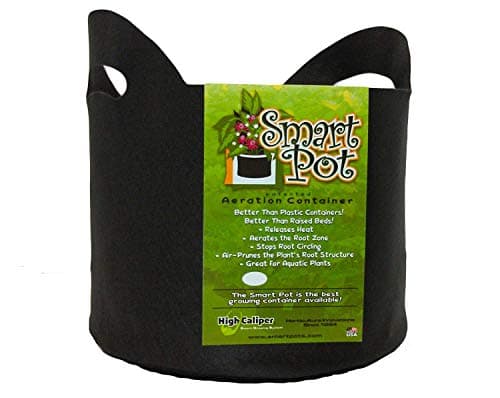 Top pickSmart Pot 10-Gallon Soft-Sided Container16 in across, 11.5 in tall, 1.33 cu ft | Bags you keep for years | 8.6 | $13.59 - View on Amazon |
| 2 | 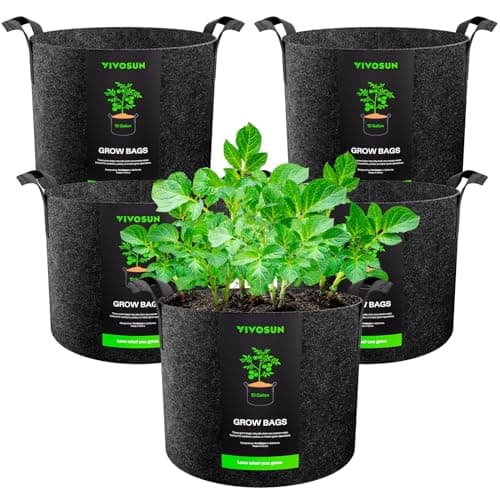 VIVOSUN 5-Pack 10 Gallon Grow BagsFive 10 gal bags with stitched handles | A first set of bags | 8.4 | Check price on Amazon |
| 3 | 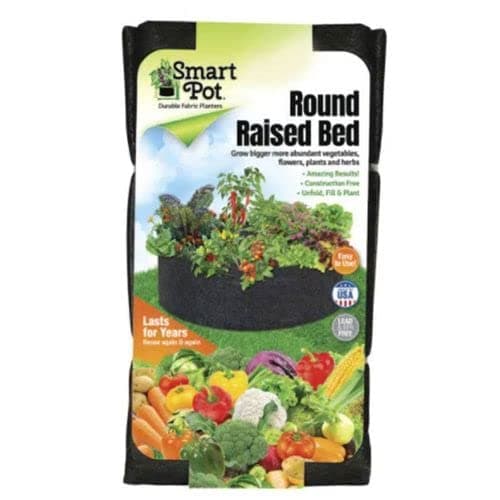 Smart Pot Round Raised Bed, 100 Gallon50 in across, 12 in deep, about 13.5 sq ft | A whole bed's worth | 8.8 | $69.95 - View on Amazon |
| 4 |  Potato Grow Bags with Harvest Flap10 gal with a side access window | Potatoes and sweet potatoes | 7.9 | Check price on Amazon |
#ad We may earn a commission - Price as of October 11, 2026
Scores are our own editorial judgment, formed from published specifications and independent sources. They are not aggregated customer ratings, and they are not the result of hands-on testing, which we do not currently do. See how we choose.
What actually distinguishes a good bag
- Fabric weight. A heavier non-woven fabric holds its shape when full and survives being moved. Thin bags slump, and a slumped bag waters unevenly.
- Stitched handles, not glued. Handles are the first failure point on a cheap bag, and a 15-gallon bag of wet mix is heavy.
- Height-to-width ratio. A squat wide bag holds more usable root volume and blows over less than a tall narrow one of the same stated capacity.
- Breathability is the point. Fabric air-prunes roots and lets excess water out of the sides, which is why bags tolerate overwatering far better than plastic pots. It is also why they dry out faster.
- Reusability. Good bags fold flat and come back for five seasons or more. Cheap packs are often a one- or two-season product -- fine if you know that going in.
For the wider picture on fabric as a format, the best grow bags for vegetables covers size by crop across the whole garden and goes further into how long fabric lasts.
Watering is the real price
A fabric bag loses water through every surface, not just the top. In July an unmulched 10-gallon bag with a full-grown tomato in it can want watering every single day, and a 5-gallon bag can want it twice. Tomatoes respond to inconsistent moisture with blossom end rot and split fruit, so this is not a corner you can cut.
Three things make it manageable. Mulch the surface of the bag -- an inch or two of straw, compost or wood chips cuts evaporation noticeably. Stand the bags where they get morning sun and some afternoon shade if your summers are harsh, rather than on a south-facing slab that bakes. And group them: bags standing shoulder to shoulder shade each other's sides and dry more slowly than bags spread out. A simple drip line on a timer turns the whole problem into a non-issue and is the single best upgrade for anyone growing more than three bags.
Feeding, because bags leach
Every watering that runs out of the sides takes nutrients with it, and in a bag you are watering a lot. Start with a good mix rather than cheap garden soil -- a light, well-structured potting or container mix, not heavy bed mix which compacts in a bag -- and plan to feed through the season. A balanced liquid feed every week to fortnight once the first fruit sets, at the label rate, is the simple version. Do not compensate for an undersized bag by feeding harder; it produces leaf and not fruit.
On choosing the mix itself, best raised bed soil explains why a bed mix and a container mix are different products, and the lighter container-oriented options in that roundup are the right family for bags.
Staking a plant that is standing in fabric
This is the practical problem nobody mentions. A bag has no structure, so a cane pushed into it is held only by the mix, and an indeterminate tomato in full leaf is a sail. Three approaches work: push a sturdy stake right through to the ground beneath if the bag is on soil; stand the bags against a fence or wall and tie the plants to a horizontal wire or trellis panel; or use a freestanding frame or cage that straddles the bag and takes the load itself.
What does not work is a short cane in a 5-gallon bag. The whole thing goes over in the first summer storm with fruit on it. If you want the support solved structurally instead, a bed with built-in trellising is a cleaner answer -- raised beds with trellis covers that format.
End of season
Empty the bags rather than leaving them standing full over winter. Spent mix from a tomato bag is not waste -- it goes on a bed as a soil improver or into the compost bin, where the leftover nutrients and structure are useful. Rinse the bags, let them dry, and fold them flat. Do not reuse the mix for next year's tomatoes: that is how you carry soil-borne tomato disease forward, which was one of the main reasons to be in bags in the first place.
And if the daily watering turns out to be the thing you cannot live with, that is the honest signal to buy a frame. Raised beds vs grow bags makes the comparison directly, and the best raised beds for tomatoes covers depth and support in a permanent bed.
The picks in full
Top pick
Smart Pot 10-Gallon Soft-Sided Container
Smart Pot
The original bonded-fabric pot, and the one still in use when the cheap multipacks have gone brittle and split at the seams.
Fabric pots are a commodity with one real quality variable: how long the fabric lasts outdoors in sun. A bag that splits at the seam in August, full of wet mix and a fruiting plant, is a bad afternoon.
At 16 inches across and 11.5 inches tall this holds about 1.33 cubic feet, which is one indeterminate tomato with a cage, or two peppers, or a generous clump of basil and chard. It is not a mixed planter.
The honest way to buy fabric pots is to split the difference: a couple of pots like this for the plants you grow every year, and a cheap multipack for the extras you are experimenting with.
What works
- Heavier fabric than the multipack bags, and it holds its shape when full
- UV stabilized, which is what decides whether a bag survives a second summer outdoors
- Aeration through the sidewall air-prunes roots instead of letting them circle
- Folds flat for storage like any fabric pot
What does not
- Costs several times what a bag from a five-pack costs
- Sixteen inches across is one plant, not a mixed planting
- Still needs daily watering in summer -- fabric does not change that
Skip it if: you want five bags today for the price of one. This is a single pot at a single-pot price, and the case for it is the fifth season rather than the first.
| Type | Bonded fabric aeration container |
|---|---|
| Capacity | 10 gal, about 1.33 cu ft |
| Size | 16 in across, 11.5 in tall |
| Fabric | UV-stabilized nonwoven, no plastic liner |
| Handles | Available with or without |
A first set of bags
VIVOSUN 5-Pack 10 Gallon Grow Bags
VIVOSUN
#ad We may earn a commission - prices are shown by Amazon, not by us
Five bags for about what one rigid planter costs, and 10 gallons is the size that actually grows a tomato rather than keeping one alive.
Ten gallons is the useful number here. University of Maryland Extension puts the minimum container size for a standard tomato, a pepper, an eggplant or a cucumber at 5 gallons, so a 10 gallon bag is comfortably above the floor rather than at it -- which in practice means fewer collapses on a hot afternoon.
The fabric is mid-weight: thicker than the throwaway bags sold ten to a pack, thinner than the bonded-fabric pots that last a decade. For a first season, while you are deciding whether you like growing this way, that is the right place on the scale.
Fill them with potting mix, not garden soil or raised bed mix. Soil in a container compacts and drains badly, which is the single most common reason a bag of tomatoes underperforms the same plant in the ground.
What works
- Ten gallons is the right size for one tomato, pepper or eggplant
- Handles are stitched rather than glued, so a full bag can be moved
- Five bags let you chase the sun around a patio
- Folds away flat at the end of the season
What does not
- Thinner fabric than the premium bags, so expect a shorter life
- Needs watering far more often than a bed of the same volume
- Dark fabric gets genuinely hot in full afternoon sun
Skip it if: you are growing root crops. Ten gallons is 11 or 12 inches of depth once settled, which is short for carrots and parsnips.
| Type | Nonwoven fabric pot with handles |
|---|---|
| Capacity | 10 gal each |
| Size | Roughly 16 in across and 12 in tall at 10 gal |
| Fabric | Mid-weight nonwoven polypropylene |
| Handles | Reinforced, stitched to the body |
| Pack | 5 bags |
A whole bed's worth
Smart Pot Round Raised Bed, 100 Gallon
Smart Pot
A fabric raised bed rather than a pot: wide enough to plant like a bed, cheap enough to buy two, and it folds flat in October.
This is the grow bag that behaves like a bed -- Smart Pot has also sold it as the Big Bag Bed. At roughly 50 inches across it gives you about 13.5 square feet of planting area -- the same growing area as a 4 x 4 ft frame -- in something that arrives folded in a flat parcel and needs no assembly at all.
Twelve inches of depth is the number that matters. That is enough for lettuce, beans, chard, bush cucumbers, peppers and determinate tomatoes, and it is shallow for carrots, parsnips and a serious potato crop. It is the same depth limit a shallow metal or vinyl bed has.
The cost is the fill. A bed-sized bag needs a bed-sized volume of potting mix, so the bag being inexpensive does not make the project inexpensive. Work out the mix cost first, using the soil calculator on this site, because that number rather than the bag decides whether this is the cheap option for you.
What works
- Gives you bed-scale planting area without a frame to assemble
- Twelve inches of depth is enough for most vegetables, including determinate tomatoes
- Folds flat for winter storage, which no rigid bed does
- Enclosed bottom means you can put it on a patio, gravel or a driveway
What does not
- Needs a full 13.5 sq ft of potting mix, which is the real cost of the format
- Dries out faster than a soil-filled frame of the same depth
- Fabric is a consumable -- plan on replacing it after a few seasons
Skip it if: you want the garden to look built. This is a black fabric circle sitting on the ground, and planting around it does not disguise that.
| Type | Round fabric raised bed |
|---|---|
| Capacity | 100 gal |
| Footprint | About 50 in across |
| Depth | 12 in |
| Growing area | About 13.5 sq ft |
| Base | Enclosed fabric bottom |
| Service life | Manufacturer states 3 to 5 years outdoors |
Potatoes and sweet potatoes
Potato Grow Bags with Harvest Flap
Various
#ad We may earn a commission - prices are shown by Amazon, not by us
The one grow bag with a feature you cannot get any other way: a flap at the base, so you can take new potatoes out without ending the plant.
Potatoes are the crop that justifies a grow bag on its own terms rather than as a substitute for a bed. They want depth, they want to be earthed up as they grow, and they are the one crop where harvesting means destroying the root zone anyway.
The flap is the real feature. Open it in midsummer, feel for the potatoes nearest the surface, take a meal's worth and close it again. The plant keeps growing and keeps setting tubers.
Buy on fabric weight rather than on the number of bags in the pack. The flap seam carries the load of wet mix, and that is where a thin bag gives out.
What works
- The harvest flap lets you pull early potatoes and leave the plant growing
- Deep enough to earth up a potato crop as it grows, which a shallow bed is not
- No digging, so no fork through a tuber
- Empties in one tip at the end of the season
What does not
- The flap is a weak point and the first place a bag fails
- Fabric quality varies a lot across brands in this category
- Needs steady watering -- potatoes in a dry bag crack and go knobbly
Skip it if: you are not growing potatoes. For everything else the flap is a seam waiting to leak, and a plain bag is the better buy.
| Type | Nonwoven fabric bag with hook-and-loop side flap |
|---|---|
| Capacity | Commonly 7 to 10 gal per bag |
| Access | Flap at the base for harvesting |
| Handles | Side handles for moving a full bag |
| Pack | Usually sold in multipacks |
Common questions
What size grow bag is best for tomatoes?
10 gallons per plant for a determinate or patio variety, and 15 to 20 gallons for a full-size indeterminate. A 5-gallon bag will grow a dwarf tomato but will need watering once or twice a day in summer, and most grow-bag tomato problems come from undersized bags rather than bad bags.
How many tomato plants per grow bag?
One. Two plants in a single bag halves the root volume each gets and doubles the water demand, which produces two poor plants instead of one good one. The exception is a large round fabric bed of around 100 gallons, which comfortably holds three.
How often do you water tomatoes in grow bags?
Daily in hot weather for a 10-gallon bag with a mature plant, and potentially twice daily for anything smaller. Fabric loses water through its sides as well as the surface. Mulching the top of the bag and grouping bags together both slow it down measurably.
Do tomatoes grow better in grow bags or raised beds?
A raised bed gives better results for less work, because the larger soil volume buffers both water and nutrients. Bags win where a bed is impossible -- a patio, a rental, a balcony -- and where you need to break a soil-borne disease cycle with fresh mix each season.
Can you reuse grow bag soil for tomatoes next year?
Reuse the bag, not the mix, for tomatoes specifically. Carrying old mix forward risks carrying soil-borne tomato diseases with it. The spent mix is still useful: spread it on a bed as a soil improver or add it to the compost bin.
Sources
Factual claims on this page are backed by the published sources below, and product specifications are the manufacturers’ own. Where a figure is not published, we say so rather than estimating it.