Step 1 - Raised Beds
The Best Raised Bed for Asparagus
This is a twenty-year planting. Buy the bed you would still be happy to look at in 2046, and buy it deep.
Janet H. - the hands-on owner behind Janet Media Group.
Published
This page contains affiliate links. If you buy through them we may earn a commission at no cost to you, and it never decides what we recommend. How this site is funded.
For asparagus, buy a 24-inch-deep steel bed in the largest footprint you have room for -- the Anleolife 8 x 4 ft at its deepest configuration is our pick, because asparagus crowns are planted in a trench 6 to 8 inches below the surface and then back-filled as the spears grow, and a shallow bed simply cannot stage that. The other thing that decides this purchase is lifespan: a well-established asparagus bed produces for fifteen to twenty years, so a frame that will need replacing in six is a frame you will be dismantling around live crowns.
What asparagus actually demands of a bed
- Depth for the trench. Crowns go 6 to 8 inches down and the soil is drawn back over them through the first season. You need that depth plus a full root zone underneath it.
- Free drainage. Crowns sitting in wet soil rot. This is the single most common way an asparagus bed is lost, and a raised bed is a genuine advantage here over heavy ground.
- Permanence. You cannot rotate it, you cannot easily move it, and digging anywhere in the bed risks spearing a crown. The frame has to outlive the decision.
- Length over width. Rows 18 inches apart with crowns 12 to 18 inches apart in the row means a long narrow bed is more efficient than a square one.
- No competition. Asparagus is a poor competitor against perennial weeds, and weeding a mature bed is awkward. Start clean and mulch heavily.
Quick picks
| # | Product | Best for | Score | Price |
|---|---|---|---|---|
| 1 | 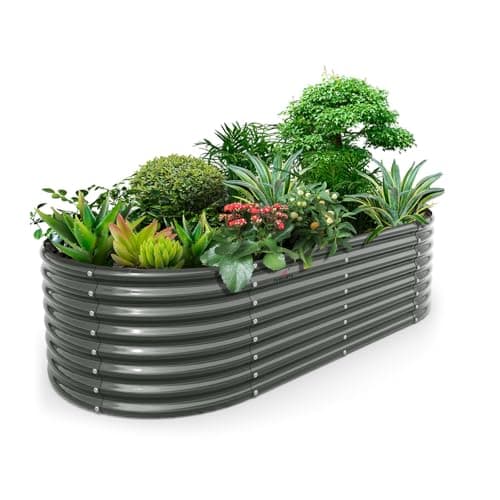 Top pickAnleolife 8 x 4 ft Metal Raised Garden BedUp to 24 in deep, 22-gauge corrugated steel | Deep beds for root crops | 8.8 | $148.85 - View on Amazon |
| 2 |  Birdies Tall Metal Raised Garden BedAbout 30 in tall, Aluzinc steel | Standing-height gardening | 8.7 | Check price on Amazon |
| 3 | 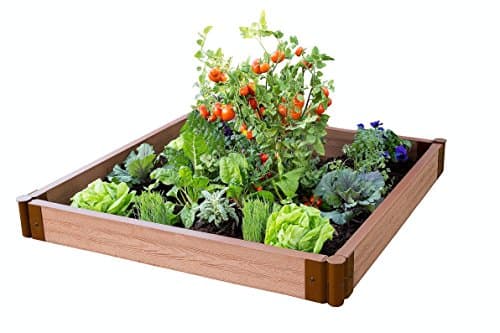 Frame It All Composite Raised BedRecycled composite boards, stackable system | Wood looks without wood rot | 8.3 | $103.47 - View on Amazon |
| 4 | 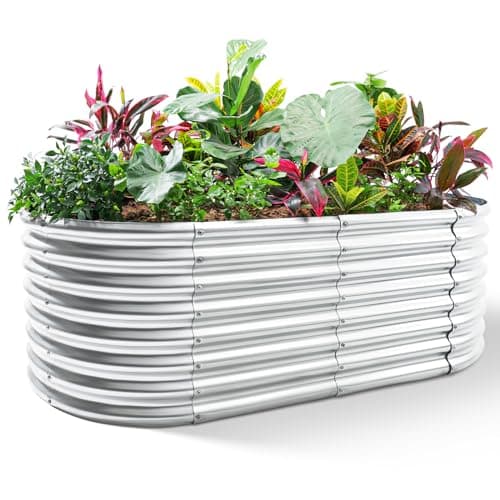 Land Guard Galvanized Raised Garden BedGalvanized steel, large footprints, budget price | Most growing area per dollar | 8.2 | $79.99 - View on Amazon |
#ad We may earn a commission - Price as of October 11, 2026
Scores are our own editorial judgment, formed from published specifications and independent sources. They are not aggregated customer ratings, and they are not the result of hands-on testing, which we do not currently do. See how we choose.
Size, depth and how many crowns
| Bed | Depth | Crowns | What that feeds |
|---|---|---|---|
| 4 x 2 ft | At least 18 in | 3 to 4 | A token picking -- more a taster than a crop |
| 4 x 4 ft | 18 to 24 in | 6 to 8 | Occasional meals for two in season |
| 8 x 4 ft | 24 in | 12 to 16 | Our default: regular picking for a household |
| 8 x 4 ft, standing height | 30 in | 12 to 16 | Same crop, no bending to cut |
| Two 8 x 4 beds | 24 in | 24 to 32 | A genuine surplus to freeze |
Most people under-buy. Asparagus yields roughly a modest handful of spears per crown per week during a six-to-eight-week spring window, and you cannot extend that window by picking harder -- cutting past the point where the plant needs to build next year's reserves is how beds get exhausted. If asparagus matters to you, the honest minimum is around a dozen crowns.
Material, because this one is a twenty-year bet
Coated steel is the default recommendation for a perennial bed and the reason is unglamorous: it does not rot. Untreated cedar is lovely and will give you ten years or so before the lower boards start going, which on an annual vegetable bed is fine and on an asparagus bed means replacing a frame around established crowns. Composite boards are the third honest option -- they cost more up front, they look like timber, and they do not decay, which makes them a genuine fit for a planting this permanent.
Standing-height beds deserve a mention here specifically. Asparagus is harvested by cutting at or just below the surface, every day or two, for weeks. At 30 inches tall that is a pleasant job and at 10 inches it is a crouch. If back strain is a factor, elevated raised beds covers the format properly -- the caution being that a tall bed is a lot of soil to buy.
Planting, the part the bed has to accommodate
- 1
Fill the bed, then dig the trench
Fill with a free-draining raised bed mix to the top, then open a trench 6 to 8 inches deep and about 12 inches wide down the length of the bed. Two trenches 18 inches apart in a 4-foot-wide bed.
- 2
Work compost into the trench bottom
A few inches of finished compost in the base, forked in. This is the last chance to improve soil at root depth for twenty years.
- 3
Set the crowns
Space them 12 to 18 inches apart, roots spread out like a splayed hand over a small mound of soil, bud side up. Cover with 2 inches of mix.
- 4
Back-fill as the spears come
Through the first season, draw more soil over the trench each time the spears push up, a couple of inches at a time, until the bed is level again by late summer.
- 5
Do not harvest for two years
Let everything fern out and die back naturally. Cut the dead ferns down in late winter. Take a light picking in year three and a full one from year four.
Mulch and feed, forever
Once the crowns are in, you will never dig this bed again, so everything happens from the top. Mulch 2 to 3 inches deep every year -- compost, aged wood chips or straw -- to suppress weeds and feed the bed. Top up with compost in early spring and again after the harvest window closes, when the plant is rebuilding reserves for next year. That autumn and spring compost habit is exactly what a home compost bin produces for nothing; the best compost bins is the cheapest long-run answer to a permanent bed's annual appetite.
Weeds are the real enemy. Hand-pull anything that appears, never hoe deeply, and do not let a perennial grass get established -- untangling couch grass from asparagus roots is a job that ends the bed. A thick mulch, maintained, is worth more than any weeding routine.
What we would not buy for this
Not a shallow 8-to-11-inch bed. It cannot stage the trench, and crowns planted nearer the surface are more exposed to frost heave and summer drying. Not a fabric bed or grow bags either, however well they work for annuals -- a twenty-year planting in fabric means the fabric fails under the crop, and raised beds vs grow bags sets out where bags genuinely win, which is emphatically not perennials.
The picks in full
Top pick
Anleolife 8 x 4 ft Metal Raised Garden Bed
Anleolife
Thicker gauge steel and a deeper box than most kits, which is what stops a long bed bowing outward once it is full of wet soil.
Gauge is the specification nobody reads and everybody should. Steel gauge runs backwards -- a lower number is thicker metal -- and Anleolife's 22-gauge panels are noticeably more rigid than the thin budget beds that bulge in the middle after the first heavy watering.
That rigidity matters most on an 8-foot run, where soil pressure has the most leverage. The center brace on the long sizes is not decoration; leave it out and the sides will slowly bow.
Be realistic about the depth. A 24-inch bed at 8 x 4 ft holds around 64 cubic feet of fill. You do not have to buy 64 cubic feet of bagged mix -- the bottom third can be coarse organic material, which is what the hugelkultur and cheap-fill guides are for -- but you do have to plan it.
What works
- Heavier 22-gauge steel resists bowing on long runs
- 24 in depth suits potatoes, parsnips and long carrots
- Large growing area in one kit
- Center brace included on the long sizes
What does not
- Deep beds need a lot of fill, and fill is the real cost
- Galvanized rather than Aluzinc coating
- Long panels are awkward to handle solo
Skip it if: your budget is tight. The extra depth is real, but it also means roughly twice the soil of a 12-inch bed, and soil is the bigger bill.
| Material | 22-gauge corrugated galvanized steel |
|---|---|
| Depth | Sold in several heights, including 24 in |
| Footprint | 8 x 4 ft and other sizes |
| Assembly | Bolt-together panels with center support |
| Soil needed | About 64 cu ft for 8 x 4 ft at 24 in of fill |
Standing-height gardening
Birdies Tall Metal Raised Garden Bed
Birdies
#ad We may earn a commission - prices are shown by Amazon, not by us
The original Australian-designed tall bed: expensive, well finished, and the one to buy if the point is gardening without kneeling.
Birdies is the bed the rest of the category copied. If a 30-inch working height is the specific problem you are solving -- a bad back, a wheelchair, or simply not wanting to kneel on wet ground -- this is a sensible place to spend money.
The catch is volume. Doubling the height doubles the fill, and fill is where a raised bed budget actually goes. Plan the bottom half as coarse material: logs, branches, leaves, spent potting soil. Only the top 10 to 12 inches has to be a proper growing mix, because that is where almost all vegetable roots live.
One practical note: tall beds dry from the top faster than they drain from the bottom. Mulch the surface, and water deeply rather than often.
What works
- Standing height removes most of the kneeling and bending
- Long-standing design with a good reputation for finish
- Rounded-corner shapes suit tight patios
- Aluzinc steel throughout
What does not
- Premium price before you have bought any soil
- Fill volume is the highest of any bed here
- Availability varies more than the mass-market brands
Skip it if: you are filling it with bagged mix alone. A 30-inch bed swallows an enormous amount of soil, and the bottom half should be cheap bulk material.
| Material | Aluzinc-coated steel |
|---|---|
| Height | About 30 in on the tall models |
| Shapes | Rectangular and rounded corner versions |
| Assembly | Bolt-together panels |
| Soil needed | Roughly 2x a 15 in bed of the same footprint |
Wood looks without wood rot
Frame It All Composite Raised Bed
Frame It All
Composite boards that look like timber and do not rot, with a stacking system that lets you add depth a tier at a time.
Composite splits the difference between cedar and steel: it reads as timber from a few feet away and it does not rot. If the bed is going somewhere visible and steel looks too industrial for the setting, this is the option that solves that.
The stacking system is genuinely useful. Start with one 6-inch tier for salads and herbs, and add a second when you want to grow something with a deeper root, rather than committing to a full fill on day one.
Price is the real objection. Per square foot of growing area you are near premium steel territory, which makes this a choice about appearance more than value.
What works
- Will not rot, split or need re-staining
- Curved boards allow shapes steel kits cannot make
- Stacks to whatever depth you want
- Made from recycled material
What does not
- Expensive per square foot
- Heavier to move than steel panels
- Fewer color options than it first appears
Skip it if: cost per square foot is your deciding number. Composite is priced closer to premium steel than to cedar.
| Material | Recycled composite boards |
|---|---|
| Depth | Stackable tiers, commonly 6 in each |
| Shapes | Straight and curved boards for custom layouts |
| Assembly | Slot into corner joints |
| Soil needed | About 16 cu ft for 4 x 8 ft at 6 in |
Most growing area per dollar
Land Guard Galvanized Raised Garden Bed
Land Guard
The cheapest honest way to get a large steel bed, as long as you accept plain galvanizing instead of an Aluzinc coating.
If the goal is to grow the most food this year for the least money, area beats coating. A large cheap bed you can actually fill will feed you better than a small premium one, and Land Guard exists for exactly that calculation.
Understand what you are giving up. Plain galvanizing is a zinc coating; Aluzinc adds aluminum and magnesium and holds up considerably better at the soil line, which is where beds fail. Expect good years rather than decades.
The panels are thinner too, so use the supplied braces and do not skip the center support on the long sizes.
What works
- Lowest cost per square foot of growing area
- Large sizes available in one kit
- Simple assembly with basic tools
- Good way to trial a big bed before committing
What does not
- Plain galvanizing, not the longer-lived Aluzinc
- Thinner panels flex more when filled
- Edges deserve a careful check during assembly
Skip it if: you want the bed to outlive the mortgage. Plain galvanized steel is fine for years, not decades, especially where soil stays wet.
| Material | Galvanized steel |
|---|---|
| Depth | Commonly 12 in and 17 in |
| Footprint | Large rectangles including 8 x 4 ft |
| Assembly | Bolt-together panels |
| Soil needed | About 32 cu ft for 8 x 4 ft at 12 in |
Common questions
How deep does a raised bed need to be for asparagus?
At least 18 inches, and 24 inches is the comfortable answer. Crowns are planted in a trench 6 to 8 inches below the finished surface and then back-filled as the first season's spears emerge, so you need that staging depth plus a full root zone beneath it.
How many asparagus crowns fit in a 4 x 8 raised bed?
Twelve to sixteen, in two rows 18 inches apart with crowns 12 to 18 inches apart along the row. That is about the smallest planting that produces a regular picking for a household rather than an occasional taster.
Can you grow asparagus in a metal raised bed?
Yes, and coated steel is our default for this crop precisely because it does not rot. A perennial bed has to outlive a twenty-year planting, and replacing a decayed timber frame around established crowns is a job nobody wants.
When can you first harvest asparagus from a new bed?
Take nothing in the first two seasons and let the plants fern out to build reserves. A light picking in year three and a full six-to-eight-week harvest from year four onward. Cutting earlier or harder than that is the usual reason a bed declines.
Does asparagus need a deeper bed than other vegetables?
Yes. Most vegetables are satisfied by 10 to 12 inches of good soil. Asparagus needs the trench depth on top of the root zone, and because the bed is never dug again, the depth you buy is the depth it has forever.
Sources
Factual claims on this page are backed by the published sources below, and product specifications are the manufacturers’ own. Where a figure is not published, we say so rather than estimating it.